Category: Accountability

  • 52 Tips in 52 Weeks: “This is the way it’s always been done!” – is this mentality stopping you from achieving excellence?

    52 Tips in 52 Weeks: “This is the way it’s always been done!” – is this mentality stopping you from achieving excellence?

    As frequent readers of this blog know, the Standards for Excellence: and Ethics Code for the Nonprofit Sector document is a consensus model for how the most well-managed and responsibly-governed nonprofits operate. This means that when nonprofit leaders review the tenets and benchmarks of the code, they generally agree with the benchmarks and principles.  But, on the other hand, there are many fewer organizations who can say that they live by every one of the sixty-seven Standards. Standards for Excellence accredited organizations can say this! Achieving accreditation takes intentional planning and implementation, potentially mixed in with negotiation and debate among board and staff members over specific standards.  So, if nonprofit leaders agree with benchmarks like having a conflict of interest policy, an annual evaluation of the executive director, and having an advocacy policy, what is the disconnect between agreement and implementation? For some, of course, it’s the rush of so many different responsibilities and not enough time. For others, it’s a bit of adherence to the “because this is the way we’ve always done it” mentality. Think about your own organization—how many times do you fall back on solving problems by past experiences and past actions?

    Last week, the Standards for Excellence Institute held the 2020 Standards for Excellence Licensed Consultant program.  During the program, class members were treated to presentations and discussions conducted by leading experts, including a board governance expert, Marla Bobowick of Bobowick Consulting, and a Standards for Excellence Licensed Consultant. She suggested that boards should check themselves every time someone states “that’s the way this has always been done” or “that’s the way we’ve always done this.”  She offered that board members and nonprofit leaders should consistently challenge themselves when this phrase is uttered and Marla made a suggestion that it would be great to issue brightly colored paddles for folks to hold up whenever this phrase passes someone’s lips (and that the back of the paddle should say simply “Why?”). Perhaps with a visual reminder to challenge ourselves every time someone states that we should continue with how things have always been done, we’ll put ourselves in a better position to take that step to implement that benchmark in the Standards for Excellence code that we haven’t yet tackled!  What will it be for your organization? Which benchmark are you particularly interested in moving from the “should do list” to the “completed list”?  Maybe you’d like to focus on stronger program evaluation strategies, a new communications policy, or a new approach to working with others who are raising money on your behalf? Marla, thank you for helping us remember this practice that sometimes thwarts our efforts to get the job done. Your paddle is in the mail, Marla!  Here’s a prototype!

    The Standards for Excellence Institute offers a comprehensive collection of Standards for Excellence educational resource packets that include sample policies, tools and model procedures to help nonprofits achieve best practices in their governance and management – can be accessed by contacting a licensed Standards for Excellence replication partner,– one of the over 170 Standards for Excellence  Licensed Consultants, or by becoming a member of the Standards for Excellence Institute.

  • 52 Tips in 52 Weeks: Navigating Whistleblower Policies

    52 Tips in 52 Weeks: Navigating Whistleblower Policies

    I read with interest a recent article from the Philadelphia Inquirer entitled “Philadelphia Mulls Protections for COVID-19 Workplace Whistleblowers.” (June 11, 2020 by Karen Kahn). The story discusses a bill that the Philadelphia City Council is considering which would protect employees who speak up about unsafe conditions in their workplaces related to COVID-19 risks and transmissions.

    The story cites the findings from the National Employment Law Project (NELP)’s recent study, Silenced About COVID-19 in the Workplace by Irene Tung and Laura Padin.  NELP’s report is a national study and illustrates “that retaliation against whistleblowers in the workplace is prevalent during the pandemic” and that “Black workers are more likely to work under conditions that are both hazardous and repressive.”  The report goes on to say that “Black workers are more than twice as likely as white workers to have seen possible retaliation by their employer.”[1] The researchers used Google Consumer Surveys and polled 1,137 individuals in May 2020. These issues are so important for us to focus on and commit to redress.

    As the Standards for Excellence: An Ethics and Accountability Code for the Nonprofit Sector states, “Organizations must provide employees, board members, and volunteers a confidential means to report suspected impropriety or misuse of organizational resources. Organizations should have in place a policy prohibiting retaliation against persons reporting improprieties.”

    Nonprofit organizations should do all they can to foster a culture of openness and accountability. Nonprofit leaders should attempt to uncover and eliminate misconduct at the earliest possible stage whether the misconduct is related to finances, COVID-19 or something else entirely. Research supports that employees are more likely to make the decision to report internally when internal reporting channels are perceived as adequate.[2] Organizations should have a process and mechanism to encourage individuals associated with a nonprofit to report suspected impropriety.

    With the advent of the American Competitiveness and Corporate Accountability Act of 2002 (Sarbanes-Oxley Act), more and more nonprofit organizations have been implementing whistleblower protection policies. While the Sarbanes-Oxley Act addresses governance standards and financial oversight in publicly traded companies, it does not specifically regulate nonprofit organizations – with two notable exceptions:  whistleblower protection and document destruction. For nonprofit organizations, Sarbanes-Oxley requires all corporations, whether or not they are publicly traded, to adopt and abide by document destruction policies and whistleblower protections. In order for nonprofits to meet the requirements of the Sarbanes-Oxley Act, these two policies are needed.

    As nonprofit leaders, we must make sure that we are not only complying with the law to the fullest extent but we are taking great care to ensure that our policies and processes are working well for our staff, board members, and those we serve.  Instituting a whistleblower policy is one important way that nonprofits can do this in their day-to-day work.

    For more information on whistleblowing in nonprofits, we encourage you to check out the Standards for Excellence educational resource packet “Reporting Misconduct and Whistleblower Protection”  which includes benefits of reporting improprieties, examples of misconduct and improprieties, confidential means to report improprieties, protections for those that blow the whistle, implementing a whistleblower policy, as well as sample whistleblower policy and reporting form.

    This educational resource packet and the full series of all packets  – including sample policies, tools and model procedures to help nonprofits achieve best practices in their governance and management – can be accessed by contacting a licensed Standards for Excellence replication partner, one of the over 150 Standards for Excellence Licensed Consultants, or by becoming a member of the Standards for Excellence Institute.

    We share our sincere wishes for your continued good health and patience as we all navigate these challenging and uncertain times.


    [1] Tung, Irene and Padin, Laura, Silenced About Covid-19 in the Workplace, National Employment Law Project, June 10, 2020, https://www.nelp.org/publication/silenced-covid-19-workplace/.

    [2]Watts, L., & Ronald Buckley, M. (2017). A Dual-Processing Model of Moral Whistleblowing in Organizations. Journal of Business Ethics146(3), 669–683.

  • Developing a Code of Ethics

    Developing a Code of Ethics

    52 Tips Graphic

    This is part of a special series, brought to you by the Standards for Excellence Institute, to provide nonprofit leaders with a brief nonprofit governance and management tip weekly over the course of 2020. We hope these short tips will be helpful to you and the nonprofits you serve. If you have suggestions for future topics, please forward these to acmadsen@standardsforexcellence.org.


    Back in the mid-1990s, I had the privilege of working with the volunteer taskforce that ultimately developed and released the Standards for Excellence: An Ethics and Accountability Code for the Nonprofit Sector in 1998.  The group had all the hallmarks of an exemplary  volunteer team—incredibly dedicated, extremely knowledgeable, and willing to roll up their sleeves to get the job done!  I learned so much from this group and I’m grateful for their service. Quite a few of these volunteers still support the Standards for Excellence program in various roles. 

    One of the projects this taskforce completed was a large-scale review of all of the existing codes of ethics that we could find from a variety of professional industries, the government, the private sector, and the nonprofit sector.  Volunteers completed a substantial amount of homework to collect these codes. In these pre-internet years, finding such documents took a lot more work than it does today!  The volunteers read each one, studied the topics addressed, and completed a matrix to assess the strengths and weaknesses of the various codes   It was a terrific undertaking that resulted in one of the most comprehensive code of ethics for nonprofits that exists today.  


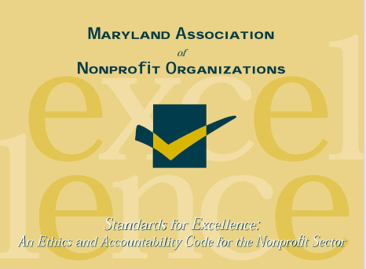
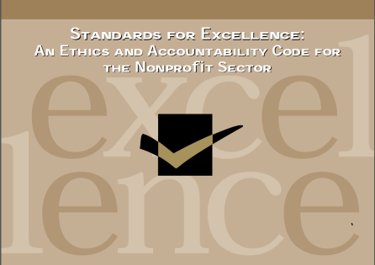
    First Standards Code developed      First National Standards Code Developed

    Images from L-R: The cover of the very first Standards for Excellence code (circa 1998) and the first national edition of the Standards for Excellence code (circa 2001)


    Having a code of ethics for the entire nonprofit sector is helpful to outline how nonprofit organizations can and should govern and manage their work.  It is also important for individual nonprofits to have their own code of ethics to guide its work and decision-making.  The Standards for Excellence states that nonprofits should “ensure that they have an explicit and clear set of ethical principles and, as appropriate, operational or program standards that have been discussed by their board and staff and that are transparently clear to all stakeholders.”


    More information is available in the Standards for Excellence educational packet on developing a code of ethics which includes discussions of the reasons for having a code of ethics, how nonprofits can put their values into practice, types of codes of ethics, training on the ethics code, and steps to developing a code of ethics. 

    This educational resource packet and the full series of all packets  – including sample policies, tools and model procedures to help nonprofits achieve best practices in their governance and management – can be accessed by contacting a licensed Standards for Excellence replication partner, one of the over 150 Standards for Excellence Licensed Consultants, or by becoming a member of the Standards for Excellence Institute.

  • NANOE: New Guidelines for Tomorrow’s Nonprofit – A Review

    NANOE: New Guidelines for Tomorrow’s Nonprofit – A Review

    This NANOE review originally appeared on Maryland Nonprofits blog. Read the original post at www.marylandnonprofits.org. 

    Nonprofit leaders who haven’t found the time to make their way through the 111-page nonprofit manifesto released by the National Association of Nonprofit Organizations & Executives (NANOE) will be forgiven. No worries, I am here for you. I present to you a high-level overview and a short review.

    There has been some puzzlement and a lot of questions about emails that started showing up in the inboxes of thousands of nonprofit leaders across the country in July 2016, nominating them to be part of a Board of Governors whose sole task is to review and ratify a new set of guidelines for nonprofit practices. The full text of the Guidelines can be downloaded and reviewed here.

    For the past several decades, there has been general concurrence among nonprofit leaders on best practice standards, including Maryland Nonprofits and the Standards for Excellence Institute (where I serve as the Director of Accreditation and Education), the BBB Wise Giving Alliance, the Principles and Practices for Nonprofit Excellence (Minnesota Council of Nonprofits), the Principles for Good Governance and Ethical Practice (Independent Sector), the Council of Foundation’s National Standards for U.S. Community Foundations, BoardSource, and other industry specific accrediting bodies such as the Council on Accreditation and CARF. For example, generally accepted best practices call for boards to be diverse and represent the communities they serve, to be all-volunteer, and to be responsible for financial and program oversight, and for setting the direction and policy for the organization. While there is some level of competition among standards-setters, there is general agreement about what the best practices are, with different approaches to measuring and articulating them.1

    We believe that best practices call for boards to be more engaged, not less. Boards should be more diverse, not less. Boards should represent their communities as a whole, not just the elite…


    Enter NANOE with a new set of guidelines for the nonprofit sector, designed, at least in part, to address the chronic under-resourcing of nonprofit organizations. Our assessment is that these guidelines are a mix of old news, ill-supported propositions, or suggestions downright contrary to best practices that could carry significant risks. They are written in an unwieldy, repetitive fashion that may make them impractical for use by nonprofit leaders and consultants that NANOE intends to certify, and also lack credible sourcing. I’ve provided an overview below that outlines the Guidelines based on three categories.

    1. This is not news: Guidelines in this category are statements about good practices in the nonprofit sector that we can all agree with.  For example, NANOE suggests that relationship building is critical.

    2. Not enough info: Guidelines in this category may have some merit, but the detail contained in this text is not sufficient to fully vet them or, it is unclear whether a nonprofit would have the means or authority to implement these practices. For example, NANOE offers that donors should be a nonprofit’s primary customers.

    3. Cause for concern: These practices directly contradict best practice and/or there is no practicable way to implement these practices sector-wide. For example, NANOE suggests that boards should have only four members and that board members be paid for their service.


    This is Not News

    If you’ve been around in the sector long enough, you have definitely run across a board of directors (or two, or ten…) that is running at less that optimum effectiveness. We’ve seen instances in which the board has too much authority and control, and we’ve seen instances in which the CEO has too much authority and control. This relationship is key to nonprofit success, but we often see it go wrong. Other statements used as the basis for the new Guidelines are not altogether wrong. Anyone who works in and with the nonprofit sector knows that relationships are key, that strong CEOs are needed, that nonprofits must work to diversify their sources of funding, and that the surest way to success is to commit some level of resources to building organizational capacity. Donors should be cultivated and engaged; programs should be evaluated for outcomes. We should be speaking out on behalf of the sector to lobby governments and funders to provide funding for indirect costs like infrastructure and administrative or fundraising overhead. These are basic points on which we can all agree. (NANOE Guidelines 1, 3, 9, 10, and 11, and parts of Guidelines 5 and 7).


    Not Enough Info

    Though we sometimes argue over what to call our sector, we have strong opinions about our purpose. We are here to make the world a better place through our efforts. We have always thought of our core mission and our primary customer as the people or causes to which we direct our resources. NANOE’s Guideline 4 recommends that we rethink this paradigm by adding donors and for-profit businesses as additional primary customers. I had to read very closely to find that the authors suggest them as an addition, rather than as a replacement for our mission. On page 56, the suggestion is that we rewrite our missions as such:

    “Faith & Hope Food Bank provides donors, business partners, advocates & volunteers the organization they require to care for our community’s hurting, hungry & homeless.” , p. 56, Guidelines

    I’m still thinking through the implications of this and weighing the pros and cons – as we all should consider what the result of this might be. I’d love to hear your thoughts, Tweet us @s4excel. One thought that immediately comes to mind is that it would fly in the face of the community empowerment movement whereby those being served play a stronger role in the governance and strategy of nonprofits that are active in their communities. (For some great examples of this, see the Building Movement Project.) Other guidelines I include in this category are things that nonprofits have little or no control over. Although there is a nugget of good thought here, these are not necessarily “guidelines” that nonprofits can implement. However, a nonprofit may be able to advocate for these ideas with their partners if it fits with their own mission and structure.

    • NANOE suggests that there should be directives to funders and for-profit partners to be actively engaged in decision-making at the organizations they fund. (NANOE Guideline 5) On one hand, this would give more power to the already powerful, but on the other hand, perhaps it could lead to more resources. This guideline is not fleshed out enough to get sense of the depth and breadth of engagement the authors suggest.

    • NANOE also offers directives to university faculty to exchange services with nonprofits: namely, assistance in securing large grants in return for using their clients as research. (NANOE Guideline 6). The faculty that I know already have a tough enough time raising funds for their research; it’s hard to imagine this truly scaling up. Not only that, but I’d like a whole lot more information about the research standards and funding rules that would accompany such a proposition.

    Finally, in this category, I would add NANOE Guideline 9. (Build more social enterprises and consider whether your organization would be better off as a for-profit or benefit/L3C corporation.) I’ve seen very successful social enterprises, and I have seen social enterprises that have fizzled out within a few years. The same can be said of other resource development opportunities – fundraising from individuals, funds from foundations, government contracts, and fundraising from events. Social enterprise is no panacea, and it should be entered into with the same caution that any leader undertakes any significant change in strategic direction.


    Cause for Concern

    I’ve saved NANOE Guideline 2 for last. In my opinion, this is the crux of the suggestions that have the most capacity to do harm to our sector. Guideline 2 calls for repurposing the relationships between the CEO and boards of directors (and with donors and for-profit organizations, which I addressed above). There are two directives in this section which bring the greatest cause for concern. 

    The first directive is to restructure the board. NANOE suggest that we disband every board and reconvene it to include only four board members – an “enterprise development” specialist, a mission specialist, a CPA, and a lawyer. (Someone show me the queue where entrepreneurs, lawyers, and CPAs are waiting in line to serve on my board!) It is also suggested that most monitoring and planning activities, including regular financial and program oversight, should be stripped from the board. Fundraising is also dropped from the list of board responsibilities. 

    The NANOE Guidelines suggest that boards are to be used primarily in an advisory function, with a strong focus on ethics, legal compliance, and managing the CEO. In return, all board members are to receive compensation for their service. In a surprise addition, all board meeting minutes, including those not already subject to sunshine laws, are to be public documents. 

    The second directive is to give more authority to the CEO. NANOE suggests that the CEO act as the Chair of the board, set board agendas, and vote on board matters. Further, NANOE suggests that the CEO should have full authority to act on all organization matters and that the CEO is solely responsible for building relationships with stakeholders. 

    When it comes to organizational monitoring and oversight, the NANOE guidelines suggest that all nonprofits should be subject to an annual audit by an independent CPA. This replaces regular financial monitoring by the CEO and board. Additionally, all nonprofits should contract with outside bodies to complete program/organizational audits. This replaces regular program oversight by the CEO and board. 

    We believe that best practices call for boards to be more engaged, not less. Boards should be more diverse, not less. Boards should represent their communities as a whole, not just the elite, who, according to these guidelines, are to be provided an avenue to do good AND to do good for themselves AND to have an important seat at the decision making table. Further disconnecting nonprofits from the communities they serve will not lead to greater success. 

    Additionally, paying board members creates a self-serving interest on the part of the board member, and thus decreases their independence and objectivity. How will a paid board, essentially selected by the CEO, effectively and impartially provide the oversight to assure that basic governance standards of the IRS, and public service missions, be met?  How would this group impartially review CEO performance and compensation? Granting the CEO authority to set agendas and vote on board matters could lead to a situation where these small, professional, and elite boards simply rubber stamp everything the CEO suggests. This has the potential to lead to a dangerously unbalanced relationship. 

    Suggesting the CEO hand over responsibility to manage the organization and the board hand over their oversight duties –  to paid contractors – is not the solution that the nonprofit sector needs. Small nonprofits do not have the resources to meet this guideline, and nonprofits who could afford it should think carefully before passing these key responsibilities to outsiders. 

    Furthermore, the idea of having outside organizational consultants conduct regular audits to replace reporting is not practical and not good practice. A high quality organizational assessment can cost tens-of-thousands of dollars and is time consuming, with a time lag between assessment date and report-delivery. It is a good tool for periodic, strategic reviews by the board and CEO, but it is exceedingly expensive and could lack consistency, accuracy and timeliness for regular reporting that the board and CEO need to govern and manage the organization. One observer called these guidelines the “consultant full employment act!” We would rather see those resources going into the mission and infrastructure of the organization – and the individuals/community served. 

    The case for this NANOE’s Guideline 2, at least in this document, appears be built on anecdotal evidence from very large nonprofits. (Small nonprofits, which make up 2/3 of the nonprofit sector in this country, would be costed-out by many of these guidelines…perhaps NANOE is suggesting that these groups should scale up or give up?!) While we share the frustration that leads the initial argument (many board/CEO relationships are not working), we cannot sign-on to the solution suggested here.


    Conclusion

    If you’ve paid your $100 to be on the Board of Governors to review and ratify this document, we suggest that you carefully read these guidelines and make your own decisions about the veracity of their claims and conclusions. There are solutions out there, offered by the many standard-setting bodies mentioned above. Our own Standards for Excellence accreditation program has been supported by independent academic research. There is no shortcut to success – organizational capacity building, strong relationships, resource strategies, and board service are HARD WORK, and there’s no getting around it. Maryland Nonprofits and the Standards for Excellence Institute are here to help you with that hard work!

    1 One exception to this consensus on best practices has been Charity Navigator and its highly popular website for donors to see ratings on charities based largely on the percentage they spend on overhead. We disagreed with the Charity Navigator rating approach because exceedingly low overhead undermines an organization’s ability to have sound management systems to ensure full ethics and accountability. The Charity Navigator star seems to be fading a bit as they finally signed on to a letter a couple of years ago stating overhead is not the most important thing, impact is, but they, like everyone else, have failed to find an easy way to measure a nonprofit’s impact.

    Maryland Nonprofits and the Standards for Excellence Institute’s President & CEO, Heather Iliff, reached out to NANOE’s leadership to inform them of our intent to publish this post and invite a response. Read NANOE’s response here. 


    NANOE Guidelines Summary

    Key: “Not news” in blue. “More info needed” in purple. “Cause for concern” in red.

    1. Relationship building is critical: egalitarian, networked, engaged, reciprocal, and trusting relationships are the keys to success.

    2. Re-Purpose Relationships between CEO, board, donors, and for-profit businesses

      • Restructure the board: Four board members only, to be used as “counsel” to the CEO (not as community members/owners of organization assets) – enterprise development specialist, mission specialist, CPA, and a lawyer. Strip most monitoring and planning activities, including regular financial and program oversight. Boards are not involved in fundraising. Emphasis on ethics, legal compliance, managing the CEO, and holding the CEO accountable for strategy and outcomes. All board meeting minutes are public. Board members are paid “at least” an honorarium.

      • Give more authority to the CEO (do NOT call them an Executive Director): They serve as Chair of the board set board agendas, and vote on board matters. CEO is granted full authority to act on all organization matters. CEOs should be freed to concentrate on building relationships, fundraising, and building the capacity of the organization, while program managers have broader authority andresponsibility over their program areas and strong development support is provided through a development office.

        • All nonprofits should be subject to an annual audit by an independent CPA (not the CPA on the board). This replaces regular financial monitoring by the board.

        • All nonprofits should contract with outside bodies (not named?) to complete program/organizational audits. This replaces regular program oversight by the board.

        • Donors and for-profit businesses are seen to be primary customers (See below, Guideline 4).

    3. Strong CEOs build and maintain effective organizational and operational capacity, including strong external relations and strong human capital practices.

    4. Re-define the mission statement to include two primary customers – donors and for-profit partners AND the community served. Rewrite mission statements such as, “Organization X provides a means for donors, advocates, volunteers to support a specific cause.”

    5. For funders and for-profit partners: Be partners with nonprofit CEOs to build high performing organizations. CEO should spend considerable amount of time on building networks and partnerships and bringing funders into organizational decision-making processes. 

    6. Diversify fundraising sources, including social enterprise and capital investments. Also, apply for governments to fund indirect costs and partner with university faculty to grow revenue (faculty has access to clients and data for research, faculty assists in securing large dollar grants). (See also guidelines 7 and 9 below).

    7. Raise capital for capacity building and grow and sustain change through the use of capital investments. Grow strategically based on a strong business plan. Report investment income separately from other revenue sources.

    8. Identify and communicate infrastructure costs as necessary to accomplish mission. This guideline is about changing the public and donor perception of overhead.

    9. Build social enterprises and consider re-incorporating (for instance, as a B-corp or L3C). (See Guideline 6 above).

    10. CEO leads all fundraising efforts and is an effective fundraiser. Cultivation and stewardship of donors is a key function of the CEO (see Guideline 2 above). CEO may engage consultants, but must maintain accountability.

    11. Engage in evaluation of the organization, its outcomes, and the effect of growing capacity on service delivery.
  • Back to Basics:  Charity Transparency, Trust, and the Board

    Back to Basics: Charity Transparency, Trust, and the Board

    nonprofit_consultant
    The following post about charity transparency was written by Standards for Excellence Licensed Consultant Carmen Marshall and is part of our “Ten Years of Advancing Excellence” blog series, celebrating ten years of the Standards for Excellence Licensed Consultant program. Carmen specializes in performance improvement, ideation and execution, communications, marketing, organizational development, training and executive coaching. As a management consultant, Carmen has helped numerous leaders, executives, and organizations grow and improve impacting their bottom line, raise additional funds and create new programs that move the organization’s vision forward. Carmen Marshall became a Standards for Excellence Licensed Consultant in 2013. 

    It’s been 10 years since the Standards for Excellence Institute® trained and licensed its first class of consultants to implement the Standards for Excellence®: An Ethics and Accountability Code for the Nonprofit Sector. When the Institute was established, it raised the bar and laid out a road map to achieving excellence for nonprofit organizations who would accept the challenge to strengthen their practices. Now a decade later, 216 nonprofit organizations have received the Standards for Excellence accreditation. In homage to the Institute’s work, it is fitting to revisit the fundamentals of the Code, that if followed, will help an organization achieve its mission with improved effectiveness and efficiency while holding to the highest of standards in nonprofit governance, ethics, and accountability. Back to Basics: Trust, Transparency and the Board is the first installment in the series. 

    Trust is to a nonprofit organization what wind is to an eagle. Without wind it cannot soar. Trust must also be integral to organizational culture lest it function in dysfunction. Consequently, the bedrock of trust building begins and ends with sincere and trustworthy leaders who are mission-driven, motivated and determined to do right by the organization. From there, that example must permeate every board, committee, and department.

    Charity Transparency: Trust-Builders and Trust-Busters

    Trust-Builder: Good communication of good information. It is imperative that information shared with and by leaders can be trusted, is timely and shared appropriately. Board members are able to make better decisions, create appropriate policy and oversight with reliable information. 

    Trust-Buster: Poor communication and bad or inadequate information sets up the board for unnecessary problems, bad decision-making or possible embarrassment. This erodes trust.
    T

    rust-Builder: Strong interpersonal communications. It may seem like a no-brainer, but simple, open and honest respectful interpersonal communication between board members or board and staff can go a long way toward building or sustaining trust. 

    Trust-Buster: Communication that is dishonoring or disrespectful is often at the root of strained relations between board members or board and staff. This not only erodes trust but it slows organizational progress. 

    Trust-Builder: Full engagement. Board members’ heads and hearts must be fully engaged to serve optimally. When board members exercise sound judgment that is always aimed at doing what is right for the organization simply because it’s right, it builds trust. When board members, staff, communities or members served by the organization know that the heart of the board is in the right place, and they are fully present and engaged, it builds trust. 

    Trust-Buster: Board members with high absenteeism, unaware of what’s going on with the organization, or who are perpetually silent do not garner trust. 

    Trust-Builder: Grace for growth based on shared values. Board members may not always agree or see eye-to-eye on every issue, but there are healthy and productive ways to solve problems and disputes, without distracting or detracting from the mission and the work of the organization. Things happen and people make mistakes, so allow for lessons to be learned and for change and correction to occur. Extend a little grace to one another knowing that even you can goof up from time to time. Resolve differences quickly, openly and honestly holding each board member in high esteem. It’s the Golden Rule, folks. Treat others as you would want to be treated. This builds trust. 

    Trust-Buster: Petty arguments and character assassination, even behind the scenes, will always spill onto center stage and distract everyone from the mission, work, and service delivery. This can damage a board, to say nothing of the organization and absolutely destroys trust. 

    Trust-Builder: Charity Transparency and Accountability. It is important to be clear about your role as a fiduciary. You are charged with safeguarding the public’s resources. As a board member, your fiduciary responsibility demands that you remain informed about the affairs of the organization. Should you ever come under scrutiny, “I didn’t know” won’t necessarily hold up, when it was your fiduciary responsibility “to know.” For starters, in every organization, there ought to be separation of duties to maintain transparency. As a board member you should be able to comfortably track and trace information and its sources so that you are comfortable that you are making decisions with the best information available. Transparency and accountability are the power twins of strong governance. 

    Trust-Buster: Refusing as a board member to take responsibility to safeguard the public’s resources either through ignorance, lack of interest or engagement. This erodes trust. 

    Finally, nonprofits in general, make an extraordinary difference serving humanity around the world. The Standards for Excellence Institute remains committed to promoting greater trust between the public and the nonprofit sector. 

    “Nonprofits enjoy the public’s trust, and therefore must comply with a diverse array of legal and regulatory requirements. Organizations should conduct periodic reviews to address regulatory and fiduciary concerns. One of leadership’s fundamental responsibilities is to ensure that the organization governs and operates in an ethical and legal manner. Fostering exemplary conduct is one of the most effective means of developing internal and external trust as well as preventing misconduct. Moreover, to honor the trust that the public has given them, nonprofits have an obligation to go beyond legal requirements and embrace the highest ethical practices. Nonprofit board, staff, and volunteers must act in the best interest of the organization, rather than in furtherance of personal interests or the interests of third parties. A nonprofit should have policies in place, and should routinely and systematically implement those policies, to prevent actual, potential, or perceived conflicts of interest. In this way, ethics and compliance reinforce each other.” Standards for Excellence Code III – Legal Compliance, Guiding Principal.