Category: Licensed Consultant

  • Planning Strategically Through Process Thinking

    Planning Strategically Through Process Thinking

    nonprofit_consultant
    The following post was written by Standards for Excellence Licensed Consultant Arshad Merchant and is part of our “Ten Years of Advancing Excellence” blog series, celebrating ten years of the Standards for Excellence Licensed Consultant program. Arshad Merchant recently founded Boost Social Sector Consulting to help nonprofit and other socially-minded ventures address critical challenges and pursue greater good. Drawing on 20 years in consulting, Arshad brings substantial experience in strategy, program improvement and organizational development. Arshad Merchant became a Standards for Excellence Licensed Consultant in 2015. Applications for the 2016 Licensed Consultant Training program will be accepted through July 1. 
    T

    his post, originally titled “A Simple Method to Improve College Graduation Rates,” first appeared in the Stanford Social Innovation Review in September 2014. 

    David Borgal and Greg Johnson faced a challenge. Their Boston-area organization, Bottom Line, helped low-income, first-generation students get into college and graduate. Dave as founder and director of operations, and Greg as executive director saw hundreds of students entering college each year with help from Bottom Line. But not enough of them were graduating. And while the six-year graduation rate of Bottom Line’s participants at 73 percent was well above the national norm of 57 percent (based on data from the National Center for Educational Statistics), Dave and Greg firmly believed the rate could be higher. With this thought in mind, Dave and Greg asked Wellspring Consulting to help Bottom Line increase the graduation rates of its students. 

    As we began our investigation, we learned about Bottom Line’s Counselors, who were spending time with 475 college students across 15 campuses, meeting one-on-one or with small groups to provide encouragement and guidance. Bottom Line considered this approach to be a core tool for achieving successful graduation rates. However, the approach used by the Counselors was haphazard, drawing primarily upon their own experience and intuition to determine how to support students. Bottom Line had no systematic understanding of how Counselors should spend their time to yield the highest graduation rates.
    T

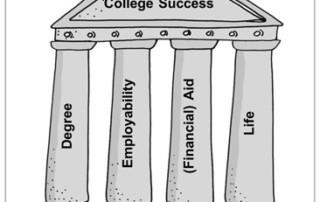
    o attack the problem, we employed an approach called Process Thinking, a powerful way to determine how daily activities can be performed to maximize the ultimate goals of a nonprofit organization. Based on the methods of Process Thinking, we began by understanding the needs of the beneficiary of Bottom Line’s services—in this case, the needs of the students. By systematically interviewing the Bottom Line staff who worked directly with students, we uncovered the four most important areas where students needed help to graduate. These were:

    1. Staying on track to graduate—which meant selecting a suitable major, understanding what requirements they must fulfill to graduate, and using strategies and support to improve their academic performance

    2. Building their employability—through securing part-time jobs, writing a resume, and defining a desired career path

    3. Maintaining sufficient financial aid—by renewing their scholarships, staying current on scholarship payments, and making smart financial decisions

    4. Managing life—by staying connected with people who cared, maintaining a positive attitude, and resolving problems that might challenge their ability to graduate

    Next, we assessed how Bottom Line counselors were spending their time. We found that the majority of counselors’ hours were spent meeting with students who were well-organized and motivated. On the other hand, at-risk students often missed meetings and were reticent to engage with Bottom Line’s counselors. Counselors with the best of intentions would too often overlook the students most in need. And without a method to prioritize their time, they weren’t focusing on those who needed them most. 

    To address this problem, we started by creating a simple mnemonic for the four dimensions of graduation success, which we called DEAL, where each letter stood for the following:DEAL

    • Degree (academic performance, on track to graduate)

    • Employability

    • (access to financial) Aid

    • Life (emotional support)

    Next, we worked with Bottom Line to create indicators for each of these four dimensions of graduation success. Students would be ranked on these indicators, using a color-coded scale where green meant “on track to graduate,” yellow meant “facing some difficulty,” and red meant “at significant risk of not graduating.”

     At the beginning of school, all students started green—presumed to be on track to graduate—and the counselor’s goal was to keep them green. As the school year progressed, counselors and other staff would regularly update student rankings in a database and tracking system that produced a scorecard for each student. Counselors then used these scorecards to determine how and with whom they should spend their time. As a result of this simple approach, Bottom Line’s counselors were finally able to focus on the students who needed the most help to graduate. 

    DEAL also helped Bottom Line identify areas where extra support was needed beyond what counselors could provide. One such area was in helping students prepare for careers after college. As a result, Bottom Line instituted a new career program. As Dave Borgal said, “DEAL highlighted that employability upon graduation mattered, which caused us to design a program to accomplish that.” 

    Because DEAL is a simple yet powerful way to align the organization around its central goals, Bottom Line uses DEAL as a key part of its formal training program for counselors. And, DEAL has been instrumental in fundraising. Mike Wasserman, Bottom Line’s former director of development who now leads the Massachusetts offices, said, “Before DEAL, we would say, ‘We help students get through college,’ and ‘We do a lot.’ Now we can show the rubric, a sample intervention, and the toolkits. Our stakeholders can more easily understand the range, scope, and nature of services we provide students.”

    With the implementation of DEAL, predicted graduation rates of Bottom Line’s students have risen to 85 percent. Process Thinking, when executed well, enables nonprofits to focus their daily activities where results will be the greatest, accelerate fulfillment of their goals, and ultimately increase their value to society.

  • The Big 4:  Transform Fund Development with Exceptional Donor Care

    The Big 4: Transform Fund Development with Exceptional Donor Care

    nonprofit_consultant

    The following post was written by Standards for Excellence Licensed Consultant Carmen C. Marshall and is part of our “Ten Years of Advancing Excellence” blog series, celebrating ten years of the Standards for Excellence Licensed Consultant program. Carmen specializes in performance improvement, ideation and execution, communications, marketing, organizational development, training and executive coaching. As a management consultant, Carmen has helped numerous leaders, executives, and organizations grow and improve impacting their bottom line, raise additional funds and create new programs that move the organization’s vision forward. Carmen C. Marshall became a Standards for Excellence Licensed Consultant in 2013. 

    Applications for the 2016 Licensed Consultant Training program will be accepted through July 1.  

    There’s good news and challenging news. The good news is that philanthropic giving to nonprofits is up. According to the Urban Institute Center on Nonprofits and Philanthropy, “in 2014, total private giving from individuals, foundations, and businesses totaled $358.38 billion, an increase of just over 5 percent from 2013 after adjusting for inflation. According to Giving USA (2015), total charitable giving rose for the fifth consecutive year in 2014. After adjusting for inflation, this is the first year to exceed the previous peak set before the recession in 2007 ($355.16 billion in 2014 dollars)”. – The Nonprofit Sector in Brief 2015 Public Charities, Giving, and Volunteering 

    The challenging news is that in 2015, the nonprofit donor retention rate average was 46% according to the 2016 Fundraising Effectiveness Survey Report.* In dollar to dollar terms, that means, over 54 percent of donors don’t return to give in the next year. This is not about simply counting the number of donors, however, but it is about being intentional around donor retention and investment of fund development resources. 

    What’s more valuable to your organization A) a fundraising event that generates a profit? B) a large one-time donation? or C) a committed donor who gives annually? 

    While a case can certainly be made for A and B, research indicates that there is no substitute for a committed nonprofit donor who believes in your organization. That donor is most likely to give year after year. Whether you’re the fund development officer or the accidental fundraiser in your organization, let’s face it, getting and keeping donors is preeminent and key to sustainability. Generating revenue to move your organization’s mission forward is paramount and inextricably tied to donor retention. There are four keys that will transform your fund development. These four keys are founded on the premise that it’s not all about you. Put these principles to work and they will not only transform your fund development, but will help you to retain donors. The Big 4 Keys to Transformation: Communicate, Cultivate, Educate and Evaluate. 

    Communicate

    • Results and Impact – Nonprofit donors want to know that their money is at work doing what you promised them. They want to know that their investment is making an impact. Your value to the donor is not only what a great charity you are, but how valuable their contribution is and what a difference it is making in the world. They need to believe in who you are and what you do. Show evidence. Your story must stand out. Communicate results and impact through your organization’s newsletters, e-news, on your website, in eblasts, Facebook posts, Twitter, Instagram, thank you letters and personal notes and occasional phone calls. One of my clients, made it a point to call selected donors and visit others in their region to hand-deliver a photo album of kids and their personal thank you notes as a way of saying thank you. That donor was so touched that she continued to give and increased her giving over the years. If there are really big news items, do an official public relations campaign, to get it on national and local news outlets.

    • Arrange for donors to meet the recipients. Create small and private donor receptions, with a personal touch, to say thank you to donors. One client used such opportunities to connect donors and scholarship recipients.

    • Remember as you communicate, you’re also cultivating.

    Cultivate

    • Be smart and strategic about how, when, the frequency and with whom you make contact. Where possible, make face to face contact.

    • Research your donors; know your market, know your donors.

    • Tell a compelling story.

    • Don’t over solicit. One of the greatest mistakes of some organizations – and turn-offs – in fundraising is over-solicitation. Nonprofit donors do not want to be bombarded with requests for money.

    • Your Fund Development Plan should include goals, timetable, strategies and assignments.

    • Don’t pin donors to your schedule. Consider staggering your asks, where possible, so that dollars can come in over the year and over multiple years. After speaking with the donors, one of my clients learned that some of her donors could make multi-year contributions and structured requests to them around their giving calendar.

    • Relationship is everything so be creative. Assign someone the task of nonprofit donor relationship management, someone who can focus on caring for your donors; also remember that, in the office, fundraising is everyone’s job – from the receptionist (first line of contact) – all the way to management. Cultivation of donors is ongoing. How you communicate can be the difference between donor retention and donor attrition.

    • Honor the donor’s information and privacy. “Nonprofits should respect the donor’s right to determine how their name and contact information is used, including providing opportunities to remain anonymous, request that the organization curtail repeated mailings or telephone solicitations from in-house lists, and have their names removed from any mailing lists which are sold, rented, or exchanged….”- The Standard’s for Excellence Code of Ethics

    Educate

    • Educate your donors. Teach them something new or provide information about your cause (i.e., drop out rates, societal impact and health risks, etc.)

    • Make it about them; answer their questions, provide useful giveaways such as free ebooks, and white papers;

    • Keep it simple, short and sweet; avoid information overload.

    Evaluate

    • Track your donor retention rate. Compare last year with this year. How many donors do you have? How many gave last year? How many of those same donors gave this year?

    • Understand the value of the retention, not just the number of donors

    • Measure your growth or decline;

    • Find out what they liked or didn’t like; want or need; use nonprofit donor surveys to gain valuable donor feedback

    Strategically implementing the The Big 4 with exceptional nonprofit donor care will transform your fund development and keep donors coming back year after year! 

    * The Fundraising Effectiveness Project is produced by Association of Fundraising Professionals (AFP) and the Center on Nonprofits and Philanthropy at the Urban Institute

  • APPLICATIONS OPEN: Become a Standards for Excellence Licensed Nonprofit Consultant

    APPLICATIONS OPEN: Become a Standards for Excellence Licensed Nonprofit Consultant

    nonprofit_consultant

    Applications are now open for the tenth Standards for Excellence Licensed Nonprofit Consultant Training program.

    The Standards for Excellence Institute® continues to build a national network of qualified nonprofit consultants licensed to provide training, consulting, and support on the Standards for Excellence: An Ethics and Accountability Code for the Nonprofit Sector. The Licensed Consultant Training is an exclusive, professional development initiative that gives independent nonprofit consultants the knowledge, skills, and tools necessary to work with organizations across the country interested in learning about, conducting self assessments, implementing change, and becoming accredited in the Standards for Excellence Program.*
    The seminar will take place in Baltimore, Maryland October 24, 25, and 26 at the Hyatt Place in the heart of Baltimore’s beautiful Inner Harbor East. Meals and refreshments will be provided during the seminar, and a reception marking 10 years of the Licensed Consultant program will take place the evening of the 25th (see program description for more details). 

    Nonprofit_consultant 
    Apply today to become a Standards for Excellence Licensed Consultant

    Program Benefits
    Applicants that are accepted to the program will participate in a three-day license certification seminar. The seminar includes:

    • Facilitation and training development to incorporate the Standards for Excellence in your nonprofit consulting practice

    • Background on the importance of self-regulation for the nonprofit sector

    • Overview of the Standards for Excellence program and the specific content contained within the 67 guidelines

    • Take-home tools to help assess organizations in alignment with the Standards for Excellence code

    • Educational tools for all Standards for Excellence signature training programs including PowerPoint slides, curricula notes, and resource handouts

    • Educational Resource Packets and Bulletins (3 full sets of each of the educational resource packets and bulletins (currently, there are 27 educational resource packets) included free – additional copies available to purchase at a reduced rate)

    • 20 copies of the Standards for Excellence Codebook (updated version released in 2014) (additional copies available to purchase at a reduced rate)

    Participants in the program will receive a two-year license to provide Standards for Excellence consultation, including the ability to mentor organizations through the process of incorporating the Standards for Excellence to improve internal management and/or applying for accreditation to be awarded the Seal of Excellence.
    All Standards for Excellence Licensed Nonprofit Consultants are listed in our searchable online directory and featured with an individual profile page on the Standards for Excellence Institute’s website, promoting your status as a National Licensed Consultant in all facets of Standards for Excellence code. Licensed Consultants also have the opportunity to serve as an additional professional resource for the Standards for Excellence Institute on a contractual basis.

    Download the full program description for more details about the Licensed Consultant Training program.

    nonprofit_consultant
    Standards for Excellence Licensed Consultants work directly with
    nonprofit organizations)

    Eligibility and Requirements 

    Individuals must complete an application and become accepted to participate in the Licensed Nonprofit Consultant Training program. Applicants should be serving in a capacity that supports educating and working with nonprofits to implement and demonstrate organizational improvement and self-regulation. All Standards for Excellence Licensed Nonprofit Consultants must commit to program reporting and evaluation requirements, submit periodic reports on Standards for Excellence related training and consulting engagements they conduct, including client contact information for consulting engagements, and abide by all copyright, intellectual property, and derivative work restrictions of the Standards for Excellence Institute. See the program description for full details about Licensed Consultant eligibility and requirements. 

    To Apply 

    All applications for the 2016 Licensed Consultant Training must be submitted by July 1, 2016.  A screening process, including review of professional experience and references will be conducted by Standards for Excellence Institute staff. Accepted applicants must participate in all facets of the three-day training seminar, and enter into a written agreement with the Standards for Excellence Institute setting forth obligations and commitments as mentioned in the program description. Applicants will be notified of acceptance decisions by August 5, 2016.

    Apply now to become a Standards for Excellence Licensed Nonprofit Consultant 

    Program Tuition 

    The tuition for the 2016 Licensed Consultant Training is $1575 (does not include travel and lodging). A $150 discount is provided to individuals who are currently members of Maryland Nonprofits or the Standards for Excellence Institute. Payment is due in full upon acceptance into the program and subject to the program cancellation policy. Upon request, participants will have the ability to pay tuition in installments and must sign a payment plan agreement. See program description for more details. 

    * Geographical limitations apply with regard to where Licensed Consultants can provide service. In areas represented by a Standards for Excellence Partner, Licensed Consultants will require written permission from the Partner to conduct Standards for Excellence related activities.  Partners may contract with Licensed Consultants to provide services within their regions. Prospective Licensed Consultants will require a letter of endorsement from replication partners operating within geographic areas where they reside and/or work. A current list of licensed replication partners and their regions can be found here. If you conduct your primary business within the geographic limits of a Standards for Excellence Institute Partner, please contact us to discuss arrangements.