Category: Nonprofit

  • Introducing: Standards for Excellence Institute® Licensed Consultants Class of June 2021

    Introducing: Standards for Excellence Institute® Licensed Consultants Class of June 2021

    Contact: Amy Coates Madsen

    Director Standards for Excellence Institute

    acmadsen@standardsforexcellence.org


    Introducing: Standards for Excellence Institute® Licensed Consultants Class of June 2021

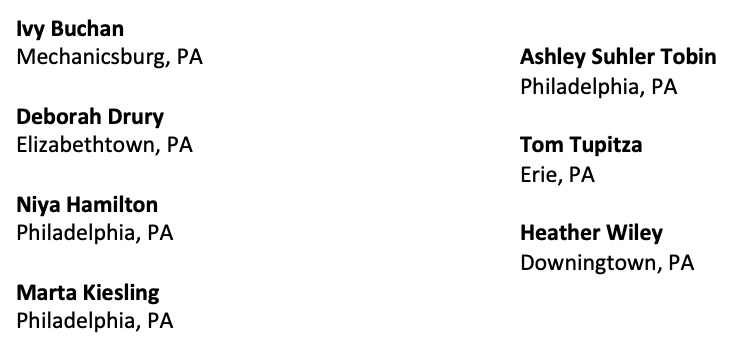
    Baltimore, MD – August 11, 2021 The Standards for Excellence Institute, an initiative designed to help nonprofit organizations operate more ethically and accountably, recently licensed a new group of Licensed Consultants from across the Commonwealth of Pennsylvania. Through a partnership with the Pennsylvania Association of Nonprofit Organizations, these seven consultants have completed a comprehensive training to assist nonprofits nationwide.

    As Standards for Excellence Licensed Consultants, these individuals have the expertise and ability to guide nonprofits in governance and management practices, as well as meeting demands for nonprofit accountability. Standards for Excellence also includes comprehensive knowledge of organizational assessments, consulting, training, and assistance in the application process for national Standards for Excellence accreditation. The most recent Licensed Consultants are listed below as well as reflections from this summer’s class.

    Here are the most recent Licensed Consultants:
    Licensed Consultant Niya Hamilton of Niya Hamilton Consultancy LLC shared, “I greatly appreciate this program, so it was imperative to continue with the national program as well. I have found this network of thought leaders, resources, and education to be pivotal in the work I do as a nonprofit and small business consultant. Every project and client I engage I apply best practices; even consulting with for profit clients. I approach each engagement from the perspective of ethics and accountability and therefore the resource guides and principles have been invaluable to myself and my clients.”

    Tish Mogan, Standards for Excellence Director, Pennsylvania Association of Nonprofit Organizations offered, “We are delighted that this group of Standards for Excellence Pennsylvania Licensed Consultants can now expand their services in other states. Standards for Excellence Licensed Consultants utilize the Standards for Excellence educational resources, sample policies, tools, checklists, etc. to strengthen nonprofit operations and governance with clients. Rather than spending time ‘reinventing the wheel,’ Consultants can take a deeper dive with organizations and help them to advance them at a faster pace.”

    The Licensed Consultant Program has grown each year since its inception in 2006. A searchable directory of consultants can be found on the Institute’s website.

    The Standards for Excellence Institute, an operating division of Maryland Nonprofits, uses the Standards for Excellence program as its vehicle for effective change. The Standards for Excellence program works to help nonprofit organizations act ethically and accountably in their management and governance, while enhancing the public’s trust in the nonprofit sector.

    Those interested in becoming a Licensed Consultant have the opportunity to join the 2022 Class of Licensed Consultants can find information and sign up to be notified when applications are available here.
  • Fostering Resilience Through the Standards for Excellence®

    According to the National Council of Nonprofits, the COVID-19 pandemic has turned many nonprofit conversations from sustainability to survivability.  Different estimates forecast that up to a third of nonprofit organizations may not survive the financial crisis and economic downturn caused by the pandemic.  Now, more than ever, it is important for nonprofit organizations to remain focused on their mission and follow best practices to ensure their long-term sustainability. 

    If I have learned anything from the six years that I have had the honor of serving on the National Standards for Excellence Council, the body that oversees The Standards for Excellence: An Ethics and Accountability Code for the Nonprofit Sector and its accreditation process, I have learned that The Standards for Excellence continues to provide the most effective roadmap to ensure nonprofit resilience, survivability and sustainability. As we continue to navigate through an uncertain future, I encourage nonprofit leaders to:
     

    1. Evaluate your current practices. The Standards for Excellence Organizational Assessment and Planning tool provides an excellent snapshot of your strengths and weaknesses and can help you identify areas where you can improve your knowledge and application of best practices. It is also a useful tool to track your progress as you make improvements.
    2. Commit to following The Standards. It is the journey to apply the Standards for Excellence that offers the best opportunity for learning, growth and resilience. If your organization is struggling, look to the Standards for Excellence for sustainability and collaboration. They will guide you in the right direction.
    3. Eat the elephant “one bite at a time.” While pursuing accreditation may seem daunting, don’t let what appears like the “enormity of the task” dissuade you from trying.  Focus on one component of the Standards for Excellence code at a time and give yourself a realistic schedule to accomplish it.  You will find that you can make significant progress reasonably quickly if you commit to doing one thing at a time by a deadline.
    4. Don’t strive for perfection. Your nonprofit does not have to be perfect in every way to achieve accreditation. In fact, “perfect can be the enemy of good” if you spend a lot of time and energy attempting to perfectly implement every standard.  The staff and peer review processes often provide useful feedback, so there is value in applying when you are “close,” even if you don’t feel that you have everything in place perfectly.
    5. Seek help from a Standards for Excellence Licensed Consultant. This can provide a great “value add” to your organization, especially with components of the Standards you have never done before. An experienced consultant can educate your board and staff and help you establish a new process following The Standards saving time and decreasing the frustration of doing it yourself when lacking experience.

    For more information about The Standards for Excellence®, engaging a Licensed Consultant, or to learn about applying to earn the Seal of Excellence so that your organization can strengthen its resilience, sustainability and survivability, visit the Standards for Excellence Institute website.

  • Introducing: Standards for Excellence Institute® Licensed Consultants Class of 2021

    Introducing: Standards for Excellence Institute® Licensed Consultants Class of 2021

    Contact: Kat LaTour

    Marketing and Communications Assistant, Standards for Excellence Institute

    klatour@standardsforexcellence.org


    Introducing: Standards for Excellence Institute® Licensed Consultants Class of 2021

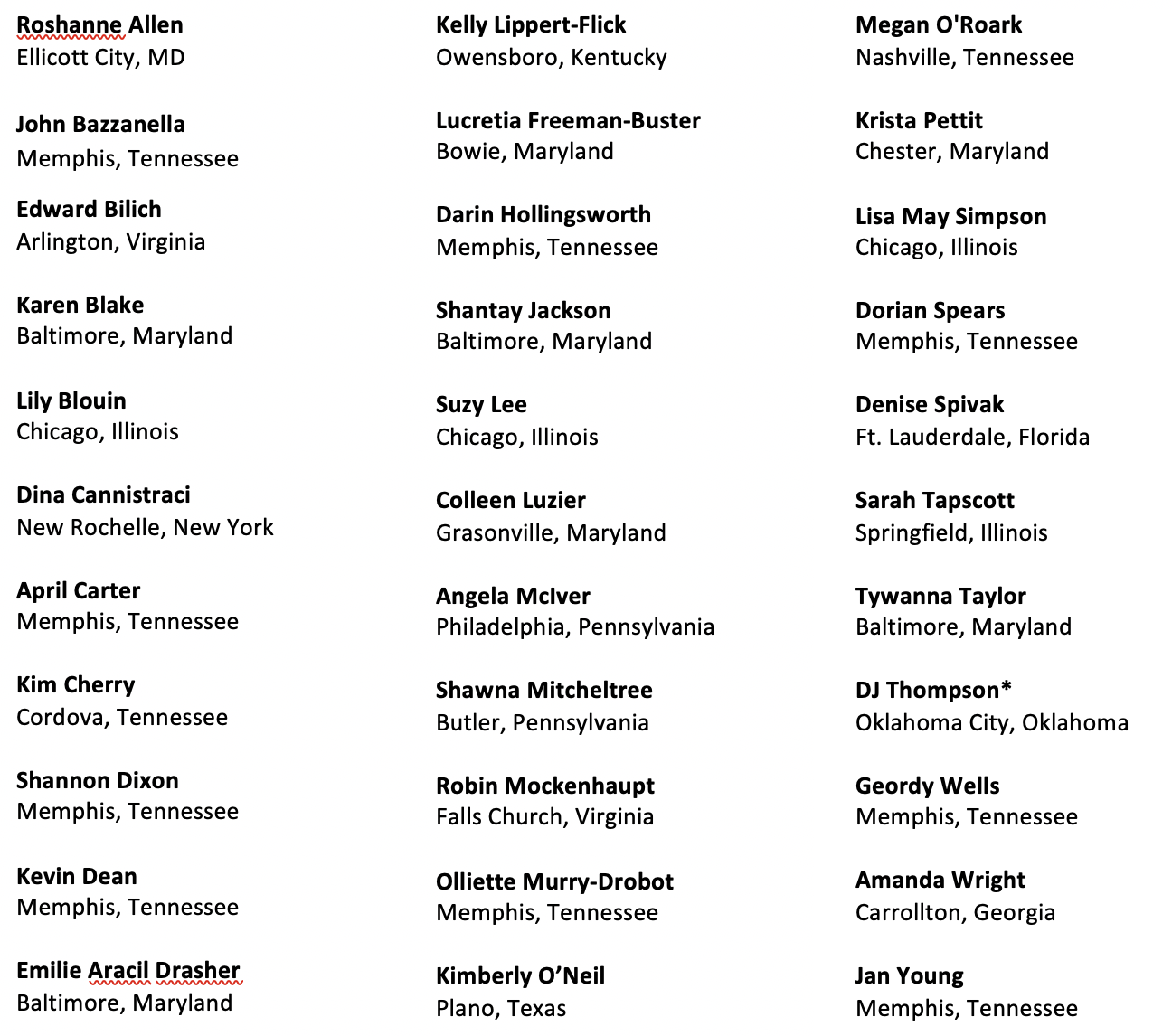
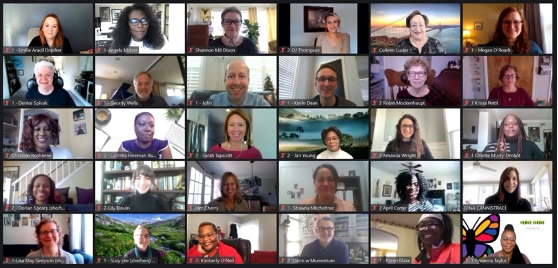
    Baltimore, MD – March 3, 2021, The Standards for Excellence Institute, an initiative designed to help nonprofit organizations operate more ethically and accountably, announces its January 2021 Class of Licensed Consultants. Thirty-three class members hailing from various regions of the country completed the intensive, five-day virtual training seminar and can assist nonprofits nationwide. They bring years of experience to the table and represent organizations from 10 different states. The program was co-hosted by Momentum Nonprofit Partners, in Memphis, Tennessee.

    Standards for Excellence Licensed Consultants use their extensive knowledge to help nonprofits strengthen their governance and management practices, in addition to meeting demands for nonprofit accountability. Licensed Consultants provide nonprofit organizations with organizational assessments, consulting, training, and assistance in the application process for national Standards for Excellence accreditation. Many licensed consultants will also work with licensed replication partners.


    Members of Licensed Consultants Offer Their Insights:

    “Momentum Nonprofit Partners was so pleased to collaborate with Standards for Excellence Institute to bring licensing training to consultants in our region of service, across the State of Tennessee and beyond. On a personal level as a participant in the training, I am thankful for the opportunity to deepen my practice in nonprofit capacity support.”

    – Dorian Spears, Chief Partnerships Officer of Momentum Nonprofits of Memphis, Tennessee


    “I had decades of experience working in, and with, nonprofit organizations as an employee and funder. Taking the Standards for Excellence Licensed Consulting training program provided me with an overarching framework and solid foundation for understanding and translating that experience to now working as a consultant with non-profits. The training program and the many resources provided will allow me to better help non-profits strive towards and achieve their mission and desired outcomes. I highly recommend this program.”

    – Robin Mockenhaupt, Robin Mockenhaupt Consulting, LLC of Falls Church, Virginia


    “The Standards for Excellence Licensed Consultant program has already had such an impact on the way I work. The information presented was relevant to the times in which we are currently living, and the digital setting was surprisingly intimate and engaging. The course not only taught us how to implement the standards with our customers, but it also provided us with useful tools to grow our practices.”

    – Shawna Mitcheltree, Alliance for Nonprofit Resources of Butler, Pennsylvania


    “Having access to the Standards for Excellence Licensed Consultant resources and peer network are invaluable for our clients and company,” she mentions. “This access allows us to streamline how we help our clients build better capacity and repurpose our internal resources so that our company’s impact can be more significant within the nonprofit startup community.”

    – Kimberly O’Neil, CEO of Giving Blueprint of Plano, Texas


    “The Standards for Excellence Institute provides a wealth of information on topics that are important for nonprofits to understand and implement so they can strengthen and grow their organization – and their mission. This training gives consultants across the country standards and principles that all nonprofits, big and small, should strive for. I am so grateful to have been a part of this training that brought together an incredible community of consultants with such diverse experiences and expertise.”

          – Emilie Aracil Drasher, Esq., Baltimore Fiscal Partners of Baltimore, MD


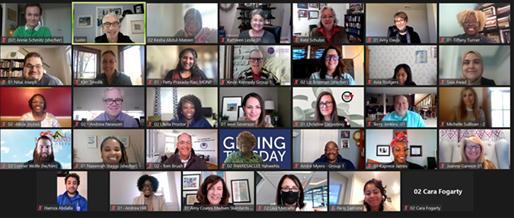
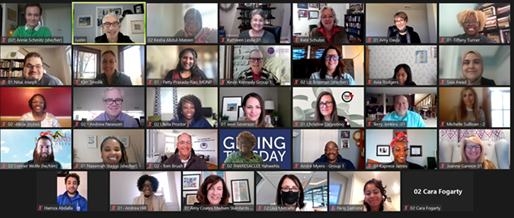
    Standards for Excellence Licensed Consultant Class of 2021 posing for a quick screenshot.


    Here are the most recent Licensed Consultants:

    The Licensed Consultant Program has grown each year since its inception in 2006. A searchable directory of consultants can be found on the Institute’s website.

    *Participated as a member of a licensed replication partner organization.


    The Standards for Excellence Institute, an operating division of Maryland Nonprofits, uses the Standards for Excellence program as its vehicle for effective change. The Standards for Excellence program works to help nonprofit organizations act ethically and accountably in their management and governance, while enhancing the public’s trust in the nonprofit sector.


    For those that are interested in becoming a Licensed Consultant, the Standards for Excellence will be offering their next training in Fall 2021. Sign up to be notified when applications are available here.
  • 52 Tips in 52 Weeks: Wrapping up the 52 Tips in 52 Weeks Series

    52 Tips in 52 Weeks: Wrapping up the 52 Tips in 52 Weeks Series


    This has certainly been an interesting year, filled with all kinds of challenges and issues that we never thought possible at the start of the year in January 2020.  One thing that I’ve held onto is this idea that the Standards for Excellence Institute would create a series of 52 Tips over each of the 52 Tips in 2020.  With this latest post, I am happy to say that we met this goal.  With the world changing so quickly, it was not difficult to come up with topics of relevance and interest to nonprofit leaders (most weeks!). I sincerely thank you for taking the time to read and digest these posts.

    As we wrap up this series, I thought it would be helpful to reflect upon a book that was highly recommended to me that I am in the process of reading:  Salsa, Soul, and Spirit by Juana Bordas. In the book, the author offers leadership approaches from Latino, Black, and American Indian Communities.  The book has a significant focus on story-telling and shares the symbol of the mythical Sankofa bird, which has its feet pointing firmly toward the future with its head looking back on the past. I just love the imagery from this West African story and believe that we can gain so much by learning each others’ stories and backgrounds.

    With our feet firmly pointed in the direction of 2021, we can hold onto all of the hope and anticipation that comes with a new year. With our heads looking back, may we take a moment to reflect on all that has happened in the last year, and what we have learned from it. Here’s a look back on the 52 Tips in 52 Months Series organized by the guiding principles of the Standards for Excellence: An Ethics and Accountability Code for the Nonprofit Sector.  We think the lessons of 2020, and this series of 52 Tips, may provide some helpful perspective even in the new year!  Happy New Year from the Standards for Excellence Institute!

    Mission, Strategy and Evaluation

    Leadership: Board Staff and Volunteers

    Legal Compliance and Ethics

    Finance and Operations

    Resource Development

    Public Awareness, Engagement and Advocacy

  • 52 Tips in 52 Weeks: Helping the Helpers

    52 Tips in 52 Weeks: Helping the Helpers


    During 2020, my family and I have taken some extra time to sit down in our home to watch movies.  One of the movies I enjoyed most in this year was the 2019 movie A Beautiful Day in the Neighborhood starring Tom Hanks. I just loved this movie – just as I adored watching Mr. Rogers and his neighborhood as a young girl.  In these times, I find myself reflecting on the quote from Fred Rogers, “when I was a boy and I would see scary things in the news, my mother would say to me, ‘Look for the helpers.  You will always find people who are helping.’”

    So many of these helpers are the folks leading, employed by, and volunteering for, nonprofit organizations.  I am grateful every day to work with people who are motivated by the world’s challenges and the problems who step up and help.  Central to the work of all nonprofits is the way that we work with others, the way we interact and treat individuals in our midst. Oftentimes, we are so laser-focused on the crisis immediately in front of us that we shortchange our efforts to support our staff and volunteer teams with guidance and assistance for how they can and should interact with the individuals we serve.

    The Standards for Excellence: An Ethics and Accountability Code for the Nonprofit Sector states:

    “In rendering its programs or services, a nonprofit should act with the utmost professionalism and treat persons served with respect. Nonprofits should provide an effective procedure for problem solving or reporting grievances, including but not limited to, legal or ethical misconduct by the organization’s employees and volunteers.  The procedure should include actions for addressing and resolving complaints effectively. Nonprofits should have policies in place that protect the confidentiality and privacy of personal information.”

    This is a good time to pause to reflect upon how our nonprofits support the work of those who provide our services.  How can we best support our team’s effort to act with professionalism and respect?  How do we ensure that confidential information is carefully and appropriately protected?  How do we ensure that we have an effective procedure for allowing those whom we serve to report grievances or problems?   Many nonprofits have standards in place to provide guidance on their service.  Many nonprofits have well-considered grievance procedures that offer individuals the opportunity to express their grievances in a way that is respectful, effective, and without retaliation. Such grievance procedures should include different avenues for reporting grievances so that the individuals we serve are not forced to choose between not reporting their concerns and reporting their concerns to the very person they believe has wronged them. Confidentiality policies are a must for nearly all nonprofits, but because our services are so varied, these approaches to confidentiality are unique and varied as well. Consider the confidentiality concerns with a nonprofit hospital compared to the confidentiality concerns with an art gallery.  Confidentiality is important to both institutions but the details and how they are carried out will likely differ tremendously.

    The Standards for Excellence educational resource packet on Working Professionally and Respectfully with Program Stakeholders addresses the three main topics of respect, confidentiality and grievance procedures and features a sample statement on privacy, a sample statement on confidentiality, and a sample policy on fundamental human rights.    

    This educational resource packet and the full series of all packets – including sample policies, tools and model procedures to help nonprofits achieve best practices in their governance and management – can be accessed by contacting a licensed Standards for Excellence replication partner,– one of the over 175 Standards for Excellence  Licensed Consultants, or by becoming a member of the Standards for Excellence Institute.

  • Introducing: Standards for Excellence Institute® Licensed Consultants Class of 2020

    Introducing: Standards for Excellence Institute® Licensed Consultants Class of 2020


    Contact: Kat LaTour
    Marketing and Communications Assistant, Standards for Excellence Institute®
    klatour@standardsforexcellence.org


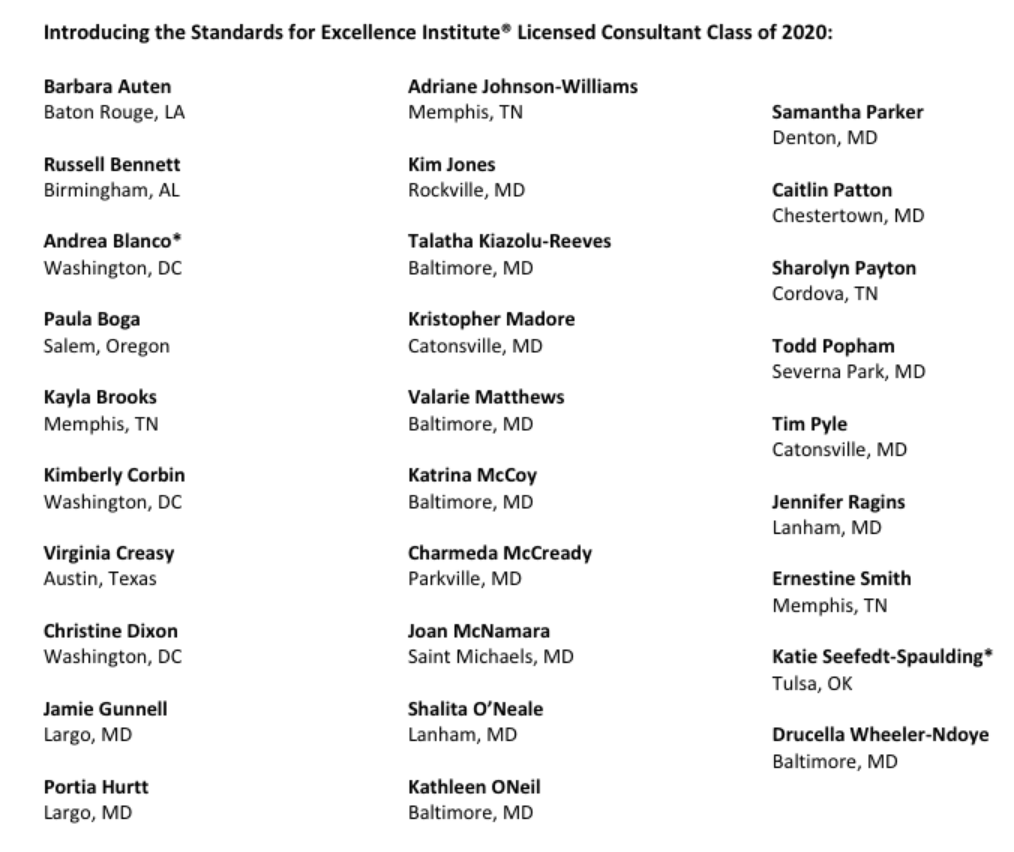
    Baltimore, MD – December 18, 2020 The Standards for Excellence Institute, an initiative designed to help nonprofit organizations operate more ethically and accountably, announces its 2020 Class of Licensed Consultants. Twenty-nine class members hailing from various regions of the country completed the intensive, five-day virtual training seminar and can assist nonprofits nationwide. They bring years of experience to the table and represent organizations from Louisiana to Maryland to Oregon– and many in between.  

    Standards for Excellence Licensed Consultants use their extensive knowledge of the multi-faceted initiative to help nonprofits strengthen their governance practices and exceed the rising demand for nonprofit accountability. They provide nonprofit organizations with organizational assessments, consulting, training, and assistance in the application process for national Standards for Excellence accreditation. Many licensed consultants will also work with licensed replication partners.  

    Christine A. Dixon, Esq., LL.M – Principal Attorney for Dixon Turnbull, stated that “Attending the Standards of Excellence training was transformational.  As a General Counsel to a non-profit corporation, I am always providing on the spot advice concerning a variety of issues daily.  The Standards of Excellence training not only solidified the knowledge I had, but supplemented in such a way that I am not only more confident, but equipped to assist my clients in their decision making by offering proven examples of non-profit best practices.”

    Joan McNamara, Communication Specialist and Business Writer for JJ Consulting, reflected on her experience: One of my favorite parts of my experience in the 2020 Standards for Excellence® Licensed Consultant training was the collegiality of the entire group. I entered this program knowing none of the 29 participants from all corners of the country and left with 29 strong connections that I now consider peers and professional mentors. Standards for Excellence® has helped me notably as a new business owner, and I have no doubt that the Standards will help many more organizations thrive in the future.”


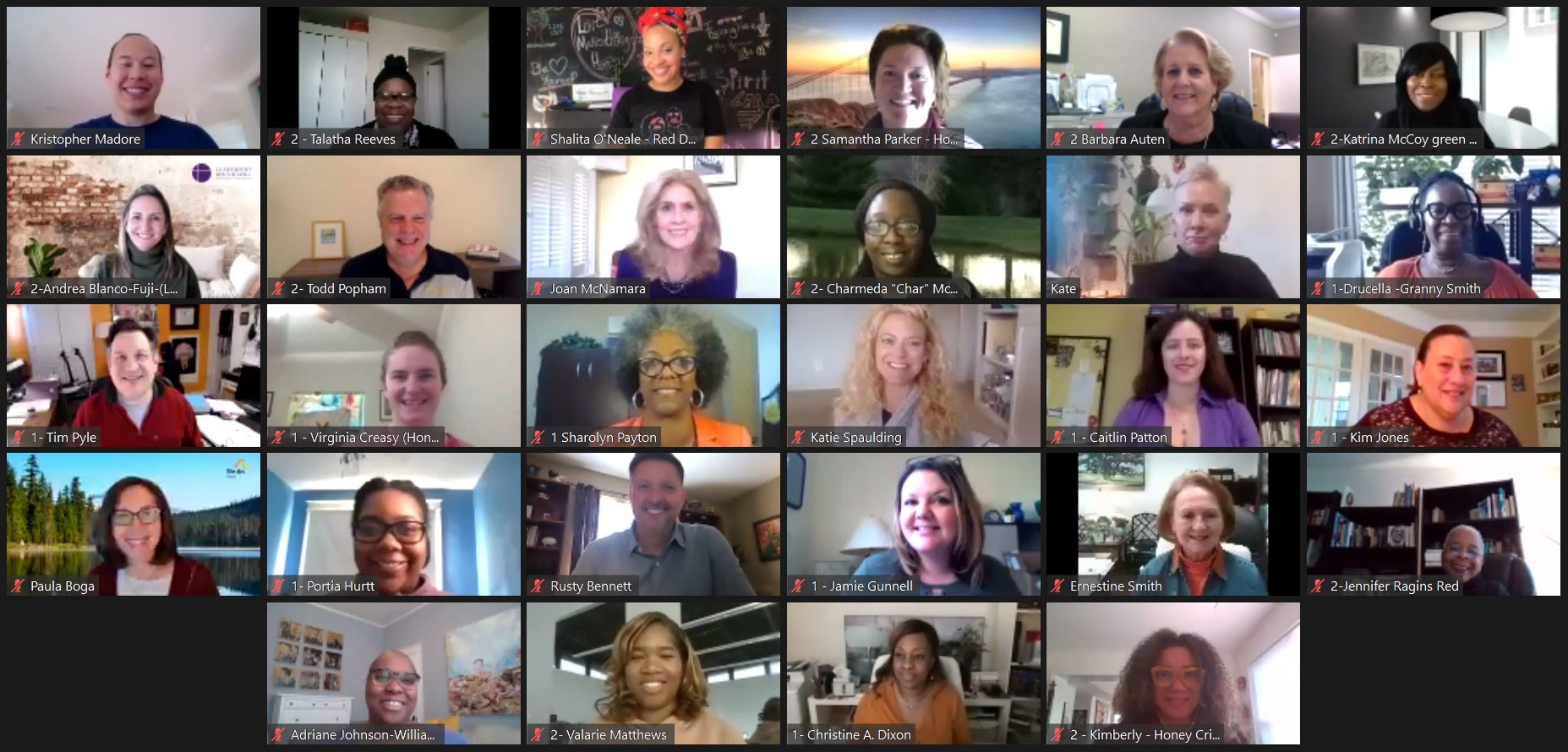
    Standards for Excellence® Licensed Consultant Class of 2020 posing for a quick screenshot.

    When asked to reflect on her experience during the training, Sharolyn Payton, of Payton Place Coaching and Consulting, remarked Overall, this was a wonderfully enriching and robust training experience. My cohort and peer consultants were brilliant and demonstrated such a remarkable spirit of support and knowledge sharing. I highly recommend this training for any consultant working in the nonprofit sector. This was by far the best training experience I’ve had, EVER!”


    *Participated as a member of a licensed replication partner organization.

    The Licensed Consultant Program has grown each year since its inception in 2006. A searchable directory of consultants can be found on the Institute’s website.

    The Institute, an operating division of Maryland Nonprofits, uses the Standards for Excellence program as its vehicle for effective change. The Standards for Excellence program works to help nonprofit organizations act ethically and accountably in their management and governance, while enhancing the public’s trust in the nonprofit sector.

    Those interested in becoming a licensed consultant have the opportunity to join the 2021 Class can find information and sign up to be notified when applications are available here!


  • 52 Tips in 52 Weeks: Can Your Donors Easily Learn about your Organization?

    52 Tips in 52 Weeks: Can Your Donors Easily Learn about your Organization?


    Last night I sat on my couch with my laptop considering my year-end charitable giving. Where to give this year?  Should I stick with those I gave to last year or give to organizations I haven’t supported in the past? Can I make all of my gifts online? Or will I have to find my checkbook and stamps? Apparently, I am not alone. According to research from the NP Source, 30 % of nonprofit giving occurs in the last month of the year. Wow! That is a bit breathtaking!

    I was talking with a friend earlier this week who was lamenting the fact while she is considering gifts to nonprofits that are new to her, she was really frustrated that so many groups did not have basic information on their website.  She said that although organizations usually do a great job describing their programs, information about the leadership staff and board members and the organization’s basic finances is often missing. When such basic information is missing, she questions the organization’s lack of transparency and whether the organization is even real!

    Since launching in 1998, the Standards for Excellence: An Ethics and Accountability Code for the Nonprofit Sector has encouraged nonprofits to publish and make an annual report available to the public.  The code states “Information about the organization’s mission, program activities, finances, board members, and staff should be easily accessible, accurate, and timely (i.e., updated at least annually).” Certainly placing an annual report or annual report data on an organization’s website is not only a best practice in nonprofit management but an expectation in the eyes of many.

    In this season of year-end giving (and all year!), it is imperative that nonprofits ensure that the giving process is as seamless as possible for donors and the public. As part of this, nonprofits should:

    1. take the time to ensure that their online giving portals are working well,
    2. ensure that gifts are followed up with receipts and acknowledgements with appropriate disclosure language that will allow their donors to take tax deductions as allowed and appropriate,
    3. make sure that solicitations are accurate, truthful and do not place undue pressure on donors, and
    4. make information about the organization’s mission, program activities, finances, board members, and staff available and easy to access

    More information is available in the Standards for Excellence educational packet on educating and engaging the public, which includes information on annual reports, as well as other methods for communicating with the public.

    This educational resource packet and the full series of all packets  – including sample policies, tools and model procedures to help nonprofits achieve best practices in their governance and management – can be accessed by contacting a licensed Standards for Excellence replication partner, one of the over 150 Standards for Excellence Licensed Consultants, or by becoming a member of the Standards for Excellence Institute.

  • 52 Tips in 52 Weeks: Sarbanes Oxley and Nonprofits – We Remember You Senator Sarbanes

    52 Tips in 52 Weeks: Sarbanes Oxley and Nonprofits – We Remember You Senator Sarbanes

    While I get most of my news directly from the pages of my daily newspaper, I was so saddened to wake up Monday morning to a tweet on my phone from a local television news show sharing the sad news that Senator Paul Sarbanes had passed away. I didn’t know Senator Sarbanes personally, but I had tremendous respect for his work, especially where it intersected with nonprofits. How many times have we uttered the phrase “SOX” or “Sarbanes-Oxley” over the years? More than I can count! In my mind, Senator Sarbanes’ name signals efforts to stop corporate and organization fraud and abuse.

    The Sarbanes Oxley Act, formally called the “Public Company Accounting Reform and Investor Protection Act,” and “Corporate and Auditing Accountability, Responsibility, and Transparency Act,” passed in 2002 in response to several major corporate and accounting scandals—notably those at Enron, Tyco, and WorldCom. The Sarbanes Oxley Act included eleven sections on a variety of topics including corporate governance, internal control, financial disclosure, auditor independence, document destruction, and whistleblower protections. The final act was passed with nearly almost no opposition in the House or Senate.

    The Sarbanes-Oxley Act addressed governance standards and financial oversight in publicly-traded companies. It does not specifically regulate these issues in the nonprofit arena, with two notable exceptions, which exceptions making it a federal crime for nonprofits to: a) retaliate against anyone providing information concerning a federal offense (a whistle-blower); and b) to destroy or conceal any document (or persuade somebody else to do so) in an attempt to obstruct a federal investigation. However, several states have established legislation applying certain other Sarbanes-Oxley provisions to nonprofit organizations. In addition, prominent nonprofit institutions and the Standards for Excellence: An Ethics and Accountability Code for the Nonprofit Sector have recommended to all nonprofits the adoption of several additional governance standards in line with the Sarbanes-Oxley Act, such as the adoption of a code of ethics, the adoption of a policy on conflicts of interest and an annual audit.

    In my view, the Act has helped to raise the level of awareness on issues related to conflicts of interest and fiduciary responsibilities generally.  Nonprofit executives and board members have a new level of understanding around corporate impropriety and are more likely to carefully consider potential conflicts of interest.  At the time of the passage of the 2002 Sarbanes Oxley Act, Maryland Nonprofits, the parent organization of the Standards for Excellence Institute and the original location of Standards for Excellence programming, had been working hard to get the word out about the Standards for Excellence program and its benchmarks.  When we kicked off the Standards for Excellence program in 1998, we found that conflict of interest policies were quite a bit less prevalent than they are today, especially around the smaller and medium sized nonprofits. In fact, we conducted a research project focused on the opinions and practices of nonprofits. Our initial survey took place in 1996 and a follow up post-survey took place in 2000.  This research found the proportion of nonprofits that had conflict of interest policies expanded significantly in those years. In fact, it doubled—starting at 21 % and growing to over 40 %.  This research study was published by the Aspen Institute Nonprofit Research Fund.  With Sarbanes Oxley passed in 2002, issues centered on the importance of good governance, good management and avoiding impropriety became even more important, carefully considered, and high profile. 

    Rest in peace, Senator Sarbanes—thank you for your leadership!


    Our Standards for Excellence educational resource packets provide relevant help as follows:
    • Conflicts of Interest
    • Document Retention and Destruction (found in our Standards for Excellence Model Employee Handbook, part of the educational resource packet, Personnel Policies and Employee Evaluation
    • Reporting Misconduct and Whistleblower Protection

    Each of these three packets, and in fact, the full series of Standards for Excellence educational packets  include sample policies, tools and model procedures to help nonprofits achieve best practices in their governance and management. They can be accessed by contacting a licensed Standards for Excellence replication partner, one of the over 190 Standards for Excellence Licensed Consultants, or by becoming a member of the Standards for Excellence Institute.

  • 52 Tips in 52 Weeks: How are you Engaging Volunteers in These Times?

    52 Tips in 52 Weeks: How are you Engaging Volunteers in These Times?


    I was intrigued by an article in the New York Times last week entitled, “Demand on Nonprofit Groups Rose in the Pandemic, Even as Volunteering Fell.” The article cited a recent study by Fidelity Charitable which found that two-thirds of all volunteers had either decreased or stopped their volunteering because of the pandemic. This is breathtaking to say the least. Certainly, it is not surprising that in the midst of these trying times volunteers are not able to engage in the same way that they were prior to the pandemic. Health, safety, stay-at-home orders, not to mention changes in the ways that nonprofits are able to provide their services are certainly some of the contributing factors.

    I am grateful that my organization has not stopped our volunteer engagement and opportunities. We continue to engage volunteers as committee members, Council members, trainers, facilitators, and peer reviewers (these volunteers review applications in the Standards for Excellence accreditation program). We have also worked with a small group of talented college and graduate student interns over the course of 2020.

    The Standards for Excellence: An Ethics and Accountability Code for the Nonprofit Sector has always highlighted the important contributions of volunteers who work generously and tirelessly to help nonprofits meet their important community missions.

    This week, our organization celebrated the return of a former graduate school intern to our organization as a new member of our staff (I love this as I myself am a former intern who is now a staff member at the nonprofit where I served as an intern!).  It is so important to keep up with former interns and volunteers of all types. Your volunteers, past and present, are often your organization’s greatest cheerleaders.  Some of these individuals may progress into bigger and more involved volunteer positions.  Others may become your key supporters and donors and still others may join your board of directors.  A few may even apply to become a member of your staff team.  Of course, it is important to communicate to volunteers that their roles as volunteers do not include a promise of future involvement or future employment.  This should be explicit and clear in an organization’s volunteer policies.  So, even if you cannot engage volunteers in all of the same ways in 2020 as you did in prior years, it’s important to continue to engage volunteers and to have a comprehensive volunteer program in place—working to support your nonprofits’ important mission.

    The  on Volunteer Policies addresses the benefits of volunteer policies, how to develop volunteer policies, preparing for incorporating volunteers into an organization’s efforts, initial assessment and screening of volunteers, volunteer training, ongoing volunteer supervision and evaluation, motivating and encouraging volunteers and recognizing and providing opportunities for volunteer advancement. The package includes: a Model Volunteer Program Policies and Procedures, a Position Description for Volunteer Coordinator, Sample Volunteer Policies, a Sample Volunteer Agreement, and a Sample Agreement for Unpaid interns.

    The full series of Standards for Excellence educational packets include sample policies, tools and model procedures to help nonprofits achieve best practices in their governance and management. They can be accessed by contacting a licensed Standards for Excellence replication partner, one of the over 150 Standards for Excellence Licensed Consultants, or by becoming a member of the Standards for Excellence Institute.

  • 52 Tips in 52 Weeks: “This is the way it’s always been done!” – is this mentality stopping you from achieving excellence?

    52 Tips in 52 Weeks: “This is the way it’s always been done!” – is this mentality stopping you from achieving excellence?

    As frequent readers of this blog know, the Standards for Excellence: and Ethics Code for the Nonprofit Sector document is a consensus model for how the most well-managed and responsibly-governed nonprofits operate. This means that when nonprofit leaders review the tenets and benchmarks of the code, they generally agree with the benchmarks and principles.  But, on the other hand, there are many fewer organizations who can say that they live by every one of the sixty-seven Standards. Standards for Excellence accredited organizations can say this! Achieving accreditation takes intentional planning and implementation, potentially mixed in with negotiation and debate among board and staff members over specific standards.  So, if nonprofit leaders agree with benchmarks like having a conflict of interest policy, an annual evaluation of the executive director, and having an advocacy policy, what is the disconnect between agreement and implementation? For some, of course, it’s the rush of so many different responsibilities and not enough time. For others, it’s a bit of adherence to the “because this is the way we’ve always done it” mentality. Think about your own organization—how many times do you fall back on solving problems by past experiences and past actions?

    Last week, the Standards for Excellence Institute held the 2020 Standards for Excellence Licensed Consultant program.  During the program, class members were treated to presentations and discussions conducted by leading experts, including a board governance expert, Marla Bobowick of Bobowick Consulting, and a Standards for Excellence Licensed Consultant. She suggested that boards should check themselves every time someone states “that’s the way this has always been done” or “that’s the way we’ve always done this.”  She offered that board members and nonprofit leaders should consistently challenge themselves when this phrase is uttered and Marla made a suggestion that it would be great to issue brightly colored paddles for folks to hold up whenever this phrase passes someone’s lips (and that the back of the paddle should say simply “Why?”). Perhaps with a visual reminder to challenge ourselves every time someone states that we should continue with how things have always been done, we’ll put ourselves in a better position to take that step to implement that benchmark in the Standards for Excellence code that we haven’t yet tackled!  What will it be for your organization? Which benchmark are you particularly interested in moving from the “should do list” to the “completed list”?  Maybe you’d like to focus on stronger program evaluation strategies, a new communications policy, or a new approach to working with others who are raising money on your behalf? Marla, thank you for helping us remember this practice that sometimes thwarts our efforts to get the job done. Your paddle is in the mail, Marla!  Here’s a prototype!

    The Standards for Excellence Institute offers a comprehensive collection of Standards for Excellence educational resource packets that include sample policies, tools and model procedures to help nonprofits achieve best practices in their governance and management – can be accessed by contacting a licensed Standards for Excellence replication partner,– one of the over 170 Standards for Excellence  Licensed Consultants, or by becoming a member of the Standards for Excellence Institute.