Category: Planning

  • Understanding Budgeting in Uncertain Times

    Understanding Budgeting in Uncertain Times

    YIKES! It’s Budget Time!

    You are all doing incredible work, finding ways to continue to provide vital services AND maintain viability even when confronting the reality that the current fiscal year’s budget is gaining greater irrelevance under the extraordinarily ‘abnormal’ operating conditions of the COVID-19 response. The current reality of what predictable expenses and revenue are, is not only different, but wholly unimagined.

    So then, what does a healthy & realistic budget process look like given that many of you are approaching the close of your fiscal year and the demands of drafting and approving next year’s budget in a time of so much ‘unknown.’

    I want to start with an observation …

    Your organization is not the organization’s budget. The organization is the day-to-day operations that put assets to work creating benefit in the world, not the prediction that was made several months ago about the sources and allocation of money for a given 12 month period (aka your budget) – nor are you the predictions you make about what the next 12-18 months might look like. The budget is just a tool we use.

    In fact, the budget process – which includes developing the financial model that represents how the organization will operate over a set 12-month period AND the monitoring of the actual operations against that model over those 12-month – is really a confidence game. Not the bad kind that they make movies about where a person builds up false confidence in a lie only to cheat someone out of their life savings, but rather the real process of creating authentic confidence in the organization and, more importantly, those who lead it.

    What we are really doing when we draft a budget is building up confidence, and comfort, about a set of assumptions, forecasts, and guesses we employ to predict the future. It is not that we have confidence in the actual numbers that show up in a budget spreadsheet, it is that we have confidence in the thinking (meaning assumptions) that produced those predictions. So much confidence, in fact, that we are willing to bind ourselves to those predictions as the basis for financial accountability for the duration of the fiscal year.

    This process helps bolster our sense of stability – a feeling most people crave – by illuminating what we can expect well out into the future. 

    In the past – you know, back in February 2020 – this made sense. We generally had a strong experiential base to step into that prediction process. The broader predictability of the external environment validated many of our assumptions AND reinforced our forecasting prowess. 

    Still, there was always a healthy dose of ‘unknowns’ and ‘what ifs’ built into this process, and for better or worse, we often took our assumptions for granted and even left them un-articulated because we ‘assumed’ they were so obvious or normal. 

    In this old budget process, we rarely had to totally revisit our assumptions or dramatically alter our predictions. Instead, we knew we would have to monitor and perhaps adjust as the fiscal year progressed, tinkering with an eye to getting as close to the original prediction as possible by the end of the year. We critiqued a deficit and/or celebrated a surplus – but rarely examined in depth the underlying assumptions we used to make the original predictions. 

    We had confidence in our assumptions and how they held true over time and, therefore, would shift our focus forward onto predicting the next year and building the next budget.

    An acceptable model, but still with cracks given the reliance on often un-articulated, and sometimes, unchecked assumptions.

    Today, that model is no longer just cracked, it is laying on the floor in pieces. A system built on predicting and codifying 12 to 18 months out does not work well when nearly everything is unknown – there is little predictability or stability to be had.

    To be clear, our current situation is not anything most of us ever imagined. And as each day passes, what we envision ‘normal’ being in the future gets a bit fuzzier.

    There are no ‘past experiences’ or ‘best practices’ or ‘examples’ of what to do. Our assumptions of how things work or will work have had the rug pulled out from under them. We have no experiential knowledge to assess whether our past and current assumptions will hold as valid or invalid in the short or long term.

    The confidence in our assumptions that our old budgeting process demanded is missing … therefore, the confidence in the predictions is missing … therefore, being comfortable with holding ourselves accountable to those predictions is unreasonable – YIKES WHERE DOES THAT LEAVE US!

    What does it look like to build a healthy, realistic budget process today, that will build the confidence we need and not bury us financially or emotionally in the future?

    First, accept that your fiduciary responsibility is not to ‘make budget’ – it is to ensure that assets are being used to effectively and efficiently advance outcomes in the community, in alignment with your values, in a way that is financially viable for as long as it can be.

    Next, acknowledge that the success of our past budgeting practices and assumptions was built on confidences we don’t currently have. We used to…

    • have clarity about what we did programmatically; what it took to do that work; and could accurately project expenses to support it
    • be able to reasonably predict a year’s worth of revenue from fees, grants, donations, and/or contracts based on our program model and past financial performance
    • had a sense of how the social, political, and economic systems would play in our favor or against us

    With much of this missing, we need to re-envision, and re-align, the budget process based on building a new set of confidences that relies on articulating and validating assumptions. We cannot expect the past budgeting practices to build the comfort, confidence, and competence we need now.

    Steps to building confidence in the next budget

    Start where you have strong competency – Programs and Operations

    Engage in scenario planning – You are good at determining what it takes to deliver your services. 

    While the external world is in constant flux with unpredictable health guidelines and economic situations now and into the near future, you still know your outcomes for people and what you value as important. You are finding new ways to advance those outcomes as best you can and are determining what those new models look like in terms of what it takes to make them work (resources, assets, infrastructure, etc). 

    You are mapping out new programming and operating models – whether you thought you were or not.

      • Continue this work assuming that there will be intermediary iterations of program delivery models that can be put in place as public health guidelines change. For each program delivery model, consider building a 1-month operating budget for the organization. This gives you a ‘modular’ type budget that you could contract or expand based on how long you think you may be delivering a specific programming model.
      • Determine several options for what the next fiscal year could look like in terms of changes in program delivery and operational support. This involves both guessing at how long you might operate under each program delivery model over the fiscal year AND noting the conditions that need to be in place to change from one model to another. For example, 1st 3 months in ‘lock-down’ model, next 3 months in ‘social-distance’ model, next 4 months in ‘small-gatherings only’ model…
        (this is an important piece of thinking to have articulated when it comes to monitoring finances moving forward)
      • Determine the financial requirements that each projected scenario requires. This ensures that the assumptions about what you can do programmatically are clearly grounded in both the external conditions that exist and the financial needs each scenario would require.

    Move to the more challenging – Revenue & Capital

    Admittedly, this is where the most ‘unknowns’ exist. So, start with what you can build confidence around.

      • What existing commitments can you reasonably rely on. What grants, contracts, and/or pledges can you expect to see during the next fiscal year (some funders are already extending grant renewals at 2019/2020 levels)?
      • If you have reserves or other restricted capital, this may be the time to put them to use as ‘revenue’ by releasing them from restriction and designating them as general operating cash for the fiscal year. (Yes, it will reduce your net assets, but it will give you needed operating funds)
      • Avoid building false confidence around past revenue models. Clearly identify revenue targets that correspond with the programming and operating model scenarios you created (see above). Identify the gap that would exist. Clearly articulate the strategy you plan to use to fill that gap and any assumptions (about economy, donors, government, etc) you are relying on to make that strategy work.

    Build ‘Predictability’ Confidence – Use A Monthly Cash Flow Budget

    Using the scenarios you created about potential programming and operating models over the course of the fiscal year, create a monthly cash flow budget for each scenario.

    This allows people to see when revenue and expenses are expected AND to see how the predicted revenue and expenses change each month based on the programming and operating model that you think may be in place at any given point of the fiscal year (see template below). It helps them know what to expect, what the operating assumptions are throughout the year, and what could change if external conditions shift one way or another.

    Sample Month-Based Cash Flow Budget

    *Any tool that aggregates data together needs to have supporting documentation with the details. For example, in the below budget, this version only has two aggregated revenue line items (Contributed Income & Earned Income). You would want to have another spreadsheet that actually broke out each of those categories in fine detail so you can track each and every revenue source and the assumptions associated with it. Click to download the sample budget.

    Create Assumption Triggers

    Throughout this process, you are building a new set of assumptions about what you will do under what conditions; the resources needed to do that; and the revenue you might be able to generate. Unlike the past, these assumptions are unvalidated. Therefore, you want to clearly identify the points at which you revisit and check assumptions and adjust your decisions and actions accordingly. Which conditions, when they present themselves, demand that you stop, pause, revisit, and readjust?

      • What change in external conditions will affect your programming and operating model?
      • What thresholds are you setting on reserve spending (both amounts and timing)?
      • What revenue expectations/assumptions do you need to track (and with what regularity)?
      • What levels of deficit/surplus will trigger conversations about revisiting your programming and operating capacity levels?
      • What will you track to determine if the financial models for our operating scenarios are accurate (are expenses and revenues tracking with your predictions)?

    Hold Yourself Accountable to a Strategy of Checking Assumptions – Not Trying to Land a Prediction

    Remember that part, way back, about budgets being guesses. They are a predication of what we think the reality is likely to be over the next 12-18 months. This is currently unknowable in an innumerable set of ways. 

    By all means, we should be creating reasonable potential scenarios and playing out their predictions over the course of the next 12-18 months. That is a responsibility of governance…

    However, we must not be bound by guesses we are making now, when the reality is likely to be different than imagined. Our greatest strength is to reassess based on where we actually are at any point in the future and what is knowable at that point in time.

    Determine what your organization’s confidence window is – AND HONOR IT! 

    This may mean that 12 months is not a projection you can be confident or comfortable binding yourselves to. It may be that you need to check in every quarter, or every month, or when one of the above triggers is reached. And at that check-in point you may need to re-code your prediction – actually modifying your budget at its core and creating a new set of projections to work towards.

    A 12-month confidence window is certainly not possible right now when it comes to actually managing cash flow (the thing that actually keeps doors open and salaries paid). Realistically, 12 weeks might be a stretch. Which means executive leadership may be focused on a rolling 12 week operating budget, tightly monitoring cash flow each week. (My guess is that every executive is doing this in some way already – because you all find amazing ways to make it work). This is your life line right now, not any projected 12 month budget.

    Course changes are highly likely as our communities adjust to new social, economic, and political realities. We must be nimble in our ability to put down past assumptions and try out new ones. Even discarding the ones we are developing right now, if the future reality invalidates them. And, not holding our feet to the proverbial budget fire that was started with outdated assumptions (no matter how new or prescient we thought they were).

    It’s All About Building Confidence

    The budget process is a confidence game. 

    • We need confidence that we will be viable. 
    • We need confidence that we are serving the community. 
    • Our staff need to know we have confidence in their strategies and ability to adjust. 
    • We need confidence that we can reconsider our assumptions and chart a different path. 
    • We need to understand how much confidence our predictions warrant. 
    • We need to acknowledge where we lack confidence and comfort. 
    • And, we need to consider different process that build up our collective confidence in the organizations we serve.

  • Communicating in a Time of Crisis

    Communicating in a Time of Crisis

    Nonprofit leaders around the country are working hard to continue to meet their important community missions in the midst of the COVID-19 crisis. With this in mind, we’ve been engaged in analysis around which aspects of the Standards for Excellence program could play a role in helping prepare a nonprofit for the turbulent and uncertain times that we are all facing. We’ve heard from nonprofit leaders that they are grateful that the Standards for Excellence program helped them to develop policies, tools, and plans that help them weather the current situation— things like comprehensive disaster plans, remote work policies, exemplary board practices, and treating donors with respect. In addition to these undoubtedly crucial areas, another key item many nonprofits are leaning on is their communication policy and their crisis communications plan.

    The Standards for Excellence: An Ethics and Accountability Code for the Nonprofit Sector, states that “A nonprofit should have written, board-approved administrative policies that are periodically reviewed by the board. At a minimum, these policies should address issues such as crisis and disaster planning, information technology, communications, and social media.”

    Implementing a crisis communications plan is an essential part of a nonprofit’s disaster preparedness efforts. In the event of a crisis, a nonprofit must be able to communicate with all stakeholders with confidence, speed, and accuracy. Protecting the positive public image of your organization and ensuring the public confidence are the main goals of your crisis communications plan.

    When a disaster or crisis arises, your organization should have a well-considered plan of action to communicate both internally and externally to all stakeholders, including the public and media. This plan identifies who will (and will not) speak on behalf of the organization, how the messages will be developed, how all staff and board members will be prepared to deal with inquiries, and how the response will be evaluated afterwards so that improvements can be made to the plan, as needed. While its most advantageous to have a crisis communications plan in place prior to the onset of a disaster, for those who have not taken that step, there is no time like the present- it can also be beneficial to develop your plan even in the midst of a crisis, particularly when the crisis appears to be lengthy and drawn out.

    In addition to your nonprofit’s communications plan addressing general topics like what systems the organization has in place for communications, social media usage/engagement, and who is responsible for selecting the communications system, a communications policy and plan will also address topics like, who is in charge of creating the crisis response(s)?  Specifically looking at crisis communications, nonprofits are encouraged to have contingency plans for major crisis that may affect your organization. Such a plan should also address preventative measures and adaptive measures (i.e. addresses measures to prevent the disaster and addresses measure to adapt to the disaster) and should address communications at all levels of the organization. 


    The Standards for Excellence educational packet on Administrative Policies includes helpful resources such as steps to developing a crisis communication plan, Sample Emergency/Crisis Communications Plan, and a Sample Communications Policy.   

    This educational resource packet and the full series of all packets – including sample policies, tools and model procedures to help nonprofits achieve best practices in their governance and management – can be accessed by contacting a licensed Standards for Excellence replication partner,– one of the over 150 Standards for Excellence  Licensed Consultants, or by becoming a member of the Standards for Excellence Institute.

    We share our sincere wishes for your continued good health and patience as we all navigate these challenging and uncertain times.

  • Crisis and Disaster Planning

    Crisis and Disaster Planning

    This is part of a special series, brought to you by the Standards for Excellence Institute, to provide nonprofit leaders with a brief nonprofit governance and management tip weekly over the course of 2020. We hope these short tips will be helpful to you and the nonprofits you serve. If you have suggestions for future topics, please forward these to acmadsen@standardsforexcellence.org.


    Not a week goes by when we don’t hear about some nonprofit that is tackling the impact of some type of disaster.  Whether it’s a fire, a health emergency like an epidemic or pandemic, a natural disaster, or a violent act, nonprofits big and small are tackling disasters on an on-going basis.  International disaster and relief organizations, hospitals, health and human services, food and housing organizations, and animal rescues are often a part of the first responder teams in many emergencies – and many of these organizations continue to provide support long after the immediate event.

    At my organization, I am sincerely grateful for my colleagues who head up our efforts for disaster preparedness.  The time and effort that is invested in ensuring that our emergency plans are up to date, that emergency supplies and water are replenished, that drills are carried out, that our team is trained, and that emergency communications strategies are available and ready to be employed is essential for ensuring not just the continuity of our services, but protecting the safety of our team. 


    The Standards for Excellence: An Ethics and Accountability Code for the Nonprofit Sector encourages all nonprofits to have written board-approved administrative policies addressing crisis and disaster planning that are periodically reviewed by the board.


    Nonprofit services are vital to many communities. So maintaining capacity to serve others is crucial. Having a crisis and disaster plan can help ensure that nonprofits:

    • Prepare for emergencies, to the extent possible
    • Respond quickly and clearly to all constituents
    • Continue to offer its essential programs
    • Resume full operations as soon as possible
    • Safeguard and protect vital organizational resources

    The Standards for Excellence educational packet on Administrative Policies includes helpful resources and samples of a crisis and disaster plan; roles and responsibilities of the nonprofits’ disaster/crisis response team; a nonprofit risk assessment worksheet; a business continuity plan worksheet; and a sample emergency crisis communication plan. 

    This educational resource packet and the full series of all packets  – including sample policies, tools and model procedures to help nonprofits achieve best practices in their governance and management – can be accessed by contacting a licensed Standards for Excellence replication partner, one of the over 150 Standards for Excellence Licensed Consultants, or by becoming a member of the Standards for Excellence Institute.

  • 5 Ways to Make Changes That Stick

    5 Ways to Make Changes That Stick

    As a Standards for Excellence Institute Licensed Consultant, I sometimes see organizations crumble when faced with change. Both internal and external factors force organizations to change their way of operating and fulfilling their missions. When external changes arise, (such as changes in grants, donors, or volunteers) nonprofit organization are left to cope with limited resources. Internally, nonprofit organizations also cope with changes in technology, staff, and funding. These changes are often more traumatic than we expect they will be. Unfortunately, significant changes can bring negative consequences to organizations that are not equipped to deal with transition.
    With Standards for Excellence Institute® resources, nonprofit organizations have measures in place to adapt to significant changes, making them more equipped to function effectively as times change.
    Make sure that your organization is ready to embrace change using these 5 tips:

    1. Make a compelling, supportive argument.

    Staff members are more likely to accept a change when they can see that it is essential to the development and function of the organization. With certain changes, especially those in technology and software, it’s difficult for staff members to grasp the importance of the change. Inspire your staff to embrace the change by showing them that you just can’t function without it!

    The Standards for Excellence® Code identifies specific benchmarks and measures that provide objective standards and best practices on how a nonprofit should operate.  According to the code, “the executive is responsible for the day-to-day management and operations of the organization. The executive should be committed to the mission of the organization and have the skills necessary to manage the paid and volunteer talent, and financial resources of the organization.”

    As an executive director you can combat resistance using data that proves changes are benefiting your organization in program reach and communication effectiveness, and with stories to show the positive impact the change is making in the community you serve. Putting a face to the change will compel staff, volunteers, and community members to embrace it.

    You can show that the change is doing more than benefiting your organization’s internal function. It is helping you to fulfill your mission and serve your community more effectively.

    2. Be a role model.

    In uncertain times, we look to leaders to guide us into the unknown. Establish which key staff members are driving the change, as they will become the leaders that model the transition. If there is a change in technology, those who master the new system first will become a resource for those still catching onto it.
    Ensure that executive directors and board members show interest in the change. If the leaders of the organization do not support the change, no one else will either! You can’t compel your staff to respect something without modeling that respect yourself.

    3. Provide massive support.

    Your staff will likely adjust to the change in a variety of ways. Provide an extensive support system so that your staff doesn’t feel abandoned in the transition. Often, more support is needed than we expect, so plan on providing more support than seems required. Provide helpful resources and emotional support to guide everyone along in the process. Holding the hands of your staff through a difficult process will help everyone to emerge more equipped, comfortable, and confident in the changes that were made.

    Not everyone can admit when they are uncertain or confused with new changes. Allow extra time for adjustment, giving everyone a chance to catch up!

    4. Acknowledge fears and doubts.

    In conjunction with your established support systems, assure your staff that it is OK to feel insecure about unfamiliar territory! Shifting roles, staff rearrangement, and the redistribution of resources may leave employees feeling disconnected to their work, or useless in their new roles. Employees are especially sensitive to shifting roles and changes in staff structure. Unfortunately, colleagues may not readily respond to others’ new roles and power structures.

    To combat these emotional consequences, pay attention to the existing social structure of your organization, and comfort team members when the norm is disrupted.

    5. Plan extensively for the change.

    Break larger goals into smaller, concrete steps. With this approach, when small goals are accomplished, we can celebrate mini-victories along the way! This boosts the mood of everyone involved and sheds a positive light on the transition process.

    Additionally, predict problems before they arise. Issues with technology (problems with new software or a lack of training with new systems) and resistance from your team are very common. By acknowledging that these problems may come up, you can competently attack issues as they arise.

    Finally, create your own definition of “done.” Track your organization’s progress towards the goal by remembering your original vision, resources used, and any milestones accomplished along the way. Then, when your team reaches the end goal, you can look back and feel accomplished about everything that was completed along the journey.
    Then, establish a marker that will signify the official ending of the change. Without a specific ending point to mark the completion of the change, we lose interest and feel as if the goal is not complete. Combat this anxiety and unrest over unmet goals by establishing a finite, terminal end goal. Now, all that is left to do is celebrate the successful transition!

    Rob Levit is a Standards for Excellence® Licensed Consultant.

  • Choose Your Own Adventure: 5 Steps to a Sustainable Strategic Plan

    Choose Your Own Adventure: 5 Steps to a Sustainable Strategic Plan

    Life is like a “choose your own adventure” book.

    With each choice we make, our adventure changes. With one big difference. In a “choose your own adventure” book, we don’t know where the decisions will lead us (unless we look at the end). But in real life, we’re pretty good at anticipating consequences – if we think of it. It’s one of the things that makes us human.
    Consider – if you look backward, you can probably describe the path that led you to live where you live, work where you work, love whom you love. Hindsight makes the path easy to see. Moment after moment you made choices – consciously or unconsciously – and each choice created the possibility of making the next choice.
    Each moment is the result of all the moments that came before. As Hildy Gottlieb wrote in The Pollyanna Principles: Each and every one of us is creating the future, every day, whether we do so consciously or not.

    We can choose our own adventure when we plan for the future.

    Not only can we anticipate the consequences of a particular choice, we can reverse engineer the future we want, imagine the steps that led us there, and consciously use those steps to build a path to that desired future. We can imagine we are standing in that future, and use imaginary hindsight to recount how it happened.

    What about Strategic Planning?

    In an organization, reverse engineering is tailor made for strategic planning. Here are the five steps:
    1. Gather all the people who have a stake in your future – board, staff, volunteers, clients, supporters, funders, government – and envision the future.

    • If we are 100% successful in whatever it is we decide to do, what will be different?
    • For whom? What does that future look like? Who will be affected?

    THIS is the inspiration. By envisioning the future, you inspire each member of the board, staff and community to make it a reality. What will be different because YOU exist?

    Asking many people who will be affected reminds us that whatever we do is being done by – and affecting – people: clients, frontline staff, administration, community, donors, board, neighbors. This is key to the success of the plan. Think about how difficult change is for some people. It’s often because the people who were planning didn’t include and get buy-in from the different people who would be affected.
    2. Consider what needs to be in place for that future to be a reality.

    • What do each of these ‘whoms’ need to know, believe, have, for you to achieve this success?
    • What needs to be in place for this plan to be successful?

    Some of these are beliefs, e.g., staff and board need to believe this vision is possible. It might be knowledge, for example, staff need to know how to do the job – which itself leads to realizing that the staff will need training. It might be feelings, for example, the board needs to feel engaged in the process and willing to step out of their comfort zone — which leads to a need for board guidance. It may be legislation, like appropriate laws or appropriations, which may mean the board needs to advocate. It may be tangible things, like a building in which to work, or updated technology.
    3. Assess the resources you already have access to, and identify the resources that you don’t yet have.
    Unlike traditional strategic planning, where you start by considering whether what you have are strengths or weaknesses, when you start with a vision of the future, you have something to measure your resources against. You can evaluate whether your assets are really strengths. Just because you have a great music department, if you’re trying to become a STEM resource center, it’s not necessarily an asset. Framing the question about needed resources this way, you can think of missing resources as just one more step to take on the way to the end result.
    Based on our previous examples, needed resources might be time, people, faciliaties. Time for staff to be trained; time and locations for staff meetings; activists or lobbyists to advocate the legislature; a building, funds for a building, or relationships with commercial property owners.
    4. What actions do we need to take to make sure the resources are available; to ensure the things we need are in place?
    Now that we know what we need, and what we have, we can figure out what we need to do. When we start with the vision, identify what needs to be in place, and assess what we already have, then it becomes obvious what actions you need to take.
    For example, if legislation needs to change, then we know we need to research our legislators’ positions so we can effectively speak with them; we need to train our board members to be advocates; our staff needs to create materials to support our advocates’ work and a calendar that correlates with the legislative calendar.
    Finally:
    5. Individuals accept responsibility for making sure each item gets done.
    Plans without accountability – knowing who is doing what, by when – are the kinds of plans that get put on a shelf. Nice ideas, elaborate wish lists, but not truly actionable. As Tom Peters is reported to have said, What gets measured gets managed.

    Complexity and Success

    These five simple steps become more complex – and far more successful – as we identify more affected stakeholders. Including all the people who will be affected makes it far more likely that the needs of each will be taken into account, and no steps will be missed. You’ve looked at both external and internal conditions for success, with an emphasis on the people, rather than the things.

    Congratulations! You can choose your own adventure!

    What will YOUR future be?

    For more tips and thoughts on nonprofit board governance, planning and facilitation, sign up at The Detwiler Group, or email Susan Detwiler directly.
    Blog post originally posted on detwiler.com.

    Photo Credit: Credit to Sharon Fullerton Photography.

  • Planning Strategically Through Process Thinking

    Planning Strategically Through Process Thinking

    nonprofit_consultant
    The following post was written by Standards for Excellence Licensed Consultant Arshad Merchant and is part of our “Ten Years of Advancing Excellence” blog series, celebrating ten years of the Standards for Excellence Licensed Consultant program. Arshad Merchant recently founded Boost Social Sector Consulting to help nonprofit and other socially-minded ventures address critical challenges and pursue greater good. Drawing on 20 years in consulting, Arshad brings substantial experience in strategy, program improvement and organizational development. Arshad Merchant became a Standards for Excellence Licensed Consultant in 2015. Applications for the 2016 Licensed Consultant Training program will be accepted through July 1. 
    T

    his post, originally titled “A Simple Method to Improve College Graduation Rates,” first appeared in the Stanford Social Innovation Review in September 2014. 

    David Borgal and Greg Johnson faced a challenge. Their Boston-area organization, Bottom Line, helped low-income, first-generation students get into college and graduate. Dave as founder and director of operations, and Greg as executive director saw hundreds of students entering college each year with help from Bottom Line. But not enough of them were graduating. And while the six-year graduation rate of Bottom Line’s participants at 73 percent was well above the national norm of 57 percent (based on data from the National Center for Educational Statistics), Dave and Greg firmly believed the rate could be higher. With this thought in mind, Dave and Greg asked Wellspring Consulting to help Bottom Line increase the graduation rates of its students. 

    As we began our investigation, we learned about Bottom Line’s Counselors, who were spending time with 475 college students across 15 campuses, meeting one-on-one or with small groups to provide encouragement and guidance. Bottom Line considered this approach to be a core tool for achieving successful graduation rates. However, the approach used by the Counselors was haphazard, drawing primarily upon their own experience and intuition to determine how to support students. Bottom Line had no systematic understanding of how Counselors should spend their time to yield the highest graduation rates.
    T

    o attack the problem, we employed an approach called Process Thinking, a powerful way to determine how daily activities can be performed to maximize the ultimate goals of a nonprofit organization. Based on the methods of Process Thinking, we began by understanding the needs of the beneficiary of Bottom Line’s services—in this case, the needs of the students. By systematically interviewing the Bottom Line staff who worked directly with students, we uncovered the four most important areas where students needed help to graduate. These were:

    1. Staying on track to graduate—which meant selecting a suitable major, understanding what requirements they must fulfill to graduate, and using strategies and support to improve their academic performance

    2. Building their employability—through securing part-time jobs, writing a resume, and defining a desired career path

    3. Maintaining sufficient financial aid—by renewing their scholarships, staying current on scholarship payments, and making smart financial decisions

    4. Managing life—by staying connected with people who cared, maintaining a positive attitude, and resolving problems that might challenge their ability to graduate

    Next, we assessed how Bottom Line counselors were spending their time. We found that the majority of counselors’ hours were spent meeting with students who were well-organized and motivated. On the other hand, at-risk students often missed meetings and were reticent to engage with Bottom Line’s counselors. Counselors with the best of intentions would too often overlook the students most in need. And without a method to prioritize their time, they weren’t focusing on those who needed them most. 

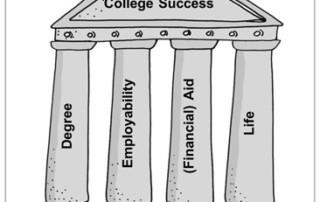
    To address this problem, we started by creating a simple mnemonic for the four dimensions of graduation success, which we called DEAL, where each letter stood for the following:DEAL

    • Degree (academic performance, on track to graduate)

    • Employability

    • (access to financial) Aid

    • Life (emotional support)

    Next, we worked with Bottom Line to create indicators for each of these four dimensions of graduation success. Students would be ranked on these indicators, using a color-coded scale where green meant “on track to graduate,” yellow meant “facing some difficulty,” and red meant “at significant risk of not graduating.”

     At the beginning of school, all students started green—presumed to be on track to graduate—and the counselor’s goal was to keep them green. As the school year progressed, counselors and other staff would regularly update student rankings in a database and tracking system that produced a scorecard for each student. Counselors then used these scorecards to determine how and with whom they should spend their time. As a result of this simple approach, Bottom Line’s counselors were finally able to focus on the students who needed the most help to graduate. 

    DEAL also helped Bottom Line identify areas where extra support was needed beyond what counselors could provide. One such area was in helping students prepare for careers after college. As a result, Bottom Line instituted a new career program. As Dave Borgal said, “DEAL highlighted that employability upon graduation mattered, which caused us to design a program to accomplish that.” 

    Because DEAL is a simple yet powerful way to align the organization around its central goals, Bottom Line uses DEAL as a key part of its formal training program for counselors. And, DEAL has been instrumental in fundraising. Mike Wasserman, Bottom Line’s former director of development who now leads the Massachusetts offices, said, “Before DEAL, we would say, ‘We help students get through college,’ and ‘We do a lot.’ Now we can show the rubric, a sample intervention, and the toolkits. Our stakeholders can more easily understand the range, scope, and nature of services we provide students.”

    With the implementation of DEAL, predicted graduation rates of Bottom Line’s students have risen to 85 percent. Process Thinking, when executed well, enables nonprofits to focus their daily activities where results will be the greatest, accelerate fulfillment of their goals, and ultimately increase their value to society.

  • How Excellent Is Your Program Evaluation?

    How Excellent Is Your Program Evaluation?

    Nonprofit program evaluation refers to the process of gathering data about a service or program an organization offers to determine its effectiveness. Nonprofits that thoroughly and strategically evaluate their programs show a commitment to the communities they serve by identifying their successes and challenges. More and more charitable donors now expect to see an evaluation plan in the programs they fund. 

    The Standards for Excellence: An Ethics and Accountability Code for the Nonprofit Sector identifies key areas of effective nonprofit management, and offers guidance on developing and implementing a successful nonprofit program evaluation plan. 

    Consider the Cost 

    A good rule of thumb is to outline your program evaluation plan as you are creating the program itself, at the very beginning of the planning stage. This allows you to include the costs of implementing your evaluation in your program’s budget, and many funders consider underwriting the evaluation costs as evidence of a commitment to delivering the highest-quality program. If your nonprofit has already engaged in delivering your program without an evaluation plan in place, don’t worry! It’s never too late to research cost-effective strategies and include them in your budget and planning session for the coming year. 

    Define Your Program 

    Nonprofits typically form to alleviate specific problems or address certain issues in society, and define mission statements that include a purpose and broad methods for achieving their goals. When drafting your program evaluation plan, be sure to begin with a comprehensive definition of your program at the beginning to establish the plan’s objectives. Move beyond the mission statement to identify the vital components of your program to help you determine an appropriate evaluation method for each one. 

    Monitoring vs. Evaluation 

    Nonprofits should be prepared to include both monitoring and evaluation procedures in their evaluation plans to ensure they are consistently and thoroughly analyzing their effectiveness. Monitoring refers to the essential, ongoing process of collecting information related to your program delivery and operations. Outlining monitoring systems early on ensure you won’t lose or miss valuable information that could be gathered during your activity and later assessed, such as how many people participated, how much time did we dedicate, how much money was spent or generated, or anything else that is important to count.
    Evaluation goes beyond monitoring. It weighs the information gathered by your monitoring systems and assesses the impact you can claim as resulting from your program. Whatever evaluation methods you use, be sure to look at how your program has changed the conditions for your targeted population or problem.

     Effectiveness vs. Efficiency 

    The key to determining program effectiveness is the identification of standards, benchmarks, or criteria against which progress or performance can be assessed. Perhaps you are evaluating the year-over-year results of an annual fundraiser, or the outcome of a program against national statistics. Be sure to include criteria in your evaluation plan that you can compare against your data to help identify specific results and areas of improvement. 

    Efficiency is determined by the ratio of outputs to inputs. Efficient programs offer satisfactory results that are achieved with an appropriate amount of dedicated resources. Paying attention to the efficiency of your program minimizes waste, expenses, and unnecessary effort. 

    Ready to learn more about creating an excellent nonprofit program evaluation plan? Members of the Standards for Excellence Institute and its Replication Partners have access to an extensive library of educational resources to help nonprofit organizations implement each area of the Standards for Excellence code. Our educational resource packet on program evaluation includes tip, tools and best practices to support your program evaluation development. Become a member and download your resources today!