

Category: Public Affairs & Public Polity

  • Nonprofits and Political Advocacy

    Nonprofits and Political Advocacy


    This is part of a special series, brought to you by the Standards for Excellence Institute, to provide nonprofit leaders with a brief nonprofit governance and management tip weekly over the course of 2020. We hope these short tips will be helpful to you and the nonprofits you serve. If you have suggestions for future topics, please forward these to acmadsen@standardsforexcellence.org.


    It’s an election year and it’s important for nonprofits to understand what they can and can’t do when it comes to political advocacy. There is a common misconception that nonprofit organizations are legally prohibited from engaging in advocacy or lobbying activities. This is entirely untrue. Nonprofits can advocate and lobby so long as they abide by federal and state regulations. In fact, nonprofits should engage in advocacy in or to represent the interests of the people they serve and “influence public policies that affect the organization’s ability to achieve its mission.” When nonprofits do engage in lobbying and advocacy, expenditures must be disclosed, paid lobbyists or staff that engage in lobbying must be properly registered with the state and Congress if necessary, and most importantly all lobbying and advocacy activities must be nonpartisan. This means that nonprofits may not endorse or imply support for or opposition to a particular candidate or contribute in any way to a political campaign. However, there are numerous ways in which nonprofits can be active during election season, from the provision of nonpartisan study, analysis, or research to the hosting of candidate forums. It is therefore crucial that nonprofits “have a written, board-approved policy on advocacy defining the process by which the organization determines positions on specific issues.”  (Standards for Excellence: An Ethics and Accountability Code for the Nonprofit Sector)


    More information is available and helpful models and sample are available in the Standards for Excellence educational resource packet, Advancing the Mission through Public Policy which outlines the benefits of advocacy and the limits on and legal requirements for nonprofit lobbying. This educational resource packet and the full series of all packets  – including sample policies, tools and model procedures to help nonprofits achieve best practices in their governance and management – can be accessed by contacting a licensed Standards for Excellence replication partner, one of the over 150 Standards for Excellence Licensed Consultants, or by becoming a member of the Standards for Excellence Institute.
     

  • IRS Advisory Committee on Tax Exempt and Governmental Entities Releases 2016 Report

    IRS Advisory Committee on Tax Exempt and Governmental Entities Releases 2016 Report

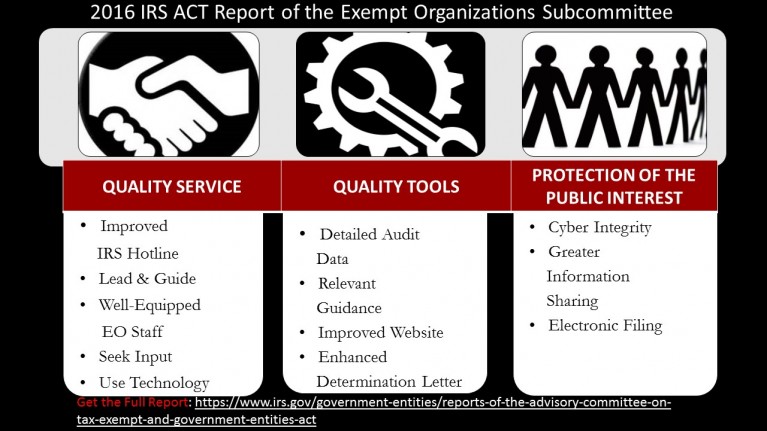
    In 2014, it was my honor to accept an appointment to the Internal Revenue Service’s Advisory Committee on Tax Exempt and Government Entities (the ACT). ACT members are appointed by the Secretary of the Treasury and advise the IRS on issues impacting tax exempt organizations and government entities. The ACT includes external stakeholders and representatives who deal with employee retirement plans; tax-exempt organizations; tax-exempt bonds; federal, state, local and Indian tribal governments. My colleagues on the ACT are exceptional individuals and I am humbled to be in their company. I serve on the Exempt Organizations subcommittee and, for the last year, have had the privilege of serving as a co-chair of the subcommittee. As part of my responsibilities, yesterday, I helped present our committee’s annual report to the Commissioner of the IRS, John Koskinen. 

    Today, it is my pleasure to share with you the 2016 report of the Exempt Organizations subcommittee of the IRS Advisory Committee on Tax Exempt and Governmental Entities. This year’s report to the Exempt Organization Leadership is titled Stewards of the Public Trust:  Long-Range Planning for the Future of the IRS and the Exempt Community. 

    The report focuses on planning for the future – big picture areas the Exempt Organizations function should consider in planning for the next two to three decades in overseeing exempt organizations. The report makes recommendations to the IRS to prepare it for the challenges and environment in overseeing and regulating exempt organizations into the future. In connection with the report, the ACT conducted extensive interviews with exempt organization leaders, practitioners, and regulators to identify challenges and gaps for the IRS regarding its oversight of and guidance to the sector. We are grateful for the input received from the interviewees. 

    We encourage you to read the full report and to share it with the members of your networks. 

    The ACT was established under the Federal Advisory Committee Act to provide an organized public forum for discussion of relevant issues affecting the tax exempt and government entities communities.

  • Sealholder Spotlight: Public Justice Center

    Sealholder Spotlight: Public Justice Center

     The Public Justice Center was founded in 1985 as a nonprofit legal advocacy organization. Since its inception the PJC has been focused on systemic change through legal services. The PJC’s efforts focus on confronting unjust laws, practices and institutions, particularly those affecting people living in poverty. The PJC takes a dynamic approach to systemic change by functioning as a legal services office as well as a policy campaign leader, and a community action partner to attack systemic problems of injustice at their roots. The Public Justice Center has been an accredited sealholder of the Standards for Excellence Institute since 2013.  Kayleigh Harper, Social Media and Marketing Intern for the Standards for Excellence Institute, got the chance to have a conversation with Director of Development Jennifer K. Pelton, CFRE about the organization and their experience as a Standards for Excellence sealholder. 

    Tell me about why the PBJ was founded and its mission. 

    The Public Justice Center was founded 30 years ago in order to fight injustice and discrimination at the root cause. We use every tool in the lawyer’s toolbox to create systemic change in areas like housing, work, health care and education. We will provide legal services help to a case if it represents a larger issue. 

    What are some services that your staff provides? 

    The common thread in all of the Public Justice Center’s work is to improve access to justice. We are providing civil legal services for low-income tenants in landlord/tenant disputes, for low-wage workers claiming wages they rightfully earned, and for homeless and foster kids seeking educational stability to name a few. We are focused on getting the right to counsel in civil cases, which is not a universally protected right in the United States.  We are also advocates for reformed policies and provide workshops to help people better understand and enforce their rights.

    How has your accreditation with Standards since 2013 benefitted your organization? 

    Well, it raises the standard! We looked into the Standards and began working on the processes of good governance long before applying. It definitely made us stronger in every area. It was like laying bricks for a strong foundation. 

    What factors brought you to Standards? 

    We had the desire to be known as the effective organization that we are. The Public Justice Center has a credible reputation as a civil legal organization. The seal expands that and declares that we are also meeting the high mark as a well-managed nonprofit organization. 

    Can you recall a recent time that you turned to the Standards for guidance? 

    One of the new requirements from Standards is for the board to be involved in planning the organization’s fundraising efforts. While we are planning the next fiscal year’s budget, the board is also planning what fundraising activities they will be doing in that coming year. This gets the board involved in not only setting goals but also encourages them to be accountable for their part, which really takes it to the next step. This is a rounder view of revenue and expense that’s really helpful. 

    Are there any recent achievements from the Public Justice Center that you’d like to highlight? 

    Yes! In the fall we released our report, Justice Diverted which can be found on our website. It’s a look at the rent court system, and a look towards how the landlord/tenant system can be reformed. We are also active members of the on Working Matters coalition, that is driving momentum behind pass new laws to Marylanders the right to earn paid sick leave which made significant progress through Maryland General Assembly this year. We are settling a decades-old law suit case regarding healthcare in the Baltimore City Detention Center. The results will improve the way that healthcare is given to the incarcerated.  More information is available about the PJC website about our work.
    In 2016, the Public Justice Center celebrates 30 years. 

    The Public Justice Center’s mission is to build a just society.  If you’d like to learn more about any of their activities, strategies or achievements or donate to the Public Justice Center, visit their website at http://www.publicjustice.org/index.cfm 

    Public Justice Center contact information: 

    1 North Charles Street, Suite 200 
    Baltimore, MD 21201 
    Telephone: (410) 625-9409 
    Fax: (410) 625-9423 

    Kayleigh Harper has been a marketing and communications intern with the Standards for Excellence Institute since January 2016. She is a junior at Towson University where she is completing a bachelor of science in Law & American Civilization. She is active in the campus community, especially in areas involving community service and volunteering.