Category: Strategic Planning

  • Communicating in a Time of Crisis

    Communicating in a Time of Crisis

    Nonprofit leaders around the country are working hard to continue to meet their important community missions in the midst of the COVID-19 crisis. With this in mind, we’ve been engaged in analysis around which aspects of the Standards for Excellence program could play a role in helping prepare a nonprofit for the turbulent and uncertain times that we are all facing. We’ve heard from nonprofit leaders that they are grateful that the Standards for Excellence program helped them to develop policies, tools, and plans that help them weather the current situation— things like comprehensive disaster plans, remote work policies, exemplary board practices, and treating donors with respect. In addition to these undoubtedly crucial areas, another key item many nonprofits are leaning on is their communication policy and their crisis communications plan.

    The Standards for Excellence: An Ethics and Accountability Code for the Nonprofit Sector, states that “A nonprofit should have written, board-approved administrative policies that are periodically reviewed by the board. At a minimum, these policies should address issues such as crisis and disaster planning, information technology, communications, and social media.”

    Implementing a crisis communications plan is an essential part of a nonprofit’s disaster preparedness efforts. In the event of a crisis, a nonprofit must be able to communicate with all stakeholders with confidence, speed, and accuracy. Protecting the positive public image of your organization and ensuring the public confidence are the main goals of your crisis communications plan.

    When a disaster or crisis arises, your organization should have a well-considered plan of action to communicate both internally and externally to all stakeholders, including the public and media. This plan identifies who will (and will not) speak on behalf of the organization, how the messages will be developed, how all staff and board members will be prepared to deal with inquiries, and how the response will be evaluated afterwards so that improvements can be made to the plan, as needed. While its most advantageous to have a crisis communications plan in place prior to the onset of a disaster, for those who have not taken that step, there is no time like the present- it can also be beneficial to develop your plan even in the midst of a crisis, particularly when the crisis appears to be lengthy and drawn out.

    In addition to your nonprofit’s communications plan addressing general topics like what systems the organization has in place for communications, social media usage/engagement, and who is responsible for selecting the communications system, a communications policy and plan will also address topics like, who is in charge of creating the crisis response(s)?  Specifically looking at crisis communications, nonprofits are encouraged to have contingency plans for major crisis that may affect your organization. Such a plan should also address preventative measures and adaptive measures (i.e. addresses measures to prevent the disaster and addresses measure to adapt to the disaster) and should address communications at all levels of the organization. 


    The Standards for Excellence educational packet on Administrative Policies includes helpful resources such as steps to developing a crisis communication plan, Sample Emergency/Crisis Communications Plan, and a Sample Communications Policy.   

    This educational resource packet and the full series of all packets – including sample policies, tools and model procedures to help nonprofits achieve best practices in their governance and management – can be accessed by contacting a licensed Standards for Excellence replication partner,– one of the over 150 Standards for Excellence  Licensed Consultants, or by becoming a member of the Standards for Excellence Institute.

    We share our sincere wishes for your continued good health and patience as we all navigate these challenging and uncertain times.


  • The One Thing Strategic Plans Forget

    The One Thing Strategic Plans Forget

    Ahh, the glorious feeling of looking at the month after next on your calendar and seeing whole empty daysHow easy it is to be magnanimous and say “yes” when asked to take on a job that isn’t due for two months. So we say “yes,” and put it on the calendar. When another someone asks us to do something in the future, we again check our calendar, see that it’s still pretty empty, and again say “yes.” This happens a few more times, and all of a sudden, the 1st week in December starts looking pretty full.

    Then as December 1 approaches, all the things we want to accomplish – long-term projects, researching new programs, reading for professional development – have to get squeezed into the unscheduled times, alongside putting out the inevitable fires that weren’t anticipated, calling our parents, and taking our kid to the doctor.

    If we’d scheduled the projects, research, and professional development, then that week wouldn’t have looked so free. We might have more carefully evaluated the request, and said ‘no’ to some of them, in order to have time to accomplish our own long-term goals.

    Almost everyone experiences this phenomenon. Dan Ariely, the behavioral economist who wrote Predictably Irrational, said:

    “Because of the ways calendars are created, people actually take more meetings than they should…  We have this satisfaction of having our calendar seem busy. We have the satisfaction of not saying ‘no’ to things. But at the same time, we’re chasing away things that are important to us for things that are unimportant.”

    When you add together the many individuals on a board or in a department, the problem gets compounded. We all know whole departments and companies that fill their time with tasks and meetings, leaving all the workers wondering if they’ve actually accomplished anything.  Similarly, nonprofit boards of directors are often left wondering why their strategic plans are never accomplished.

    A strategic plan without concrete, timed, scheduled milestones is a wish list.

    Several organizations I’ve worked with want to build a stronger board. The sequence goes like this:

    • In 2014, they stated that by the year 2017 we’ll have a stronger, more diverse board, representative of the community.
    • In 2016, they determine that by 2019 we’ll have a stronger board, representative of the community.
    • In 2018, are they going to say that by 2021 we’ll have a stronger, more diverse board, representative of the community?

    Probably. Unless they schedule the time to think through what it will take to make that shift. Then schedule the time to execute each step on that newly planned path.

    We all have the best intentions in the world to accomplish our strategic plans. Yet without putting them on the calendar, those planned goals are going to get squeezed out by the so-easily scheduled meetings, the inevitable fires, and the daily tasks that we take for granted and therefore forget that they take time.

    Tom Peters, author of In Search of Excellence and A Passion for Excellence is famous for the dictum, “What’s measured gets done.”   Back in business school, I learned this phrase as a component of Managing by Objective, which requires that these critical questions be answered:

    • What are you planning to do?
    • Who will be in charge?
    • By when will it be accomplished?

    The problem is that MBO leaves out the step of scheduling the time to actually work on it. There is still room for procrastination. Even if the objective is accomplished, nothing keeps it from being done at the last minute or squeezed into inconvenient half-hour chunks of time around scheduled meetings. The result is frenetic or burned-out workers and volunteers.

    After a recent strategic planning session, a participant approached me and said that it was one of the most intense sessions she’d ever experienced. She really felt that they had the path forward. She said the biggest difference was that they actually set completion dates for every activity, and scheduled when they would work on it.

    On the two hour drive home, I remembered Ariely’s column about personal planning. In an aha moment, I realized that while setting milestones may get activities accomplished, it’s:

    • Acknowledging that those milestones exist,
    • Keeping them in front us, and
    • Scheduling the time to accomplish them,

    that makes the plan realistic.

    Scheduling the time in which to accomplish the milestones forces you to acknowledge that accomplishing these goals will take time. It makes it a lot easier to say ‘no’ to a request that will divert your time away from the agreed-upon goal.

    What gets measured gets done. True. What gets scheduled gets done more sanely.

    If we don’t plan our own future with the things that matter to us, then we relinquish our future to the obligations of others.

  • 5 Ways to Make Changes That Stick

    5 Ways to Make Changes That Stick

    As a Standards for Excellence Institute Licensed Consultant, I sometimes see organizations crumble when faced with change. Both internal and external factors force organizations to change their way of operating and fulfilling their missions. When external changes arise, (such as changes in grants, donors, or volunteers) nonprofit organization are left to cope with limited resources. Internally, nonprofit organizations also cope with changes in technology, staff, and funding. These changes are often more traumatic than we expect they will be. Unfortunately, significant changes can bring negative consequences to organizations that are not equipped to deal with transition.
    With Standards for Excellence Institute® resources, nonprofit organizations have measures in place to adapt to significant changes, making them more equipped to function effectively as times change.
    Make sure that your organization is ready to embrace change using these 5 tips:

    1. Make a compelling, supportive argument.

    Staff members are more likely to accept a change when they can see that it is essential to the development and function of the organization. With certain changes, especially those in technology and software, it’s difficult for staff members to grasp the importance of the change. Inspire your staff to embrace the change by showing them that you just can’t function without it!

    The Standards for Excellence® Code identifies specific benchmarks and measures that provide objective standards and best practices on how a nonprofit should operate.  According to the code, “the executive is responsible for the day-to-day management and operations of the organization. The executive should be committed to the mission of the organization and have the skills necessary to manage the paid and volunteer talent, and financial resources of the organization.”

    As an executive director you can combat resistance using data that proves changes are benefiting your organization in program reach and communication effectiveness, and with stories to show the positive impact the change is making in the community you serve. Putting a face to the change will compel staff, volunteers, and community members to embrace it.

    You can show that the change is doing more than benefiting your organization’s internal function. It is helping you to fulfill your mission and serve your community more effectively.

    2. Be a role model.

    In uncertain times, we look to leaders to guide us into the unknown. Establish which key staff members are driving the change, as they will become the leaders that model the transition. If there is a change in technology, those who master the new system first will become a resource for those still catching onto it.
    Ensure that executive directors and board members show interest in the change. If the leaders of the organization do not support the change, no one else will either! You can’t compel your staff to respect something without modeling that respect yourself.

    3. Provide massive support.

    Your staff will likely adjust to the change in a variety of ways. Provide an extensive support system so that your staff doesn’t feel abandoned in the transition. Often, more support is needed than we expect, so plan on providing more support than seems required. Provide helpful resources and emotional support to guide everyone along in the process. Holding the hands of your staff through a difficult process will help everyone to emerge more equipped, comfortable, and confident in the changes that were made.

    Not everyone can admit when they are uncertain or confused with new changes. Allow extra time for adjustment, giving everyone a chance to catch up!

    4. Acknowledge fears and doubts.

    In conjunction with your established support systems, assure your staff that it is OK to feel insecure about unfamiliar territory! Shifting roles, staff rearrangement, and the redistribution of resources may leave employees feeling disconnected to their work, or useless in their new roles. Employees are especially sensitive to shifting roles and changes in staff structure. Unfortunately, colleagues may not readily respond to others’ new roles and power structures.

    To combat these emotional consequences, pay attention to the existing social structure of your organization, and comfort team members when the norm is disrupted.

    5. Plan extensively for the change.

    Break larger goals into smaller, concrete steps. With this approach, when small goals are accomplished, we can celebrate mini-victories along the way! This boosts the mood of everyone involved and sheds a positive light on the transition process.

    Additionally, predict problems before they arise. Issues with technology (problems with new software or a lack of training with new systems) and resistance from your team are very common. By acknowledging that these problems may come up, you can competently attack issues as they arise.

    Finally, create your own definition of “done.” Track your organization’s progress towards the goal by remembering your original vision, resources used, and any milestones accomplished along the way. Then, when your team reaches the end goal, you can look back and feel accomplished about everything that was completed along the journey.
    Then, establish a marker that will signify the official ending of the change. Without a specific ending point to mark the completion of the change, we lose interest and feel as if the goal is not complete. Combat this anxiety and unrest over unmet goals by establishing a finite, terminal end goal. Now, all that is left to do is celebrate the successful transition!

    Rob Levit is a Standards for Excellence® Licensed Consultant.

  • Do’s and Don’ts of a Strategic Planning Retreat

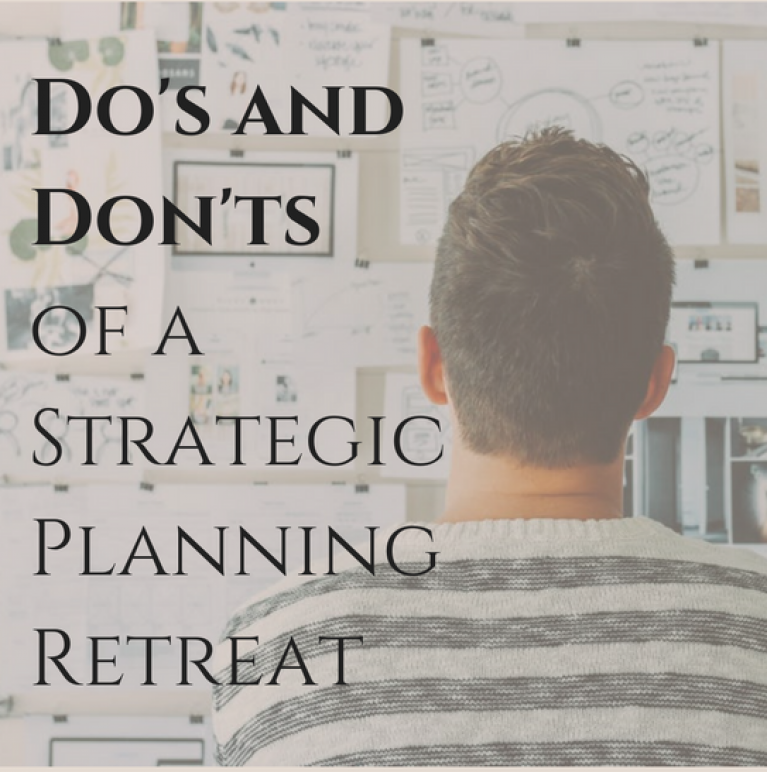
    Do’s and Don’ts of a Strategic Planning Retreat

    As an executive director, board member, and Licensed Consultant through the Standards for Excellence Institute®, I have attended and administered multiple strategic planning retreats. These getaways have the best of intentions – advancing the mission and vision of the organization, building a closer relationship between board and staff, updating the strategic plan to reflect current and emerging reality, and finding new solutions to persistent issues.
    The Standards for Excellence® Code identifies specific benchmarks and measures that provide objective standards and best practices on how a nonprofit should operate.  According to the code, “nonprofits should engage in ongoing long and short-term strategic planning activities as necessary to determine the mission of the organization, to define specific goals and objectives related to the mission, and to evaluate the success of the organization’s programs toward achieving the mission.”
    Unfortunately, many strategic planning retreats end up, at best, as a temporary exercise with little follow-up momentum and at worst, a train wreck where previously unknown organizational and board issues bubble to the surface.
    The success or failure of a strategic planning retreat can lie in the hands of the group facilitator, who must deeply understand the organization that they are guiding. Simply having the tools and resources to lead a retreat are not enough; a successful group leader is aware of the organization’s history and the personal dynamics of the group.
    Many years ago, I participated in a board retreat where the facilitator was well-meaning but basically incompetent. They unintentionally pitted two board members against the executive director, resulting in a permanent rift that led to resignations and years of rebuilding for the organization. Not good. Time, resources and energy are so often limited for retreats, so it is crucial to choose the right facilitator – one with experience, process, people skills, and intuition – to keep the agenda on track.
    All too often, strategic planning retreats go awry. However, when done right, they can be a morale boost, momentum builder and galvanizing force for a nonprofit to create a strategic plan that is accessible, visionary and most importantly, useful to the organization. Fortunately, executive directors, staff, and board can plan for an effective strategic planning retreat by taking some easy yet critical steps:

    Before the retreat…

    1. Vet the facilitator.

    Choose a Licensed Consultant from the Standards for Excellence Institute® and ask for references and previous retreat experience. It is not enough for a facilitator to have a good process or be an “expert”. They must be engaging and be able to read the energy in the room.

    Attendees can be nodding their head “yes” while meaning “no” or feel intimidated about speaking up. I see many facilitators who are clueless about the psychological and social components of a retreat. Fatigue issues and personal chemistry can affect progress, and this may go unnoticed by a facilitator barreling through a SWOT analysis or group survey.

    A good retreat leader knows three things: a) the organization he/she serves b) the essential core of the strategic planning process, and c) a little about human relations and psychology to navigate the dynamics in the room.

    2. Check expectations.

    Strategic planning retreats aim to solve complex problems and create guidelines and programs for the future. However, not everything can be accomplished in just a one- or two-day retreat. While an organization can get a good start through the retreat process, producing a strategic plan takes many hours of “offline” work. The strategic planning process goes on as team members continue planning, haggling, communicating with board members, and soul-searching.

    During the retreat…

    1. “Be the guide on the side, not the sage on the stage.”

    Facilitators should take moments to step aside, offering helpful guidelines to move the conversation forward. Setting parameters for discussion, using interesting and interactive tools that get people moving and generating ideas, and establishing mutually agreed upon rules for constructive dialogue can be helpful activities for retreats.

    2. Don’t let the loudest voice in the room dominate the discussion.

    It is critical for ALL board members and staff to speak up and be heard in the retreat. Get the conversation started by eliciting verbal or written contributions in both small and large discussion groups. All too often, the loudest voice drowns out those with valuable perspectives, leading to hurt feelings, frustration and a strategic plan that is good-looking but lacking in its full potential.

    3. Capture no more than 5 essential strategic points.

    A strategic planning session should “under-promise and over-deliver” rather than be a shopping spree of new initiatives. Focus on fewer high-quality goals, rather than an abundance of strategic directions that go unfulfilled.

    A good retreat facilitator will gently probe and push attendees to refine and define their thinking – not to lock it into place, but to clarify it. In this way, attendees can leave the retreat with stronger drive to pursue a small number of strategic points.

    4. Be aware of “saturation points.”

    Strategic planning is exhausting! Frequent breaks and interactive activities that involve movement and stations will ensure that attendees feel energized, acknowledged, and attentive.

    5. Avoid getting “into the weeds” on any one issue without a resolution or time limit.

    A strategic planning retreat should never devolve into a gripe session or focus too much on what hasn’t worked in the past. While it is critical to analyze past performance, it is human nature to become bogged down in details that happened yesterday rather than envision a future that will propel the organization forward.

    After the retreat…

    1. Organize and disseminate notes as soon as possible.

    The board chair and executive director should follow-up almost immediately with attendees to be sure that all voices were heard, that there aren’t any bruised egos, and that all that needed to be said was said. Without this step, the entire process can be derailed.

    2. Review observations with the group facilitator.

    Check in the with the facilitator for overall comments, observations on personal and group dynamics, and next steps. By analyzing the highs and lows of your group session, you can ensure the success of future retreats.

    3. Begin formulating your strategic plan.

    Assign and schedule board members with excellent writing and organizational skills to begin the difficult process of taking the strategic direction notes and formulating them into a plan.

    There are many more subtleties of a strategic planning retreat and the actual process than space allows, but I wanted to capture some of the essential “should and should-nots” of an actual retreat. Armed with this information, your organization can maximize the precious time, energy and resources of board and staff and begin the path to creating a truly useful and visionary strategic plan.
    Choosing a competent facilitator can make all the difference in your strategic planning retreat. Choose a group leader that helps you to fulfill your mission and vision, build better relationships between your staff, and strategize to create a strong future for your organization. Standards for Excellence Institute Licensed Consultants can ensure that your strategic planning session is a success. Find a Licensed Consultant near you today!

    Rob Rob Levit is a Standards for Excellence® Licensed Consultant.

  • Choose Your Own Adventure: 5 Steps to a Sustainable Strategic Plan

    Choose Your Own Adventure: 5 Steps to a Sustainable Strategic Plan

    Life is like a “choose your own adventure” book.

    With each choice we make, our adventure changes. With one big difference. In a “choose your own adventure” book, we don’t know where the decisions will lead us (unless we look at the end). But in real life, we’re pretty good at anticipating consequences – if we think of it. It’s one of the things that makes us human.
    Consider – if you look backward, you can probably describe the path that led you to live where you live, work where you work, love whom you love. Hindsight makes the path easy to see. Moment after moment you made choices – consciously or unconsciously – and each choice created the possibility of making the next choice.
    Each moment is the result of all the moments that came before. As Hildy Gottlieb wrote in The Pollyanna Principles: Each and every one of us is creating the future, every day, whether we do so consciously or not.

    We can choose our own adventure when we plan for the future.

    Not only can we anticipate the consequences of a particular choice, we can reverse engineer the future we want, imagine the steps that led us there, and consciously use those steps to build a path to that desired future. We can imagine we are standing in that future, and use imaginary hindsight to recount how it happened.

    What about Strategic Planning?

    In an organization, reverse engineering is tailor made for strategic planning. Here are the five steps:
    1. Gather all the people who have a stake in your future – board, staff, volunteers, clients, supporters, funders, government – and envision the future.

    • If we are 100% successful in whatever it is we decide to do, what will be different?
    • For whom? What does that future look like? Who will be affected?

    THIS is the inspiration. By envisioning the future, you inspire each member of the board, staff and community to make it a reality. What will be different because YOU exist?

    Asking many people who will be affected reminds us that whatever we do is being done by – and affecting – people: clients, frontline staff, administration, community, donors, board, neighbors. This is key to the success of the plan. Think about how difficult change is for some people. It’s often because the people who were planning didn’t include and get buy-in from the different people who would be affected.
    2. Consider what needs to be in place for that future to be a reality.

    • What do each of these ‘whoms’ need to know, believe, have, for you to achieve this success?
    • What needs to be in place for this plan to be successful?

    Some of these are beliefs, e.g., staff and board need to believe this vision is possible. It might be knowledge, for example, staff need to know how to do the job – which itself leads to realizing that the staff will need training. It might be feelings, for example, the board needs to feel engaged in the process and willing to step out of their comfort zone — which leads to a need for board guidance. It may be legislation, like appropriate laws or appropriations, which may mean the board needs to advocate. It may be tangible things, like a building in which to work, or updated technology.
    3. Assess the resources you already have access to, and identify the resources that you don’t yet have.
    Unlike traditional strategic planning, where you start by considering whether what you have are strengths or weaknesses, when you start with a vision of the future, you have something to measure your resources against. You can evaluate whether your assets are really strengths. Just because you have a great music department, if you’re trying to become a STEM resource center, it’s not necessarily an asset. Framing the question about needed resources this way, you can think of missing resources as just one more step to take on the way to the end result.
    Based on our previous examples, needed resources might be time, people, faciliaties. Time for staff to be trained; time and locations for staff meetings; activists or lobbyists to advocate the legislature; a building, funds for a building, or relationships with commercial property owners.
    4. What actions do we need to take to make sure the resources are available; to ensure the things we need are in place?
    Now that we know what we need, and what we have, we can figure out what we need to do. When we start with the vision, identify what needs to be in place, and assess what we already have, then it becomes obvious what actions you need to take.
    For example, if legislation needs to change, then we know we need to research our legislators’ positions so we can effectively speak with them; we need to train our board members to be advocates; our staff needs to create materials to support our advocates’ work and a calendar that correlates with the legislative calendar.
    Finally:
    5. Individuals accept responsibility for making sure each item gets done.
    Plans without accountability – knowing who is doing what, by when – are the kinds of plans that get put on a shelf. Nice ideas, elaborate wish lists, but not truly actionable. As Tom Peters is reported to have said, What gets measured gets managed.

    Complexity and Success

    These five simple steps become more complex – and far more successful – as we identify more affected stakeholders. Including all the people who will be affected makes it far more likely that the needs of each will be taken into account, and no steps will be missed. You’ve looked at both external and internal conditions for success, with an emphasis on the people, rather than the things.

    Congratulations! You can choose your own adventure!

    What will YOUR future be?

    For more tips and thoughts on nonprofit board governance, planning and facilitation, sign up at The Detwiler Group, or email Susan Detwiler directly.
    Blog post originally posted on detwiler.com.

    Photo Credit: Credit to Sharon Fullerton Photography.