Category: Uncategorized

  • Survey Says!

    Thank you so much to everyone who completed our recent Standards for Excellence website survey! Your responses provided us with valuable insight as we work to improve your online experience. According to your responses, many of you would like our website to include:

    • A reference section of best practices and commendations organizations receive during their Standards for Excellence accreditation,
    • More clearly-defined portals for different types of visitors,
    • Prominently showcased successes of Standards for Excellence organizations for the philanthropic community,
    • A forum for members of the Standards for Excellence community to share insights,
    • A search function for Licensed Consultants, accredited and recognized organizations, and partner resources,
    • More interactive resources, such as tutorials and e-training,
    • More resources on topics concerning the nonprofit sector, such as overhead ratios, and
    • Testimonials from members of the Standards for Excellence community.

    We’ll be working to implement these enhancements to the Standards for Excellence website in 2015. If you have more ideas about engaging the Standards for Excellence online we’d love to hear them! Please let us know at slarsen@standardsforexcellenceinstitute.org.

  • Alabama’s Gadsen Times says “Training will foster pursuit of excellence”

    Read the editorial that states “we believe there is something to be learned from attending the three-day [Standards for Excellence] session…It’s sure to be a learning experience for both agency directors and their boards.”

  • A Board Exercise in Gratitude

    We are pleased to bring you this article from Susan Detwiler, Standards for Excellence Licensed Consultant. 

    Where there is no gratitude, there is no meaningful movement; human affairs become rocky, painful, coldly indifferent, unpleasant, and finally break off altogether. The social ‘machinery’ grinds along and soon seizes up.

    Margaret Visser

    Thanksgiving is an obvious time to write about being thankful, and it’s nice to have a time to stop and consider all that we have to be grateful for. We think about our friends, our family, our health.

    It’s also not such a bad time to stop and contemplate how awesome your board is, and how much they’ve contributed to the well-being of your organization.

    When was the last time you thanked your board members? They’re each making your agency a priority in their lives, giving time, talent and treasure. They could be giving it somewhere else. They could also NOT be giving. But there they are, week after week, month after month, making difficult decisionsacting as cheerleaders, supporting your work, being ambassadors for your agency.

    Each board member is the equivalent of a major donor. Whether or not the dollars are substantial, she has the capacity to make your life easier, introduce you to supporters, provoke new ideas, stabilize a situation. She should be told how much she means to you.

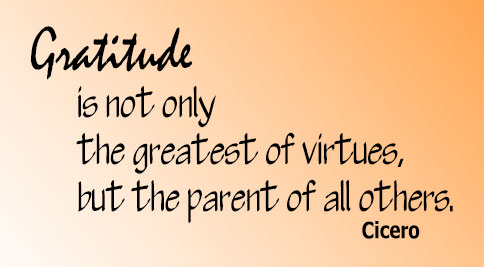
    Quote from Cicero on gratitudeHere’s a simple exercise. If you’re the Executive Director, the next time you write a thank you note to a donor, also write one to a board member. Do that until you’ve written one to every member of your board. If you’re the board president, sit down and hand write a thank you note to each board member. If you can, name a specific action for which you are grateful.

    Do you want to cultivate an attitude of gratitude within the board? At each meeting, assign one or two board members to offer a very brief statement of gratitude around the organization. It might be why they are grateful the organization exists. It might be what they appreciate about a staff member. It might be what committee they are particularly grateful to.

    In many faith traditions, there is the concept “do not withhold the wages of the laborer.” It’s obvious how that applies to staff, but the wages of a volunteer are less obvious.

    The wages of a volunteer – the wages of your board members – are the thanks he receives for his work.

    Happy ThanksgivingHappy Thanksgiving!

    The psychology of gratitude and its benefits are being researched throughout the fields of education, and migrating to the business world. Some readings on gratitude can be found at gratefulness.org.

    Visionary strategic planning is easier when board members are comfortable with each other. Exercises in gratitude are one way to facilitate this trust. For more about strategic planning and facilitating retreats, please contact Susan Detwiler at sdetwiler@detwiler.com or www.detwiler.com.

  • 5 Minute Survey on the Standards for Excellence Website

    We Value Your Input!

    As a valued individual of the nonprofit community, we would like to invite you to participate in this brief survey to let us know your thoughts about the current Standards for Excellence Institute website.

    Visit www.standardsforexcellenceinstitute.org,

    and then tell us your thoughts at

    http://fluidsurveys.com/s/SFEI-WebsiteSurvey/

    Your anonymous answers will help us to improve our website and your user-experience.

  • 6 Best Practices: Is Your Nonprofit Staff Training Effective?

    Hire for passion and intensity; there is training for everything else.
    – 
    Nolan Bushnell, technology pioneer
    Rebecca Wyatt of Salsa Labs recently wrote a blog about staff traingin at nonprofits.

  • Congratulations To Our November Organizations!

    standards_colorseal.r_transp

    The Standards for Excellence Institute would like to congratulate several organizations who recently earned or renewed their accreditation under the Standards for Excellence: An Ethics and Accountability Code for the Nonprofit Sector:

  • The One Thing Strategic Plans Forget

    We are pleased to bring you this article from Susan Detwiler, Standards for Excellence Licensed Consultant. 

    calendar delete

    Ahh, the glorious feeling of looking at the month after next on your calendar and seeing whole empty days. How easy it is to be magnanimous and say “yes” when asked to take on a job that isn’t due for two mcalendar deleteonths. So we say “yes,” and put it on the calendar. When another someone asks us to do something in the future, we again check our calendar, see that it’s still pretty empty, and again say “yes.” This happens a few more times, and all of a sudden, the 1st week in December starts looking pretty full.

    Then as December 1 approaches, all the things we want to accomplishlong term projects, researching new programs, reading for professional developmenthave to get squeezed into the unscheduled times, alongside putting out the inevitable fires that weren’t anticipated, calling our parents, and taking our kid to the doctor.

    If we’d scheduled the projects, research and professional development, then that week wouldn’t have looked so free. We might have more carefully evaluated the request, and said ‘no’ to some of them, in order to have time to accomplish our own long term goals.

    Almost everyone experiences this phenomenon. Dan Ariely, the behavioral economist who wrote Predictably Irrational, found it so common that he created the mobile app Timeful to help manage making time for the important things in life and work. In Ariely’s words,

    Mixed up dates

    “Because of the ways calendars are created, people actually take more meetings than they should…  We have this satisfaction of having our calendar seem busy. We have the satisfaction of not saying ‘no’ to things. But at the same time, we’re chasing away things that are important to us for things that are unimportant.”

    When you add together the many individuals on a board or in a department, the problem gets compounded. We all know whole departments and companies that fill their time with tasks and meetings, leaving all the workers wondering if they’ve actually accomplished anything.  Similarly, nonprofit boards of directors are often left wondering why their strategic plans are never accomplished.

    A strategic plan without concrete, timed, scheduled milestones is a wish list.

    Several organizations I’ve worked with want to build a stronger board. The sequence goes like this:calendar deleteIn 2012, they stated that by the year 2015 we’ll have a stronger, more diverse board, representative of the community.

    In 2014, they determine that by 2017 we’ll have a stronger board, representative of the community.

    In 2016, are they going to say that by 2019 we’ll have a stronger, more diverse board, representative of the community?

    Probably. Unless they schedule the time to think through what it will take to make that shift. Thenschedule the time to execute each step on that newly planned path.

    We all have the best intentions in the world to accomplish our strategic plans. Yet without putting them on the calendar, those planned goals are going to get squeezed out by the so-easily scheduled meetings, the inevitable fires, and the daily tasks that we take for granted and therefore forget that they take time.

    Tom Peters, author of In Search of Excellence and A Passion for Excellence is famous for the dictum, “What’s measured gets done.”   Back in business school, I learned this phrase as a component of Managing by Objective or MBO, which requires that these critical questions be answered:

    What are you planning to do?

    Who will be in charge?

    By when will it be accomplished?

    The problem is that MBO leaves out the step of scheduling the time to actually work on it. There is still room for procrastination. Even if the objective is accomplished, nothing keeps it from being done at the last minute or squeezed into inconvenient half-hour chunks of time around scheduled meetings. Theresult is frenetic or burned-out workers and volunteers.

    After a recent strategic planning session, a participant approached me and said that it was one of the most intense sessions she’d ever been part of. She really felt that they had the path forward. She said the biggest difference was that they actually set completion dates for every activity, and scheduled when they would work on it.

    On the two hour drive home, I remembered Ariely’s column about personal planning. In an aha moment, I realized that while setting milestones may get activities accomplished, it’s:GANTT chart
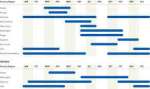
    acknowledging that those milestones exist,

    keeping them in front us, and

    scheduling the time to accomplish them,

    that makes the plan realistic.

    Scheduling the time in which to accomplish the milestones forces you to acknowledge that accomplishing these goals will take time. It makes it a lot easier to say ‘no’ to another idea that would divert your time away from the agreed upon goal.

    What gets measured gets done. True. What gets scheduled gets done more sanely.

    If we don’t plan our own future with things that matter to us, then we relinquish our future to the obligations of others.

    Will your plan be accomplished on time? Will your board and staff stay sane in the process? Let me know what you think! Post them here or you can reach me at sdetwiler@detwiler.com.

    The post was originally published by the Detwiler Group.  Susan Detwiler is a Standards for Excellence® Licensed Consultant who specializes in strategic planning, governance, board excellence and facilitation. Located in the MidAtlantic, she works with agencies across the United States. For more of Susan’s posts, or to learn more about Susan Detwiler or The Detwiler Group, please visit www.detwiler.com.

  • Boiling the Frog Fighting the Slippery Slope of Ethical Indiscretions in the Workplace

    Guest Blog by Emily C. Stumhofer, Staff Attorney, Nonprofit Risk Management Center, Member of Maryland Nonprofits

    Read the original blog here.

    Reprinted with permission from the Nonprofit Risk Management Center. For more information on the Center, visit www.nonprofitrisk.org.

    You may also be interested in signing up for the Nonprofit Risk Management Center’s eNews, or encouraging your followers to do so. The link to signing up is here: http://www.nonprofitrisk.org/risk_enews.asp.

    A familiar anecdote suggests that if a frog is dropped into a pot of boiling water, he will immediately jump out, but if he is dropped into a pot of cool water that is gradually heated, he won’t perceive the danger, and will be cooked to death. Although some recent science suggests that frogs may behave differently than this anecdote suggests, it is still an apt analogy to the case of ethical lapses in the workplace. Just as the frog in cool water, a person who continues to commit ever more serious ethical transgressions may not comprehend the increasing danger until it is too late.

    Consider the following quote: “It starts out with you taking a little bit… You get comfortable with that, and before you know it, it snowballs into something big.” This quote is from Bernie Madoff, who ended up stealing more than $18 billion from his investors.

    In a recent exchange with Plan International USA’s Kitty Holt, she describes how important it is for people with power to set the “tone at the top” and make ethically correct decisions.

    “I’m sure many of us have heard hollow words about ‘doing the right thing’ followed by the very speaker of those words doing the wrong thing, or, even worse, leaders that say ‘Do what I say, not what I do.’ Accompanying Enron’s 64-page Code of Ethics is a statement from the late CEO Ken Lay, which noted ‘We (Enron employees) are responsible for conducting the business affairs of the Company in accordance with all applicable laws and in a moral and honest manner.’ Unfortunately, Enron’s collapse was due to their not following that simple paragraph.”

    We’ve all heard the stories of corrupt politicians and people who take advantage of the power they have by making improper or illegal decisions on how to use it. The conviction of former Virginia governor Bob McDonnell is the latest example of what can happen over time when a person relaxes his ethical standards and no one steps in early to correct those transgressions.

    As a society, we often find ourselves pointing at situations like this, and wondering how someone can do something that is clearly so wrong, and in many cases, illegal. In some cases, however, instead of a single unethical decision, perhaps the real story was that lax ethical habits and behaviors led to increasingly wrong action and eventually the career-ending downfall.

    Imagine you’re at the office thinking about all the things that you need to get done. You glance over at the corner, at a huge stack of brand-new binders for filing projects at work. It would be so easy to just take an extra one home for your son’s school project. You really don’t have time to stop by the office supply store on the way home. And anyway, it’s only one binder, and it’s only this one time.

    Most of us would consider the above and think, “Well, that’s not a big deal.” But isn’t it?

    A few months ago, The Journal of Applied Psychology published a report based on studies from several universities around the country entitled “The Slippery Slope: How Small Ethical Transgressions Pave the Way for Larger Future Transgressions.” The authors of the study outline several important findings. First, overtime as people are able to rationalize small ethical indiscretions, it becomes easier to justify larger indiscretions. Thus, when faced with smaller but growing dilemmas over time, people are likely to make unethical decisions. However, when there is a large abrupt dilemma (versus a slowly increasing dilemma), the person facing it is more likely to make an ethical decision.

    The research suggests that habitual small transgressions can grow overtime into an ability to justify ever larger and more serious ethical transgressions. So how can risk leaders prevent these transgressions from ever happening in the first place?

    Showing Others the Path to What’s Right
    -Inspire a prevention focus in your workforce – By clearly outlining standards and ethical pitfalls through written policies and setting an example, an employer can reduce self-justifying behavior for small ethical transgressions. For example, by outlining the consequences of taking binders home for personal use, the ability for an employee to creatively rationalize the decision is minimized. Having a prevention focus can enable employees to check themselves and correct minor transgressions as they occur.

    -Incorporate ethical language into all parts of the organization’s culture – By embedding an ethical focus and commitment into your organization’s mission, policies, and procedures, you can create a culture where doing the right thing is part of every decision made by staff in the organization. One of the Center’s clients tethers all decisions to whether the decision is in the best interests of the vulnerable children they serve.

    -Be vigilant and resolve to address minor ethical offenses – If you are attentive to even minor ethical infractions, and address them in a timely manner, you can prevent the downward slide on ethic’s slippery slope. Also, if employees are aware that a co-worker has been called on a transgression, they might be less likely to rationalize their own ethical lapses. Remember that accountability simply means doing the things you say you are going to do.

    To explore the topic of ethics issues in the workplace in greater depth, plan to attend Ethics and Risk Management: Practical Dilemmas and Proven Strategies, featuring Jonathan T. Howe, Howe & Hutton, Ltd., and Daniel C. Borschke, National Association of Concessionaires at the 2014 Risk Summit in Chicago. For further reading, check out the Harvard Business Review’s Ethical Breakdowns article, or the Huffington Post’s How Do You Deal with an Unethical, Productive Employee.