Category: Uncategorized

  • Become a Standards for Excellence Peer Reviewer!

    ExpertPeerReviewStamp2x200

    Volunteering as a Standards for Excellence Peer Reviewer is a truly special type of volunteer experience. Unlike more traditional volunteer roles, Peer Reviewers are trained individuals responsible for evaluating an organization’s application for compliance with the Standards for Excellence: An Ethics and Accountability Code for the Nonprofit Sector®. Using a peer review process ensures that individuals with diverse opinions and expertise in the nonprofit sector review application packages and that the outcomes will be fair and unbiased.

    This volunteer opportunity offers many benefits:

    • Contribute to strengthening ethics and accountability in the nonprofit sector
    • Network with other nonprofit management professionals
    • Access professional development for your analytical and assessment skills
    • Receive complimentary registration to Standards for Excellence-related training programs

    Peer Reviewer Job Description

    Volunteers are encouraged to promote their peer review experience on their resumes and professional networks as a compliment to their professional experience in the nonprofit sector. If you are interested in this opportunity, please complete the online application. If you have any questions, please contact Susan Larsen at 443-438-2323.

  • Congratulations To Our May/June Organizations!

    SFXonly_seal2011

    The Standards for Excellence Institute would like to congratulate several organizations who recently earned or renewed their accreditation under Standards for Excellence: An Ethics and Accountability Code for the Nonprofit Sector®.

  • PA’s South Central Community Action Programs, Inc. Discusses Building a Bright Future in GettysburgTimes.com

    scaap

    Megan Shreve, Executive Director of South Central Community Action Programs, Inc. (SCCAP) recently discussed her organization’s experience with the Standards for Excellence accreditation program on GettysburgTimes.com.

    “What is really, really valuable is the work, insight and improvement that took place through the process!”

    Read how SCCAP is “Building a Bright Future” here.

  • Exclusive Interview: How They Did It!

    Exclusive Interview: How They Did It!

    We are pleased to bring you this article from Susan Detwiler, Standards for Excellence Licensed Consultant.  This topic, an important issue for all nonprofits helps us to consider the importance of benchmarks in the Standards for Excellence: An Ethics and Accountability Code for the Nonprofit Sector  on board diversity which states “The board should establish a rigorous board development strategy for recruiting and selecting new members and ensuring that the board has an appropriate mix of talent, connections to the community, and diversity.”

    Moving your board toward diversity is tough. Everyone knows it has to be done; yet, as Newton’s first law of motion states, a body at rest tends to stay at rest. Inertia, the tendency of a body to resist change, is the norm. Similarly, without a push or a pull, we continue to look to our usual sources for new board members. Or worse, to satisfy ‘best practice’ requirements, we collect tokens.

    But what if the incentive is big enough to disrupt the inertia? If your board foresaw a financial crisis, all of a sudden the trustees would start looking for funds. But what external force would push a board to focus on diversity? Is there a compelling reason to really embrace diversity on a board?

    Yes. The future.

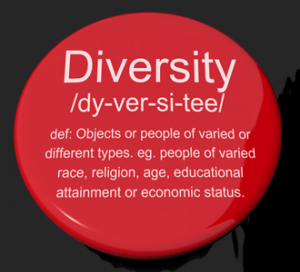
    definition of diversity As reported by David Feitler in Harvard Business Review, two different studies show that diverse groups are more likely to foster innovation. Prof. Lee Fleming and his colleagues at Stanford University found that “higher-valued industrial innovation…is more likely to arise when diverse teams are assembled of people with deep subject matter expertise in their areas.” Prof. Ben Jones and colleagues at Kellogg Business School of Northwestern University found that “the most influential [research] papers…exhibited an intrusion of interdisciplinary information” and “groups were more likely to foster these intrusions than solo researchers.”

    Surprisingly, it’s not a great leap to go from research and industrial innovation to nonprofit boards; even in the nonprofit sector, research supports the idea that greater diversity promotes greater organization success.

    Of course, research is great, but if you want to hear a real world example, I can attest to the excitement that comes from having a diverse board. Meeting with the board of a regional theater group, I showed them a headline from five years in the future. “Exclusive interview: Theatre Group tells how they did it!”

    Their assignment? For the next ten minutes, write down what amazing things the organization had accomplished that prompted this headline. What activities or initiatives did you take that made it possible? How did you do it? Whom did you collaborate with? What did it do for the community?

    When we regrouped, the stories started emerging. But instead of centering on what the organization was currently doing, each individAbstract Artual brought her own vision of what the organization could become. One focused on the what the competedcapital campaign would make possible. One added the idea that theireducation programs became a template for programs across the country. Another focused on building the writers’ workshops. Another focused oncollaboration with a number of other community arts organizations. As each idea was presented, conversation grew more animated, as each added details from their own backgrounds.

    Because of the diversity in age, experience, life stage, ethnicity, and socioeconomic status, they built a rich picture of the future that no single one of them could have imagined. The stories they created together are forming the basis for a vision toward which they’ll work.

    This same exercise, in a much less diverse group, produced stories that were less visionary.  Group members were almost all of the same ethnicity, age range and socio-economic level.  They built on each others’ ideas, but with incremental steps in the same direction.  The difference between the two groups was evident.

    We tell people to think outside the box, but it’s not easy.  We are bound by our own experience.  Yet when your board is filled with people who naturally come from other backgrounds, the scope of imagination is enlarged by this rich diversity.

    Diversity isn’t a box to check on a grant application, or an ‘ought to have.  Diversity of experience and thought is vital to the future of your organization.

    This post was originally published by the Detwiler Group.  Susan Detwiler is a Standards for Excellence® Licensed Consultant who specializes in strategic planning, governance, board excellence and facilitation. Located in the MidAtlantic, she works with agencies across the United States. Have some thoughts to share on this subject?  Get in touch with her at sdetwiler@detwiler.com. 

  • Keeping the Focus on the Mission

    Keeping the Focus on the Mission

    We’re pleased to bring you this guest blog post from Maribel Torres-Pinero, CPA, CEO & Director of Client Accounting Services at Lumix CPAs and Advisors.  Maribel is a Standards for Excellence Peer Reviewer.  

    You start with the mission – Point A.  This is your intent.  You want to achieve the objectives – Point B which is stated in your mission.  This is your goal.  You then create your annual report, which is a way of showcasing your accomplishments.  The fundamental message of this report is demonstrate how well you’ve connected the dots.  So why did your annual report miss point B?

    Many organizations report on accomplishments that do not address their stated mission or there is no clear and logical connection between their intent and their achievements.  Some organizations measure activities instead of results. I suspect that many find themselves confronted with having to report their accomplishments, and at the time, come up with the best available data that somehow measures what they’ve done.  This is a last-minute exercise at displaying such a vital aspect of your organization.  I view this as a lack of proper planning at the time you set your mission and improper mapping of those essential points that align your intent with your accomplishments.

    Your mission should be as specific as possible, stating a narrowly focused intent.  You can have a short-term mission and revise as you grow and are able to tackle broader issues.  A laser beam intent should be one that can be translated to a specific target by a specific date.  From the perspective of your mission, you should be aiming directly at your accomplishments. There it is: Point A to Point B.

    delete

    However, getting from Point A to Point B is not necessarily a direct route.  Along the way, you should be hitting the following points that will keep you on track:

    1. What specifically will I accomplish?  State your accomplishments now as if you were writing it in your annual report.  State accomplishments based on how you have affected your constituents, not based on your activities.How will I measure these accomplishments?  It is crucial at this time to set up a system of measurements or metrics that include a base line, questionnaires, follow up calls or visits and other proactive methods of obtaining data.
    2. Strategic plan: This plan, regardless of how simple or complex, or whether it is short term or long term, should be aligned with your stated intent and should have measurements incorporated to each strategic objective.  This document should faithfully mirror your mission, but if it does not have clearly defined measurements that document real accomplishments, you may have created an instant disconnect from your mission.
    1. Annual budgets: A budget is a plan for financial activity and results of operations.  This plan should be aligned with your strategic plan, addressing each strategic objective.  If you have more than one program, create a budget by program, then make sure the planned expenses and operational results are consistent with your strategic objective. The planned use of your organization funds should have a clear connection to achieving the intended results.
    1. Faithfully monitor the system of accumulating data on your accomplishments.  This system is as important as your accounting system, and modern technology allows us to accumulate this data in real time with your accounting data.  You should have access to the data and review it at least monthly, if not more frequently.  Any negative trends or indication that you will not meet your target should be addressed proactively.  If feasible, each program should have its own set of measurements and targets.
    1. Quarterly budget to actual reports. The Board should review these reports and understand any deviations from the plan, particularly for each individual program.  Ask the question, “How does this result affect our targeted accomplishments?”
    1. Quarterly dashboard reports.  These reports should report on preliminary accomplishments against the yearly target and describe how these are measured.  Ask the question, “Are we on target and if not, how do we shift to meet or exceed our target?”

    At any stage of your organization’s life, it’s worth taking a few steps back to ensure that your mission is properly aligned with your actions to produce the desired results, measured in objective accomplishments to those you serve.

  • Dear Nonprofit Board President…By Susan Detwiler

    We’re pleased to bring you this guest blog post from Susan Detwiler of The Detwiler Group.  Susan is a Standards for Excellence Licensed Consultant.  Standards for Excellence Licensed Consultants are an elite group of independent consultants that have been selected by the Standards for Excellence Institute and have received extensive training in using the Standards for Excellence code and program materials for the advancement of their work and the nonprofits and other institutions with whom they work.  To find a Licensed Consultant in your area, check out the online listing of Licensed Consultants.  For more information on applying to become a Licensed Consultant, click here for application information (The deadline for the Class of 2014 is July 8, 2014). 

    Dear Nonprofit Board President,

    Your board members need to hear this. In person. From you.  

    Thank you for all the time and wisdom you’ve been contributing to our organization.  We have a firm foundation now, with a great executive at the helm.  

    Our clients rely on us to change their lives. You’ve heard their stories; and I’ve heard how passionate you are about what we do.  

    Every time we’ve invested in making our dreams happen, we’ve had a great return on that investment. We invested time and energy into finding a path out of debt. We invested time and energy into finding our new executive.  

    And in the last year, we’ve made great plans for the future.   Now we have to make those plans a reality. When you joined the board, you made a commitment to invest in our future.

    It’s time to fulfill that commitment so we can start the new year knowing we can make those goals come true.  

    Please join me in making this organization, that I know you passionately love, your top philanthropic priority.  

    You have a vital responsibility to your agency (big or small!) to take your job to effectively lead your fellow board members seriously. As the President, you lead. Your words carry weight.   If your board members think the only reason for 100% participation is so other funders will give to you, then you need to rethink who’s on your board.   Donors give money. Volunteers give time. Board members do both.  

    If you’d like to hear more about inspiring your board members  – please get in touch. I’d love to hear from you. Susan [link to sdetwiler@detwiler.com]   The post was originally published by the Detwiler Group.  Susan Detwiler is a Standards for Excellence® Licensed Consultant who specializes in strategic planning, governance, board excellence and facilitation. Located in the MidAtlantic, she works with agencies across the United States. Have some thoughts to share on this subject?  Get in touch with her at sdetwiler@detwiler.com.

  • Standards For Excellence® Institute Announces Newest Partner, The Partnership for Nonprofit Excellence

    pne_logo_4C_hi

    Baltimore, MD – The Partnership for Nonprofit Excellence, central Virginia’s go-to nonprofit capacity building hub, announced in May that it is now a Replication Partner of the Standards for Excellence Institute. There are over 1,600 nonprofit organizations in Central Virginia, and the Partnership for Nonprofit Excellence (“PNE”) wants to help each one of them remain sustainable and strengthen their community.

    Standards for Excellence is a national initiative that is designed to promote the highest standards of nonprofit governance, management, and operations. As a Replication Partner, PNE—through its Organizational Solutions program—will bring the full complement of Standards for Excellence educational resources, expertise, and programming to Central Virginia’s nonprofit community.

    “Nonprofits contribute significantly to the cultural, social and economic landscape. It is imperative that nonprofits of all sizes be effective, efficient, credible and transparent as they strive to meet critical community needs. Standards for Excellence provides the tools and templates that enable nonprofits to get a better and faster handle on their policies and practices while maintaining a focus on meeting their mission,” said Melissa Hough, President & CEO of the Partnership for Nonprofit Excellence.

    Local nonprofits of all sizes can benefit from the content-rich training, assessment tools, resource materials, and technical assistance provided by Standards for Excellence Institute. The PNE has launched a summer cohort training opportunity for local nonprofits to become early adopters of Standards for Excellence. Cohort participants will learn about and implement best practices that will enhance their ability to deliver on their missions effectively and efficiently. Topical areas that will be covered in the Standards for Excellence programming include Leadership:  Board, Staff, and Volunteers; Legal Compliance and Ethics; Resource Development; Finance and Operations; Public Awareness, Engagement, and Advocacy; and Mission, Strategy, and Evaluation. Funding for implementing the Standards for Excellence program locally has been generously provided by Altria. Additionally, cohort participants will receive a portion of their programming fees underwritten by Flashpoint Fund, a philanthropic organization focused exclusively on charitable organizations that benefit the greater Richmond area.

    “We’ve been searching for some time for a program with the comprehensive resources designed to help nonprofits better achieve sustainability. Sustainability goes beyond financial stability. It includes all of the operational aspects required to ensure strong business functionality. We are pleased that we can bring the Standards for Excellence to Central Virginia,” continued Hough.

    Darcy S. Oman, President & CEO, The Community Foundation Serving Richmond and Central Virginia, added, “Building stronger nonprofits means building stronger communities. The Community Foundation is pleased to support the PNE in offering Standards for Excellence as a comprehensive tool and management resource to promote and recognize operational excellence in the nonprofit sector.”

    PNE will begin to offer full Standards for Excellence programming in September 2014. Nonprofits in Central Virginia who are interested in learning more should go to www.orgsolutions.org or contact Jenay Barbee, Senior Manager, Organizational Solutions, PNE at (804)330-7027 ext.134 or at jbarbee@pnerichmond.org. For more information on the Standards for Excellence Institute, contact Amy Coates Madsen, Director at (410) 727‐1726 ext. 2314or atacmadsen@standardsforexcellenceinstitute.org.

    About Partnership for Nonprofit Excellence (PNE)

    The Partnership for Nonprofit Excellence is an affiliation of four programs that provide nonprofits in Central Virginia with the tools they need to improve their effectiveness and efficiency for greater impact. The four programs, Nonprofit Learning Point, ConnectVA, HandsOn Greater Richmond, and Organizational Solutions, provide a comprehensive support system so nonprofits can collaborate successfully, employ best practices, and gain access to a wealth of volunteers. By opening the door to such resources as project management expertise, communications tools, and ongoing professional development, the PNE helps nonprofits achieve their mission. The Partnership for Nonprofit Excellence was created in 2006 by The Community Foundation Serving Richmond and Central Virginia with the common goal of helping local nonprofit succeed and is now supported by multiple funders. www.pnerichmond.org.

  • The Five Missing Qualities Every Board Member MUST Have

    The Five Missing Qualities Every Board Member MUST Have

    We’re pleased to bring you this guest blog post from Susan Detwiler of The Detwiler Group.  Susan is a Standards for Excellence Licensed Consultant.  Standards for Excellence Licensed Consultants are an elite group of independent consultants that have been selected by the Standards for Excellence Institute and have received extensive training in using the Standards for Excellence code and program materials for the advancement of their work and the nonprofits and other institutions with whom they work.  To find a Licensed Consultant in your area, check out the online listing of Licensed Consultants.  For more information on applying to become a Licensed Consultant, click here for application information (The deadline for the Class of 2014 is July 8, 2014). 


    We all know that getting the right board members around the table is crucial. That’s probably why there are thousands of articles and blog posts that talk about recruiting new board members.

    Some focus on the “attribute grid” or “board matrix,” or “skills grid.”  That’s the grid that helps you identify the skills and attributes you want on your board, relative to the skills and attributes you already have on your board, and where the gaps are.  The Standards for Excellence Institute®   has one for its members, as does KPMG  and many others.

    Then there are articles that tell you to throw the infamous grid out the window, like Blue Avocado, in their article ‘Ditch Your Board Composition Matrix’. These make the very valid point that just having a lawyer on your board doesn’t mean a darn thing, if she’s a divorce lawyer and you need someone with real estate law knowledge. Or if he’s a tax accountant, and you need someone who can oversee the nonprofit accounting process.

    True confession: In the past, I have been a proponent of attribute grids, while leaning more towards the Blue Avocado model – what are we trying to accomplish? Who do we have, who do we know, who’s in our corner who can help us accomplish this? As a matter of fact, I still think that way.  But there’s a glaring omission.

    The thing is, skills don’t make a board, people do. And people have basic qualities that can make a board exceptional – or dysfunctional.  Board members who don’t respect the Executive or each other are toxic. Board members who don’t care about the cause won’t do anything to further it. Board members who live in the past – ‘tried it once, didn’t work’ – don’t consider how the world has changed. So, when using an attribute matrix in assessing your board composition and recruiting new members, be sure that it is not used in a vacuum, that it is not the only consideration.  The matrix is one tool and should only be employed when considering other important characteristics.

    And no matter what other skills a board member has, she must have these:

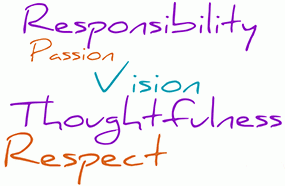
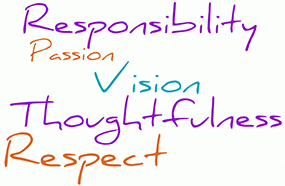
    • A passion for the cause
    • Respect for others
    • Thoughtful ability to consider issues, and to articulate those thoughts
    • A sense of responsibility for making things happen
    • The vision to think beyond today

    Passion for the cause is first and foremost. Why waste a seat on the board with someone who doesn’t care enough to really work for your success?

    Respect is probably next. I’ve experienced too many boards where board members belittle the executive or a staff member in front of the board or their peers. And I’ve experienced other boards where discussions devolve into a shouting match between two members who don’t even try to listen to each other. Time is too short and your cause is too worthy, to waste a seat on a disrespectful board member, no matter how much money they might give.

    Thoughtfulness – the ability to really consider the issue at hand and weigh its ramifications for the organization – is a rare gem. The best board members ask questions that cause you to think through your own responses as well. If a board member can’t stop to think about why he is in favor or against an initiative, then you’re allowing his personal past experiences to automatically have a vote, regardless of where those experiences have led.

    Passion, respect and thoughtfulness are great, but responsibility is where the rubber meets the road. When it comes time to act, you need board members who take responsibility for ensuring that promises are fulfilled. Whether it’s connecting the executive with the governor, reviewing the audit, or making calls to supporters, promises don’t cut it. Board members must take responsibility. As sung by Eliza Doolittle in My Fair Lady,  “Don’t talk of love, show me!

    Finally,board members must be able to envision the future and think beyond today. So many decisions affect both today and tomorrow; considering only today’s issue jeopardizes your future. Faced with an excess of income (it does happen!), do you put the funds aside for tomorrow or  spend it today? Do you invest in building infrastructure or in professional development now, so tomorrow you can serve more clients? Faced with a significant deficit, do you cut back programs or invest in development staff? Envisioning the future ramifications of today’s decisions is imperative for your future.
    5.6.14bpWordCloud✓     Passion
    ✓     Respect
    ✓     Thoughtfulness
    ✓     Responsibility
    ✓     Vision


    This is the final checklist when weighing the value of a new board member.  Without these five qualities, you can have the best real estate lawyer, the best CPA, the best HR administrator, each at odds with each other, unable to make a decision and unwilling to connect you to those who can help you change the community.

    So go ahead, consider what you want to accomplish, and seek people who are able to make it happen. But before putting them on the board, use this checklist. Ask yourself, do you want to work with this person?

     bw

    The post was originally published by the Detwiler Group.  Susan Detwiler is a Standards for Excellence® Licensed Consultant who specializes in strategic planning, governance, board excellence and facilitation. Located in the MidAtlantic, she works with agencies across the United States. Have some thoughts to share on this subject?  Get in touch with her at sdetwiler@detwiler.com.

  • How Good Is Your Executive Director?

    How Good Is Your Executive Director?

    We’re pleased to bring you this guest blog post from Susan Detwiler of The Detwiler Group.  Susan is a Standards for Excellence Licensed Consultant.  Standards for Excellence Licensed Consultants are an elite group of independent consultants that have been selected by the Standards for Excellence Institute and have received extensive training in using the Standards for Excellence code and program materials for the advancement of their work and the nonprofits and other institutions with whom they work.  To find a Licensed Consultant in your area, check out the online listing of Licensed Consultants.  For more information on applying to become a Licensed Consultant, click here for application information (The deadline for the Class of 2014 is July 8, 2014). 


    Does the quality of the Executive Director make a difference?

    You bet it does.  Or, at least in the corporate world, a great CEO seems to have an outsized impact on the strength of the corporation.

    Image

    Walter Frick, reviewing work by professors Quigley and Hambrick at Penn State and University of Georgia, makes the case that in corporate America, when business is more dynamic and less predictable, the CEO has a disproportionate effect on the success of the corporation. They looked at data spanning more than 60 years – the equivalent of 18,000 firm-years, that is, the combined years that the firms had been in existence – and found that the effect of the CEO almost doubled from 1950-2009.

    What does this mean for the nonprofit world?  Look carefully at this quote from Frick (italics mine):

    “an increase in business dynamism has amplified the impact of CEOs over time, but that effect is at its highest in companies where industry and economic constraints still limit the firm’s options.

    While I wouldn’t make one-to-one comparisons between for-profit and nonprofit organizations, you can’t deny that by its very nature, the nonprofit world is continually under economic constraints, with limited options, facing increased competition for support, higher needs, and declining resources. How well you manage these constraints is a function of the Executive Director and the Executive-Board partnership.

    One of the most important functions of a Board of Directors is to hire, evaluate and, if necessary, replace the Executive Director.  The quality of the partnership between the Executive and the board has an enormous effect on whether the board’s vision is achieved, or whether the board and Executive spend most of their time on minutiae.

    Hiring well, and putting in place a sound evaluation system based on relevant criteria, can make a huge difference in the future of your organization. And, if there is any similarity to the for-profit world, it is even more important in uncertain times.

    Consider it an investment in the future of your agency.

    For more hallmarks of transformational boards, or to find out more about achieving nonprofit Standards for Excellence®, get in touch. Let’s have a conversation.

    Susan Detwiler

    The post was originally published by the Detwiler GroupSusan Detwiler is a Standards for Excellence® Licensed Consultant who specializes in strategic planning, governance, board excellence and facilitation. Located in the MidAtlantic, she works with agencies across the United States. Have some thoughts to share on this subject?  Get in touch with her at sdetwiler@detwiler.com.

  • Sealholder Featured on Illinois Website for Achievements in Excellence

    Sealholder Featured on Illinois Website for Achievements in Excellence

    logo


    Sealholder Featured on Illinois Website for Achievements in Excellence

    DuPage Pads is proud to be one of the first nonprofits in [Illinois] to be a recipient of the Seal of Excellence by the Standards for Excellence Institute. This exemplifies DuPage Pads’ dedication to ending homelessness and desire to meet the highest standards of ethical principles.”