Category: Uncategorized

  • Maryland Nonprofits’ Standards for Excellence Forum Brought Together State’s Nonprofit Leaders

    Maryland Nonprofits’ Standards for Excellence Forum Brought Together State’s Nonprofit Leaders

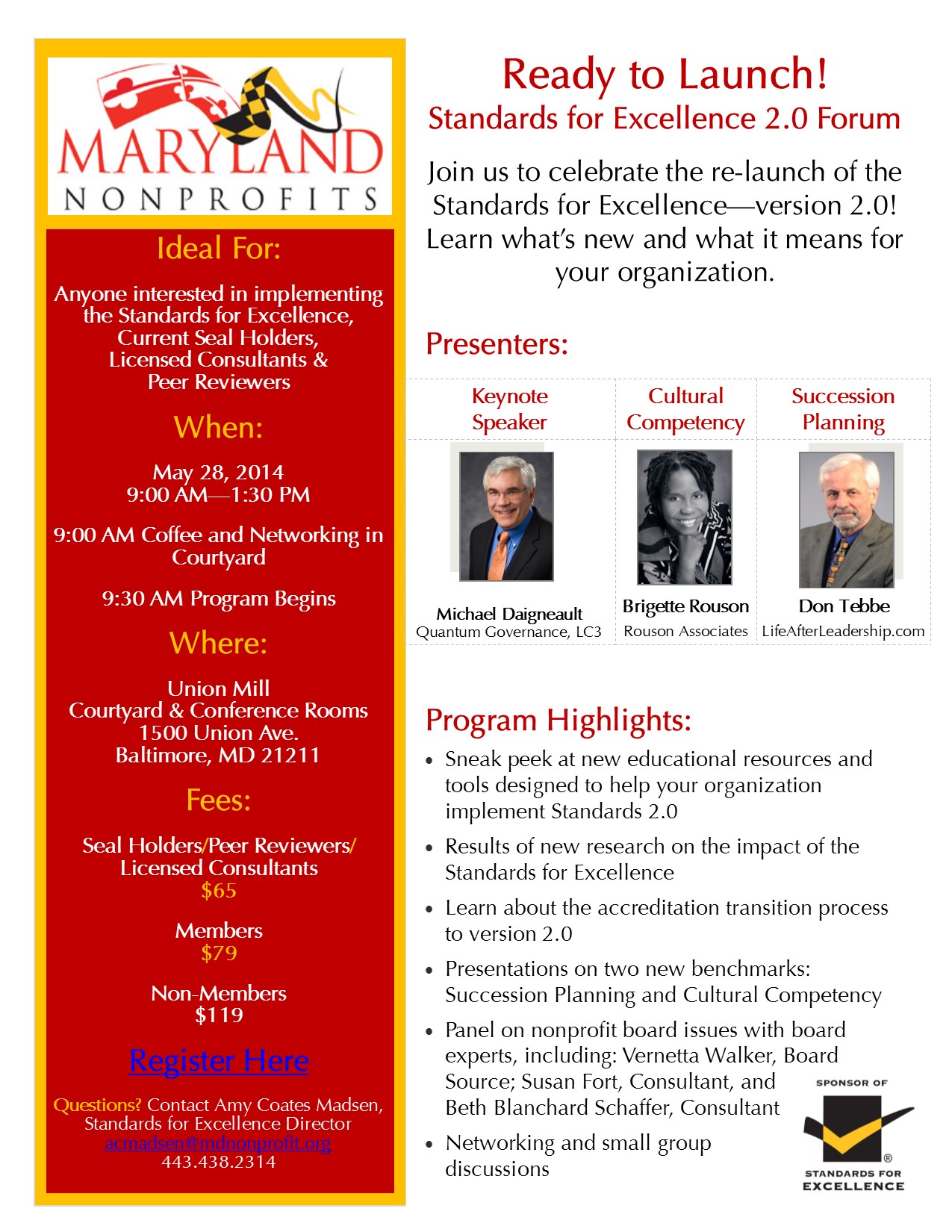
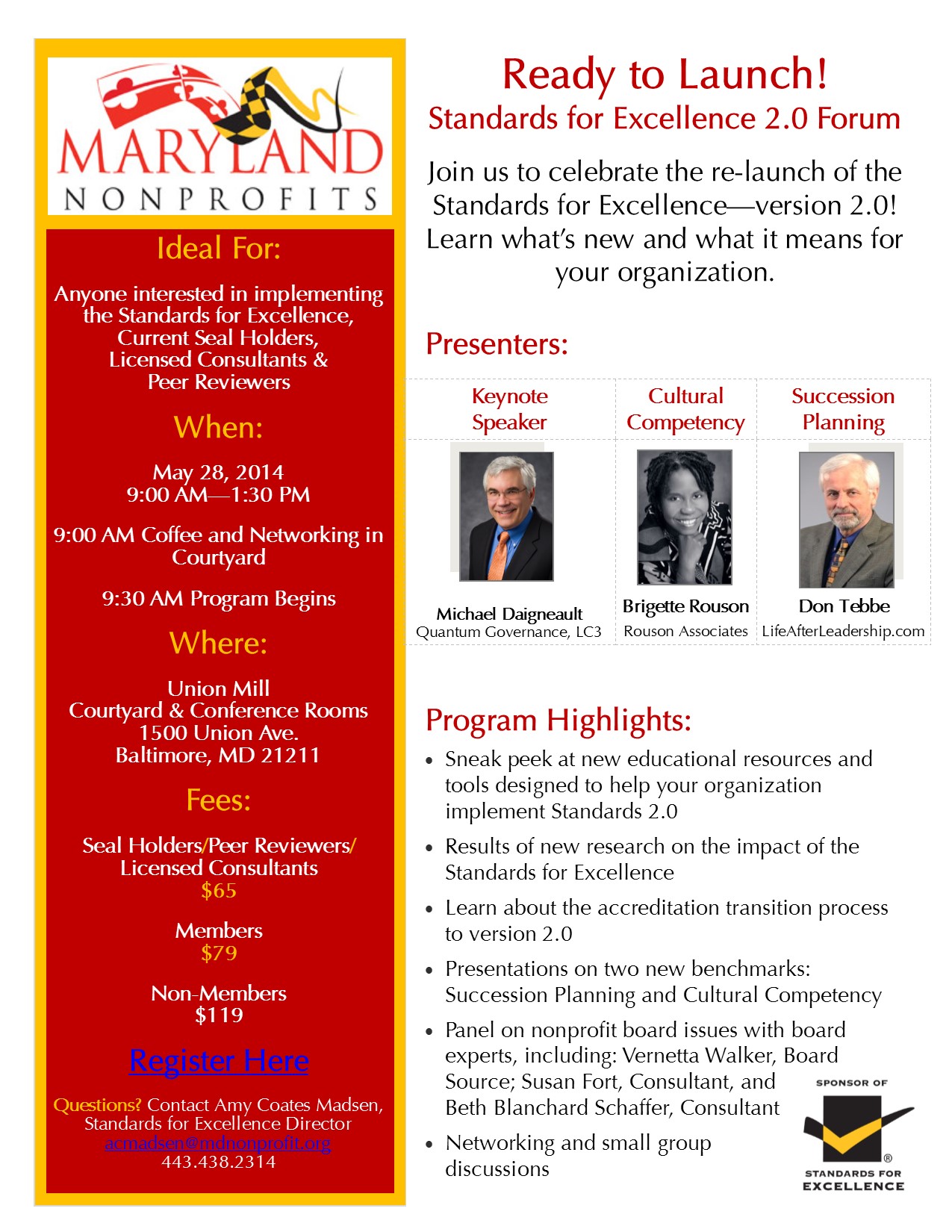
    Baltimore, MD – At the Standards for Excellence Version 2.0 Forum on May 28, over 60 representatives from Maryland’s nonprofit community gathered to celebrate the re-launch of the Institute’s signature resource, Standards for Excellence: An Ethics and Accountability Code for the Nonprofit Sector®.

    OLYMPUS DIGITAL CAMERA

    The event was held at Maryland Nonprofits’ headquarters at the Union Mill Building, 1500 Union Avenue in Baltimore. It included presentations from several nonprofit experts in the region including Michael Daigneault of Quantum Governance, LC3, Brigette Rouson of Rouson Associates, Don Tebbe of LifeAfterLeadership.com, and Vernetta Walker of BoardSource.

    Greg Cantori, President & CEO of Maryland Nonprofits, hosted and spoke at the forum. The event was also attended by executive directors of organizations accredited under the Code of Excellence, such as Hillary Lindeman of the Human Services Coalition of Prince George’s County, Dan Puskar of Association of Partners for Public Lands, and Tom Bonderenko of Moveable Feast.

    OLYMPUS DIGITAL CAMERA

    Attendees had the opportunity to network with other nonprofit professionals involved with Maryland’s Standards for Excellence program, including Licensed Consultants, volunteers, and Sealholders. After a courtyard breakfast, guests participated in a ribbon-cutting ceremony to usher in the program enhancements. The forum then offered presentations on new resources and tools developed to compliment the Code, results of comprehensive research on the impact of the Standards for Excellence program, and in-depth discussions on nonprofit topics such as succession planning and cultural competency.

    ???????????????????????????????

    Stephen H. Morgan, Executive Director of The Arc Baltimore said “Attending the Maryland Nonprofits Standards for Excellence Forum provided an exciting opportunity to learn what the new Standards will mean for nonprofits like ours that voluntarily live by the Standards for Excellence code and have earned the Seal of Excellence. It was impressive to learn about the care, effort and diligence that the task force invested in the creation of SFX 2.0 – taking attainment of SFX Accreditation to an even higher plane. We are already planning how we can incorporate the enhancements in the months and years to come.”

    ???????????????????????????????

    “The revised Standards for Excellence are reflective of the evolution of today’s nonprofit sector. The six guiding principles and 67 standards provide a guide for responsible and ethical nonprofit management and governance that demonstrate best practices at every level,” said E. Kim Rhim, Executive Director of The Training Source, Inc.

    About the Standards for Excellence Program

    The Standards for Excellence originated as a special initiative of Maryland Nonprofits in 1998 and has since expanded into a national program to help nonprofit organizations achieve the highest benchmarks of ethics and accountability in nonprofit governance, management and operations. The program has been formally adopted by twelve state, regional and national affiliate organizations, and is supported by 66 Licensed Consultants and over 100 volunteers with professional experience in nonprofit governance and administration. Since its inception, the program has accredited over 200 individual nonprofit organizations that completed a rigorous application and review process to demonstrate adherence to the Standards for Excellence: An Ethics and Accountability Code for the Nonprofit Sector.

    In 2008, BoardSource named the Standards for Excellence code as “one of the most important milestones in the field of nonprofit governance in the last 20 years.” The Institute’s program has been cited as exemplary at hearings and roundtables before the US Senate Committee on Finance and the American Society of Association Executives.

    About Maryland Nonprofits

    Maryland Nonprofits is one of the nation’s largest nonprofit associations and serves as the collective voice for over 28,000 nonprofit organizations in Maryland. Maryland Nonprofits helps develop and support a nonprofit’s ability to engage communities by educating their boards, staff, and volunteers through professional development opportunities; group savings on services; the Sector Connector newsletter; addressing government and legislative issues; and providing key information on how to start and operate a nonprofit. With over 1,400 members and 300 associate members across the state, Maryland Nonprofits promotes the Standards for Excellence Institute, a nationally-replicated accreditation program that enhances governance, management and the public’s trust in the nonprofit sector.

    If you would like to learn more about the enhancements to the Standards for Excellence program, the national taskforce, details about the accreditation process, or general information about the program, visit the Standards for Excellence page at marylandnonprofits.org, or contact Amy Coates Madsen, Standards for Excellence Program Director, at 443-438-2314 or acmadsen@mdnonprofit.org.

    Click here for a list of organizations within Maryland that are tier-recognized or fully accredited with the Standards for Excellence program.
  • Become a Standards for Excellence “Licensed Consultant”

    Become a Standards for Excellence “Licensed Consultant”

    Image


    The Standards for Excellence® Institute continues to build a national network of qualified consultants licensed to provide training, consulting, and support on the Standards for Excellence: An Ethics and Accountability Code for the Nonprofit Sector®. We are pleased to offer our 8th Licensed Consultant Workshop, to be held October 20-22, 2014 in Baltimore, Maryland. The Licensed Consultant Training is an exclusive, professional development initiative that gives independent consultants the knowledge, skills, and tools necessary to work with nonprofit organizations across the country interested in learning about, conducting self assessments, implementing change, and becoming accredited in the Standards for Excellence Program.

    A full description of the program can be found here. To apply, complete the application for the 2014 Licensed Consultant Training by July 8, 2014. Applicants will be notified of acceptance decisions by August 8, 2014.

  • Enhanced Code of Excellence Featured in Chronicle of Philanthropy

    Enhanced Code of Excellence Featured in Chronicle of Philanthropy

    The Chronicle of Philanthropy, the No. 1 news source, in print and online, for nonprofit leaders, fund raisers, grant makers, and others involved in the philanthropic enterprise, recently published a feature on the Standards for Excellence program and its enhancements.

    The Chronicle notes “a recent study [that] suggests that accreditation can make a difference in how much money charities raise. Three university business professors compared 102 fully accredited nonprofits with the same number of unaccredited organizations. The study, released last month, found that the accredited nonprofits raised a median $286,589 in the year they applied for accreditation, and that figure rose to $323,754 during the first year they were accredited. The median donation to the uncertified organizations declined over the same period.”

    “The institute has also expanded its standards on topics such as fundraising, disaster planning, and relations between executives and board members. With those additions, nonprofits must now meet 67 standards to be accredited. Groups that meet the standards, after participating in a three-year review, earn the right to display a Seal of Excellence throughout their offices and in communications with donors and other constituents.”

    Read the full article here.

  • Standards for Excellence Institute Director Discusses the Accreditation Program in Maryland on Baltimore’s ABC2 News!

    Read more here: http://www.abc2news.com/business/group-pushes-for-non-profits-to-be-registered-in-maryland

  • A Matter of Balance: Fiduciary and Strategic Thought In The Boardroom by Michael Daigneault, CEO of Quantum Governance, L3C


    A Matter of Balance: Fiduciary and Strategic Thought In The Boardroom

    By Michael G. Daigneault

    CEO of Quantum Governance, L3C


    We’re pleased to bring you this guest blog post from Michael Daigneault. Michael will serve as the keynote speaker at a special Standards for Excellence Forum, being hosted by Maryland Nonprofits in Baltimore, MD on May 28, 2014. Michael will also moderate the program’s lunchtime panel on crucial issues facing nonprofit boards of directors. Click here to register to attend this program. For more information on the Standards for Excellence Licensed Consultant Program or to request an application, click here.


    I’ve long said that being a CEO of a nonprofit organization is one of the hardest jobs in the world. I’ve had the opportunity to help lead a number of them and have found myself being challenged to find the right balance between fiduciary and strategic agenda items at my own Board meetings. Having formally observed a number of Board meetings in recent years, I have realized that this struggle is shared by many nonpofit CEOs and Board Chairs. And the proof of this difficulty goes well beyond the anecdotal. In recent assessments of nonprofitsacross the US, a surprising number of Board members reported a lack of genuine strategic dialogue at their monthly Board meetings.


    Finding the right balance between operational oversight and strategic dialogue is a real struggle. But one that is very much worth fighting. There are a number of reasons why such a balance is difficult to achieve, but I’d like to focus on one reason in particular. That is…many nonprofit leaders get “stuck” in one mode of thought. What do I mean by that?


    CEOs and Board members frequently lack a framework or vocabulary to ask the full range of questions that are necessary to effectively carry out their governance responsibilities. As such, and often by default, many nonprofit boards spend the majority of their time in the Fiduciary realm of thought. Frequently, this notion of fiduciary is paired with the word “oversight.” As nonprofits, we’re very good – and often most comfortable – with providing oversight. We are stewards of our donors’ hard earned money and we are always working hard to do more with less and less. And as such, we are traditionally strong at reviewing the financials, ensuring that we are in compliance with grant requirements, conserving the organization’s resources (wherever we can!) and even mitigating key risks.


    As we should be.


    I would imagine that your nonprofit spends a great deal of time talking about (or reporting on) fiduciary items at your board meetings. In fact, I’ve had clients who issue monthly Board packets — some 100, 200 or even 300 pages in length — and then spend the vast majority of their Board meetings simply reviewing those written reports.


    Don’t get me wrong. Fiduciary thought is absolutely necessary, and it has a vital place – especially in the nonprofit sector. The problem is that while fiduciary thought is necessary, it is certainly not sufficient if you desire a Board or governance culture operating with excellence. Yes, more is needed. But the extra effort yields significantly greater rewards.


    The “more” that is needed is to begin including Strategic discussionsinto your Board meetings on a regular basis. Please note that I am not talking about “strategic planning.” It is highly likely you already incorporate some form of strategic planning into your Board meetings once a year – or every few years – when your Board undertakes the review or revision of your strategic plan.


    I am, however, suggesting that the Board and senior management exercise their “strategic thinking muscles” on a very regular basis. If you don’t, you won’t be able to adapt to programmatic landscapes. Nor will you improve at identifying, planning and implementing high-impact strategic initiatives. (It’s a lot like my golf game. I know how to hit the ball reasonably well, but playing only once or twice a year, my game has seen no real improvement in 20 years.)


    Nonprofit Boards and senior management teams can work in constructive partnership throughout the year to create the nonprofit of the future, craft thoughtful dashboards of strategic success, find ways to innovate, experiment and learn on an ongoing basis. They can also work diligently together to scan the internal and external environments surrounding their organization, address evolving constituent needs, analyze competitive benchmarks and identify key programmatic trends long before others.


    Begin to think of “strategic planning” as an ongoing process of strategic discussions and learning opportunities throughout the year — not a discreet occurrence with a start and a finish.


    And so the question is…What’s on your next Board meeting agenda?


    ##


    Michael Daigneault serves as Chief Executive Officer at Quantum Governance, L3C and has more than 30 years of experience in the field of governance, management, strategy, planning and facilitation. Quantum Governance provides nonprofits, corporations, credit unions, associations and governmental entities with strategic, cost-effective governance, ethics and management consulting, facilitation and evaluation. We are home to more strategic governance experience than any other practice in the country. The firm is a unique L3C organization that integrates the best elements of both the for- and non-profit communities into one practice. It is a low-profit, limited-liability service organization dedicated to the public good and one of the very first such legal hybrid organizations in the United States.


  • Standards for Excellence Version 2.0 Forum

    Standards for Excellence Version 2.0 Forum

    Standards for Excellence Version 2.0 Forum

    Join us to launch Standards for Excellence Version 2.0! Hear from the experts who helped develop new benchmarks. Enjoy networking with peers.

  • Musings on the Executive Director-Board Partnership by Beth Blanchard Schaffer, Standards for Excellence Licensed Consultant

    We’re pleased to bring you this guest blog post from Beth Blanchard Schaffer. Beth is a Standards for Excellence Licensed Consultant and will be a featured panelist at special Standards for Excellence Forum, being hosted by Maryland Nonprofits in Baltimore, MD on May 28, 2014. Beth and fellow panelists, Susan Fort and Vernetta Walker (BoardSource) will tackle a host of governance related issues that are new benchmarks in the Standards for Excellence version 2.0. Click here to register to attend this program. http://www.eventbrite.com/e/standards-for-excellence-version-20-forum-tickets-11171908479?aff=eorg For more information on the Standards for Excellence Licensed Consultant Program or to request an application, click here: http://www.standardsforexcellenceinstitute.org/dnn/PartnersInExcellence/LicensedConsultants.aspx

    Musings on the ED-Board Partnership

    I’ve been thinking lately about the unique, powerful, frustrating, and wondrous relationship between an executive director and the board s/he works with. We call it a partnership and we always strive for that. What’s unique? Nowhere in business or government is there a parallel. An observer new to the sector might ask, “Let me get this straight: you have a professional, highly trained and credentialed staff who report to a group of community and business volunteers who each bring a different perspective, set of skills and personal interests to the game?!? How can that work?”

    What’s powerful? When those volunteers “get it”, i.e., they internalize the mission of the organization AND their responsibilities, they free staff to create the healthiest most nimble organization possible. When staff does an effective job of recruiting, orienting and supporting a diverse board, they unleash a force that staff alone cannot generate. And when board members not only assume their legal and fiduciary roles but they also generate winning strategies – winning things they can do – that add value to the organization. Since they serve as the organization’s ambassadors to the community at large, board members’ words and actions can carry enormous weight in heightening a positive profile and reputation with all audiences. Indeed, the most effective pitch for investments in a nonprofit will come from its volunteer leadership – in concert with staff leaders of course but front and center nonetheless.

    Why frustrating? Because equipping volunteers to lead effectively can be challenging. Their externality positions them to be acting in the public interest, not their own. But it also guarantees the language and culture of the organization initially are foreign to them. And staff members are typically immersed in day-to-day and month-to-month goals and objectives with an inward-focused perspective. And there is an inevitable tension between both partners’ desire to engage and involve board members in the organization on one hand and the need to keep directors’ sights set on the horizon – not on near-term operational questions and issues on the other.

    What’s wondrous? When an organization’s ED and board are in synch and each contributes their best to create the most effective organization, you can move mountains. And when they are not working in partnership, no amount of money or other resources are enough to sustain a healthy, nimble organization. How often do we achieve “wondrous”? One case in three? Or perhaps we should say more years than not, because the care and feeding of a good partnership can go better at some times in the evolution of an organization than others.

    This is an excellent time for the Standards for Excellence to give greater emphasis to the responsibilities that are shared by board and staff members. I look forward to exploring and encouraging how organizations can make this really work.

  • Sustainability-Building Questions Every Nonprofit CEO Should Ask by Don Tebbe

    We’re pleased to bring you this guest blog post from Don Tebbe of LifeAfterLeadership.com. Don will be a featured speaker at a special Standards for Excellence Forum, being hosted by Maryland Nonprofits in Baltimore, MD on May 28, 2014. Don will speak on sustainability building and succession planning, both new benchmark areas in the Standards for Excellence version 2.0. Click here to register to attend this program.


    Sustainability-Building Questions Every Nonprofit CEO Should Ask

    By Don Tebbe, April 24, 2014

    The goal of sustainability planning is to ensure that your organization remains a high-value community or societal asset over time. When an organization’s financial sustainability comes into question it’s often due to a financial shock of some sort. More often than not, there are other sustainability problems beneath the financial one. Building a sustainable organization requires attention to more than just the finances.

    Several years ago I conducted an extensive literature review and correlated the results with cases from our consulting practice – exemplary organizations as well as those that were struggling. What I found was that sustainability hinges on four core elements – strategy and business model, leadership, resources, and culture. Here are some high-level questions you can ask about each of these areas to build a more sustainable nonprofit.

    1. Business strategy and business model A business strategy is a top-level plan that defines your organization’s future direction. Powerful nonprofit strategies start with an impact vision, e.g., “Boost the District’s high school graduation rate to 95% by…” It should also position the organization in the market and define a future state. Do you have a strategy in place? Does it state your intended impact – how the world will be different? Does is set an inspiring direction? Does it position the organization to meet future needs and demands? Do your board and staff understand it? Are you in action – actively pursuing it? A business model is a component of strategy and it describes how your organization creates and delivers value, and how it gets paid for that value-creation process. Do you, your executive team and board have a clear understanding of the key elements of your business model? (Your target customer. The customer problem or challenge you solve. The value you deliver. How you define and differentiate the services you offer. How you reach, acquire and keep customers. How you generate revenue. Your cost structure and margins.) Where are the vulnerabilities in your business model and how can you address them? How future oriented is your business model?
    2. Leadership Good executive and board leadership are critical to sustainability. Do you have the right executive team in place to meet the current and future leadership needs of the organization? Do you have succession plans to ensure leadership continuity? Is your board an asset to the organization? If not, what changes need to be made? Is the board adequately covering the three core roles of a board: (1) shaping mission and direction, (2) ensuring leadership and resources, AND (3) monitoring and improving performance, including its own?
    3. Resources Resources are financial as well as nonfinancial. In the financial arena: Are recent trends and future outlook for revenue and expenses headed in a positive direction? Do you have sufficient financial resources to meet commitments for next few months? Are your revenue streams properly diverse and—here’s the key—will they be long lasting? Do you have a resource development strategy in place? Is there a sound link between your business model, your strategy, and your resource development plan? Your review should also include the “soft assets” (non-financial assets) that underpin sustainability. These fall into two key areas: (1) social connections and reputational capital (who you know and who you are known as); and (2) human and organizational capital (what you know and what you know how to do. This includes knowledge, systems, intellectual property, team capabilities, and leadership capacity). These are genuine assets that the organization deploys in the pursuit of its mission. They are every bit as much an asset as the financial resources, buildings, and computers. Sustainable organizations are asset builders. What are the soft assets critical to your mission? What’s the current state of each of those assets? How’s your stewardship of those assets? Is there a place to improve?
    4. Organizational Culture The final element of sustainability – often most slippery and overlooked – is organizational culture. How resilient is your culture? Do you bounce back quickly from setbacks? How agile or nimble are you? How engaged, cohesive, and energized are your board, staff, and volunteers? Could virtually anyone on the team make a compelling case for support to a potential donor?

    Organizations are complex systems and each of these elements must work together to further sustainability. A change in one area, successfully implemented, will likely require changes in other areas. For example, strengthening your business model might require developing core capabilities (resources), which might require a change in your executive team (leadership) and maybe a shift in culture to sustain the change. That might lead to an adjustment of board roles and expectations (both leadership and culture).

    This article can only touch on the topmost questions, but you can boost your organization’s sustainability by making these questions the focal point of a sustainability planning meeting with your staff and board.

    ——————-

    Don Tebbe (dontebbe.com) is a planning consultant based in Montgomery Village, Maryland. He is also the founder and editor of LifeAfterLeadership.com, a website dedicated to helping retiring leaders develop exit plans and explore life’s next chapter. He previously was a cofounder of TransitionGuides. Don is the author of Chief Executive Transitions: How to Hire and Support a Nonprofit CEO, published by BoardSource and winner of the 2009 Terry McAdam book award. He can be reached at (240) 813-4681 or Skype: dontebbe.

  • Join the Standards for Excellence Institute for a National Webinar on Standards v. 2.0 and new research findings 5/20/2014

    Ethics, Standards and Accreditation: The Impact on Nonprofit Organizations Minimize

    Join the Standards for Excellence Institute and the Alliance for Nonprofit Management for a special webinar/briefing to learn about updates and changes to the Standards for Excellence: An Ethics Code for the Nonprofit Sector®, and for a presentation of the new longitudinal research on the impact of accreditation on nonprofit organizations.

    May 20, 2014
    2:00-3:30 PM EDT
    Register here
    Cost: $69. *Alliance members receive a 50% discount on all Alliance webinars

  • Standards for Excellence® Institute Launches Enhance Code of Ethics and Accountability for the Nonprofit Sector

    For Immediate Release

    April 30, 2014

    Contacts: Amy Coates Madsen, Program Director, and Greg Cantori, President & CEO

    Phone:      410-727-1726 ext .2314

    Baltimore, MD ̶  The Standards for Excellence Institute, a nation-wide program that promotes self-regulation of ethical and accountable practices within the nonprofit sector, today is announcing comprehensive enhancements to its signature resource, Standards for Excellence: An Ethics and Accountability Code for the Nonprofit Sector®. The enhancements will be implemented into the program beginning on April 30, 2014.

    Cropped Code Cover

    A Taskforce of Experts

    In August 2012, nonprofit experts from across the country were invited to serve on a national taskforce to examine the original Standards for Excellence code and to identify opportunities for development. The review concluded in July 2013 and included an extensive environmental scan of Standards for Excellence Institute members, Seal holders, partners, as well as nonprofit professionals and members of the general public. The taskforce’s work resulted in a fully revitalized program and distinct additions to the code in areas such as sustainability planning, resource development, cultural competency, board-executive relations, and disaster planning. Members of the Standards for Excellence Institute community will have access to revised educational resources, and thorough trainings and seminars will be offered to illustrate the enhancements.

    Nonprofits Enroll in Standards for Excellence Accreditation

    The Standards for Excellence Institute is committed to raising the level of principled and responsible practices within the nonprofit sector. The Institute provides a model for organizations to implement in their operating plans so they can gain a deeper understanding of their effectiveness, improve their decision-making and minimize risks. Nonprofits that adhere to this model can become formally accredited under the Standards for Excellence codeand earn the right to display the Seal of Excellence throughout their organization.

    A recent research study conducted by faculty at Suffolk University, the University of Wisconsin-Milwaukee, and the University of Louisiana at Lafayette found that nonprofit organizations exhibit tangible benefits from receiving the Standards for Excellence accreditation. The study illustrates that the accreditation process is associated with an increase in direct public support, and that stakeholders will react positively to organizations receiving the Standards for Excellence accreditation by allocating more resources to the nonprofit. The researchers indicate that the results provide supporting evidence of the positive impacts of the comprehensive certification program offered by the Standards for Excellence Institute and its licensed partners. For more information on the research study, visit the Accreditation Page on the Standards for Excellence website at www.standardsforexcellenceinstitute.org.

    Applying for accreditation is a cooperative, three-staged process between each organization and the Standards for Excellence Institute (or one of its licensed partners). The stages include a thorough review by Institute staff, a peer review by vetted volunteer third-party professionals, and final approval by a team of volunteer nonprofit experts who serve on the Institute’s Ethics Standards Committee. Applications are reviewed with consideration of each nonprofit’s individual mission, size and resources. Applicants are provided with custom recommendations at each stage of review that are intended to strengthen the organization’s impact and qualify them as a Standards for Excellence Seal holder. Organizations also have the option to be recognized for significant accomplishments through the Institute’s tiered recognition program.

    Modernized Procedures to Earn the Seal of Excellence

    In addition to the code enhancements, the Institute has developed an online application and review system. The system is designed to streamline procedures for nonprofits applying for accreditation, as well as staff and volunteers who conduct reviews. The online application has been available through the Institute’s website since April 1, 2014.

    Why a Code of Excellence is Important

    Nonprofit organizations, as tax-exempt entities that, in many cases, are reliant on the generosity and trust of others, face sharp scrutiny to operate effectively and ethically. This scrutiny is intensified in the midst of scandals that are circulated through the media and raise concerns about accountability within the nonprofit sector. The Standards for Excellence Institute works to assist organizations in exceeding the minimum legal requirements of local, state and federal regulations to ensure they are fulfilling their obligations to those they serve, to their supporters, and to the public.

    About the Standards for Excellence Institute

    The Standards for Excellence originated as a special initiative of Maryland Nonprofits in 1998 and has since expanded into a national program to help nonprofit organizations achieve the highest benchmarks of ethics and accountability in nonprofit governance, management and operations. The program has been formally adopted by twelve state, regional and national affiliate organizations, and is supported by 66 Licensed Consultants and over 100 volunteers with professional experience in nonprofit governance and administration. Since its inception, the program has accredited over 200 individual nonprofit organizations that completed a rigorous application and review process to demonstrate adherence to the Standards for Excellence: An Ethics and Accountability Code for the Nonprofit Sector.

    In 2008, BoardSource named the Standards for Excellence code as “one of the most important milestones in the field of nonprofit governance in the last 20 years.” The Institute’s program has been cited as exemplary at hearings and roundtables before the US Senate Committee on Finance and the American Society of Association Executives.

    If you would like to learn more about the enhancements to the Standards for Excellence program, the national taskforce, details about the accreditation process, or general information about the Institute, visit www.standardsforexcellenceinstitute.org or contact Amy Coates Madsen, Director of the Standards for Excellence Institute, at 443-438-2314 or acmadsen@standardsforexcellenceinstitute.org.

    View the current list of Replication Partners and Find the Standards of Excellence in Your Area

     ###