Category: Uncategorized

  • My Top 3 Reasons for Standards for Excellence

    My Top 3 Reasons for Standards for Excellence
    by Maria Carrasquillo, MJH Consulting

    Last month, I was one of many who have been certified as a Licensed Consultant with the Standards for Excellence Institute (SFX). The three-day training was informative, intriguing, and invigorating. For many, many years, my eyes have been following this program and, finally, I find myself sitting in a room with twenty participants. As I processed my experience, I gave some serious thought to my personal reasons for participating in the program and, most of all, why now. After mulling it over, I came up with three reasons why I became a Licensed Consultant for the Standards for Excellence Institute and here they are:

    1. Strengthen Capacity Building. I wanted to be able to help organizations with strengthening their capacity. Nowadays, organizations are getting more complex and always striving to do more for the growing needs of the communities they serve with limited resources. I wanted to be a part of helping them build and strengthen.
    2. Professional Growth.  As a trainer, this is what I promote but I’m also a genuine believer of life-long learning and this was a learning opportunity I couldn’t resist.
    3. The Clock Struck Twelve.  The stars were aligned, the universe was pointing me in that direction and I didn’t resist it. As a good friend always says, ‘there are no mistakes in the universe’.


    What I didn’t anticipate was the extras that I got from participating in the training, such as an opportunity to meet like-minded professionals that have become a great resource for me (and we’re just getting started); a structure that will help me move non-profits forward; and the tools to help them get them there. Most importantly, I believe that this experience has given me a deeper understanding of the Standards for Excellence and its true purpose. For me, it’s a path for non-profits to create a ripple effect for innovation, performance management at many levels, and making a collective impact on the sector. I’m proud to be a part of that ripple.

  • Encouraging Excellence

    By: Greg Cantori, President & CEO, Maryland Nonprofits and the Standards for Excellence Institute

    Last month I had the pleasure of welcoming the 2012 class of Licensed Consultants to Baltimore for three days of extensive training in how to work with organizations seeking to implement the Standards for Excellence® code.  Planning my remarks, I decided to tell the story of my first week on the job at my previous position at the Downtown Sailing Center…

    Our summer Junior Sailing Camp was in full swing.  We had kids of all ages, races, and economic backgrounds out in the harbor learning to sail (a beautiful thing!).  I was loosely monitoring their progress from my desk – listening to the instructors’ commands via crackling radio transmission – when, all of a sudden, I heard the worst, “… body floating in the water…”  I jumped up from my desk and ran down the dock to see what was going on.  Chaos ensued: 911 was called, boats returned en masse, children disembarked, parents called, on-site counseling initiated.

    I tracked down the skipper of the boat that spotted the body and asked him to describe exactly what happened.  He said he saw the body floating face down and tacked away (turned the boat) immediately; unfortunately not before some of the children witnessed the scene.  Then he thought he saw a Water Taxi pull up and recover the body.  “You’re certain they recovered the body?” I asked, wondering if I should call 911 back.  He wasn’t, so I called the Water Taxi’s main office to be sure.

    The woman who answered the phone was befuddled – she hadn’t heard any grisly reports from her captains.  She promised to investigate and call me back.

    Five gut-wrenching minutes later I answered the phone surprised to hear her laughing…  Apparently that morning’s crop of Water Taxi patrons failed to notice when their captain involved them in the random safety drill.  The body our instructor saw was nothing more than the Water Taxi’s “Man Overboard” dummy, Oscar, who is regularly elbowed over the gunnels into the harbor.  Their lack of observation meant Oscar floated for awhile until the captain could come back to recover him.

    Hanging up the phone, I felt a rush of relief followed by the strong desire to better prepare my organization for the unknowns that tend to pop up unexpectedly…
    The point is a day in the life of any nonprofit is often hectic and sometimes chaotic.  The purpose of the Standards for Excellence program is to equip organizations with the tools and resources they need to transcend – to produce Excellence from chaos.  

    It’s our goal here at the Standards for Excellence Institute that every organization be recognized as a Tier One: Essentials organization, demonstrating that they adhere to basic legal, regulatory, and governance practices.  Our Licensed Consultants work with nonprofits here (and across the country!) to learn about, conduct self assessments, implement change, and become accredited in the Standards for Excellence program.  They are our agents of change, our disciples, our vanguard

    Thank you and congratulations to our new class of Licensed Consultants!
      Thanks also to the beautiful Pier 5 Hotel for providing accommodations for our visitors and the perfect setting from which to tell my story.

  • Nonprofit Fundraising Expenses Under Scrutiny

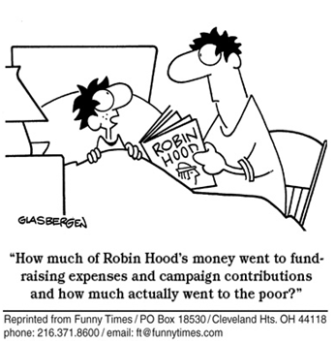
    Nonprofit Fundraising Expenses Under Scrutiny

    Image

    Cartoon Credit

    In July 2012, Sally Patterson then Interim President & CEO of the Standards for Excellence Institute and Maryland Nonprofits was interviewed by Joce Sterman of ABC2 News about nonprofit organizations that claim zero fundraising expenses. But in this Chronicle of Philanthropy article entitled, “Nonprofit Inquiry Thrusts Fundraising Costs into the Spotlight,” Suzanne Perry discusses that the current issue isn’t low cost fundraising but expenses that are too high when compared to the return to the charitable organization.

    The article highlights two charities that have been examined in a recent CNN investigative report and have received Fs from a charity-rating group. Both organizations claimed on their 990s that only 10% of money raised went to mission-related operations. Additionally, both are deeply indebted to marketing firms that helped with their fundraising efforts. The nonprofits’ public relations  departments cite the same defense against the reports and ratings: (1) High expenses and the low amount spent on operations are showing great growth, not problems, and (2) An organization must spend money to make money.

    As the Standards for Excellence: An Ethics and Accountability Code for the Nonprofit Sector states:

    A nonprofit’s fundraising costs should be reasonable over time. On average, over a five (5) year period, a nonprofit should realize revenue from fundraising and other development activities that are at least three times the amount spent on conducting them. Organizations whose fundraising ratio is less than 3:1 should demonstrate that they are making steady progress toward achieving this goal, or should be able to justify why a 3:1 ratio is not appropriate for the individual organization.

    As part of the annual budget process, the board should review the percentages of the organization’s resources spent on program, administration, and fundraising.

    Richard Steinberg, a professor of economics, philanthropic studies, and public affairs at Indiana University-Purdue University, was hired to write testimony on behalf of both organizations in 2010, and he is quoted in the Chronicle article as saying: “One cannot spend a ratio on the mission…One can only spend the money left over after the costs of the campaign have been met.”

    It is important to note that there are other considerations that factor into a nonprofit’s worth—considerations that go beyond its fundraising ratios (age of organization, its budget, the popularity of its mission, and its accounting procedures to name a few). Still, if the organizations in question here were applying for Standards for Excellence certification, it would be unlikely that they would earn the Seal.  Spending only 10% of the money raised on mission related efforts is a far cry from recommendations promulgated by the Standards for Excellence code.

  • Gifts with Strings and Friends in Low Places

    Garth Brooks sings about his less-than-reputable buddies in his popular country song, “Friends in Low Places.” It is hard to determine whose reputation appeared more sullied in Mr. Brooks’ recent headlining activities – himself or the nonprofit hospital which he sued for apparently not following his wishes.

    Recently, a jury in Oklahoma ordered the Integris Canadian Valley Hospital, to which Garth Brooks had made a $500,000 donation, to refund his contribution plus punitive damages because the medical center apparently did not comply with Mr. Brooks’ wishes to place his mother’s name on a new women’s center.

    The medical center insisted that there were no conditions on the donation and that it was initially offered as an anonymous gift. 

    Ouch. Garth Brooks looks bad.  The medical center looks bad. How could this situation have been avoided?

    The Standards for Excellence clearly states that “Nonprofits must honor the known intentions of a donor regarding the use of donated funds.”  In a situation like this, it would have been more than prudent for the recipient of the half million dollar gift to have a paper trail describing restrictions (if any) placed on the gift.  That way, any misunderstandings about restrictions or lack thereof could have been cleared up at the front end instead of in a court of law and on the front pages of the newspaper, tabloids, and television news programs.

    For more information on donor relations, you may be interested in checking out the Standards for Excellence educational resource packet, Fundraising Practices, available free of charge to members of the Standards for Excellence Institute.

  • Celebrating and Deliberating over Right versus Right Decisions

    The ethics field lost a giant last week when Rushworth Kidder, President and Founder of the Institute for Global Ethics in Rockport, Maine passed way in Naples, Florida.

    While I am sorry to say that I never personally met Rush, I was an avid reader of his publications and works and I often cited a quote from his writings.  My favorite Rushworth Kidder quote was:

    “…because nonprofits have an obligation to do the right things-often wrenching choices among competing priorities, and having to ask what choice best fits their mission-they must develop methodologies for analyzing and resolving right-versus-right dilemmas.”

    – Rushworth Kidder in Leading with Values, 2003

    The right versus right decisions that nonprofits wrestle with daily reinforces the idea that nonprofits should invest in creating tools and educating their staff and volunteers on ways to make positive ethical decisions.

    Over the course of nearly 40 years, Dr. Kidder authored 12 books, including:

    • “Good Kids, Tough Choices: How Parents Can Help Their Children Do the Right Thing” (2010);
    • “The Ethics Recession: Reflections on the Moral Underpinnings of the Current Economic Crisis” (2009);
    • “Moral Courage: Taking Action When Your Values are Put to the Test” (2005);
    • “How Good People Make Tough Choices: Resolving the Dilemmas of Ethical Living” (1995);
    • “Shared Values for a Troubled World: Conversations with Men and Women of Conscience” (1994);
    • “Heartland Ethics: Voices from the American Midwest” (as editor) (1992);
    • “In the Backyards of Our Lives and Other Essays” (1992);
    • “Global Ethics: A Quartet of Interviews” (1992);
    • “Reinventing the Future: Global Goals for the 21st Century” (1989); “An Agenda for the Twenty-First Century” (1987);
    • “E.E. Cummings: An Introduction to the Poetry” (Columbia Introductions to Twentieth-Century American Poetry) (1979); and
    • “Dylan Thomas: The Country of the Spirit” (1973).

    For more information on the life and work of Rushworth Kidder, please visit the Institute for Global Ethics tribute website.

  • Public media, ethics and integrity

    I had a pang of sadness and nostalgia recently when I read that the Helena Rubinstein Foundation would soon be closing its doors and ceasing operations.  You see, growing up in the seventies in suburban New Jersey, the Helena Rubinstein Foundation was the one and only foundation that ever crossed my conscientious because Helen Rubinstein was recognized on Channel 13, my local public television station as the underwriter of Sesame Street and other children’s shows.   I wasn’t aware of any other philanthropic organizations at that time, and have to admit that I could mimic the announcer’s voice stating that the show was underwritten by the foundation and often did so by sheer force of habit!

    This issue has been even more timely to me personally as I was recently asked to participate in a terrific program sponsored by Editorial Integrity for Public Media as a representative of the Standards for Excellence Institute.  Editorial Integrity for Public Media is a joint initiative of public broadcasting Affinity Group Coalition the National Educational Telecommunications Association, and the Station Resource Group.

    The group, which gathered local and national leaders in public radio, public television, and journalism, gathered in October in Madison, Wisconsin.  The group’s charge was to serve as a Roundtable Discussion of Emerging Recommendations for Principles, Policies and Practices. What an incredible group of experts!   In their discussions of Principles for Public Media, Developing a Code of Transparency, and the like, it struck me that the ethical topics and issues addressed by public broadcasting leaders are not unlike the ethical issues that nonprofit leaders across the board grapple with as they deliver services and strengthen our communities.  Conflicts of interest and transparency (just to mention a few!) were and continue to be issues of paramount concern.

    For nonprofit leaders interested in getting resources and assistance for their own organizations in these areas, there is no need to look any further than the Standards for Excellence Institute.  Members of the Standards for Excellence Institute have free access to educational resource packets on subjects like Conflicts of Interest and Openness with models and samples than can be used right away.  The resources can help nonprofits interested in setting up their first conflict of interest policy or interested in strengthening a policy they already have in place. The resources can also pinpoint the items that nonprofits should be sure to include in their organization’s annual report.  To access these resources, click here.

    For more information on joining the Standards for Excellence Institute, please click here.

  • When is a brother not a family member?

    The Boston Globe (Khazei OK’d hiring brother at nonprofit, 8/22/2011) reported that Democratic primary Senate candidate Alan Khazei, former president and chief executive officer of the nonprofit, Be the Change, approved a consulting contract for his brother, Lance Khazei, a Hollywood writer, for his Be the Change work on media strategy.  According to the article, Lance Khazei received $50 per hour to work on establishing a Los Angeles office. Alan Khazei, stated that the compensation was “such a small amount, $50 an hour, $2,500 a month”, totaling about $40,000 over several years, in what appears to be an attempt to minimize the situation.

    The contract with Alan Khazei’s brother was not initially reviewed and approved by the board of directors of Be the Change. In fact, as reported by the Globe, members of the board of directors only learned about the  consulting engagement when it reviewed its annual tax filing, the Form 990.

    Be the Change has a conflict of interest policy that states if officers have a financial interest “directly or indirectly, through business, investment or family,” the transaction would need to come before the board to determine whether the transaction constitutes a conflict of interest, and that individuals with a potential conflict should not be present during the review of the transaction.  As such, from all accounts, it appears that Be the Change has a standard conflict of interest policy.

    Caught in a public relations scandal, the organization argued that the brother of a chief executive should not be considered a family member under the organization’s conflict of interest policy. In a memo drafted by Be the Change’s attorney, the organization argues that the contract with Lance Khazei was not in violation of the conflict of interest policy because Alan Khazei would not benefit financially from his brother’s income, a gross misinterpretation of the intent of the policy. Most conflict of interest policies address decisions that financially impact officers or related parties, thereby intending to prevent individuals or their family members from benefiting from the decision.

    So, in effect, for this argument to hold, Be the Change is arguing that because “family” is not defined, that a brother would fall outside of the definition of a family member and therefore any financial benefit to him is outside the scope of the conflict of interest policy. Conventional wisdom is that a brother is actually a family member.  Personnel policies generally define a brother as a family member.  If you asked a person on the street if a brother would be considered a member of the family, chances are, they would answer in the affirmative.  Also, when looking at the IRS Form 990 (the informational form nonprofits file annually with the IRS), the instructions state, ““Unless specified otherwise, the family of an individual includes only his or her spouse, ancestors, brothers and sisters (whether whole or half blood), children (whether natural or adopted), grandchildren, great-grandchildren, and spouses of brothers, sisters, children, grandchildren, and great-grandchildren.”  However, under the same document’s definition of disqualified persons, and family members of disqualified persons, brother and sisters are not included:

    “For this purpose, ‘family member’ includes only the individual’s spouse, ancestors, children, grandchildren, great grandchildren, and the spouses of children, grandchildren, and great-grandchildren.”

    The Standards for Excellence: An Ethics and Accountability Code for the Nonprofit Sector states that “Nonprofits should have a written conflict of interest policy. The policy should be applicable to board members and staff, and volunteers who have significant independent decision making authority regarding the resources of the organization.  The policy should identify the types of conduct or transactions that raise conflict of interest concerns, should set forth procedures for disclosure of actual or potential conflicts, and should provide for review of individual transactions by the uninvolved members of the board of directors.”

    For more information on the Standards for Excellence educational resource packet on conflicts of interest available to members of the Standards for Excellence Institute, please click here.  For access to the members only resources, click here.

    For information on how you can join the Standards for Excellence Institute, please visit our website.
  • Fundraising Pressure

    How much pressure is too much? I am aware of churches and other faith based organizations that include a list of those families who have made financial commitments to the congregation in each week’s bulletin or order of service.  This may or may not feel like too much pressure, but surely many of us would bristle over the idea of listing all the individuals or families that haven’t made pledges to the financial health of the organization—as a kind of charitable black listing. So how do we ensure that we are asking in ways that don’t feel like arm twisting?

    The Standards for Excellence: An Ethics and Accountability Code for the Nonprofit Sector® clearly states that:

    “Solicitations should be free from undue influence
    or excessive pressure, and should be respectful of
    the needs and interests of the donor or potential
    donor.”

    What does that mean for your organization? Do you rely on high pressure tactics or extreme guilt to encourage individuals and families to donate to your organization?

    How do we ensure that our own solicitations are free from undue influence or excessive pressure?  How does this play out in our own organizations? The Standards for Excellence Institute encourages nonprofits to enact a board-approved fundraising and solicitation policy as well as a gift acceptance policy.  Such policies often provide the guidance needed by nonprofit staff members and volunteers to help ensure appropriate solicitations.

    For more information on the in depth collection of Standards for Excellence educational resource packets on fundraising topics (Fundraising Practices, Fundraising Costs, Employment of Fundraising Personnel, and Solicitation and Acceptance of Gifts) available to members of the Standards for Excellence Institute, please click here.  For access to the members only resources, click here.

    For information on joining the Standards for Excellence Institute, please visit our website.

  • Can you really deduct that as a charitable contribution?

    One of my friends once told me that she was never upset when she had to pay library fines because she supports and loves her local library.  Perhaps it is a very small price to pay for the ability to borrow such a variety of great books and not have to actually purchase these books and publications.  This is completely appropriate as long as my friend does not incorrectly assume that she can actually take a tax deduction for the library fines she’s paid.  Certainly, she can make tax deductible gifts to her local Friends of the Library organization, but she should not confuse this fee/fine for service as a ready-made tax deduction.

    There are many instances where individuals assume that a tax deduction exists even in places where it does not.  Did you know that each year, the IRS publishes a list of Dirty Dozen Tax Scams?  In this year’s 2011 edition, Don’t Fall Prey to the 2011 Dirty Dozen Tax Scams, the IRS included “Abuse of Charitable Organizations and Deductions” as one of the dozen tax scams, what the IRS deems to be the “worst of the tax scams”.  Nonprofit organizations should take care to ensure that they do not serve as a willing participant by allowing or setting up scenarios that allow its donors to misuse tax-exempt organizations and shield income or assets as a result.  The IRS Dirty Dozen Tax Scams report specifically calls out inappropriate and illegal situations where donations are overvalued and donors are even able to buy back the items at a price set by the donor! These are the “scams” that put ethical tax deductions at risk for the rest of us.

    The Standards for Excellence: An Ethics and Accountability Code® for the Nonprofit Sector specifically states that “an organization’s fundraising program should be maintained on a foundation of truthfulness and responsible stewardship.”  The Standards for Excellence code goes on to state that “nonprofits must be aware of and comply with all applicable Federal, state, and local laws. . . ” which includes “complying with laws and regulations related to fundraising.. . .

    Members of the Standards for Excellence Institute have access to more information on how you can ensure that your organization is in the best position to comply with fundraising laws and regulations, you may be interested in the Standards for Excellence educational resource packet on Fundraising Practices, which includes the helpful Standards for Excellence publication, “Disclose It: A Charitable Nonprofits’ Guide to Disclosure Requirements”

    For information on how you can join the Standards for Excellence Institute, please visit our website.

  • There’s no better time to implement the Standards for Excellence® code than right now!

    It is possible to implement Best Practices for your organization’s management and governance.

    Six months into 2011, the gyms that were so packed by well-meaning individuals with lofty New Year’s resolutions for getting in shape are now back to normal attendance levels. Many of us may also feel the year is now “old hat” and that we’ve lost the window of opportunity to start the exciting new initiatives and resolutions that are often geared toward the new year.

    I’ve had the great opportunity this past year to work quite closely with organizations applying for recognition under the Standards for Excellence voluntary accreditation program.

    Reasons for participating vary quite a bit, but they often center on themes such as: interest in propelling the organization to the next level, desire to be recognized for the good work accomplished, achieving goals associated with having strong boards, and being more attractive to donors and foundations. These organizations recognized their own need for organizational renewal and used the process as a journey to strengthen their infrastructure.

    These leading organizations had an end goal in mind. They wanted to set themselves apart from the ordinary, from the other million plus organizations in the nonprofit sector.  Groups that earn the Seal tell us that earning the Seal of Excellence has assisted their organizations in a number of different ways:

    • It’s opened doors with individual donors and foundation grants
    • For some corporate givers, the fact that the organization has earned the seal conveys “instant credibility
    • “…by going through Standards for Excellence, you make [an] investment that different parts [of the organization] strengthen and reinforce each other…
    • “…created better relationship between [certified] organization and [funder] . . . and gave . . .a sense of comfort that organization wouldn’t squander hard to come by  . . .funding
    • the standards program helped the organization get “ready for next phase – for board, ourselves and our constituency that we had come into our own as a young organization – we realized the places where we needed stronger staff, more skills, program issues  . . .it stretched us into growing up as an organization
    • For a new executive director, the Standards “was an incredibly fabulous way to learn all about the organization. . . Good structured opportunity – a real roadmap.”
    • The Standards program “opens discussions that might have been hard to have. . .”
    • For an organization that faced some tough times, [earning the seal has] “helped them get their reputation back … It was really their turning point for their organization and people now look at agency as a reputable one.”
    • “Floodgates opened up—got new foundation money in the doors
    • helped get funding from major funders”  
    • Standards program helped give an organization “instant credibility” particularly during a time when others in their service area where undergoing significant scrutiny
    • Being in [a competitive nonprofit area], nonprofits have to work twice a hard for credibility.  We had no foundation funding. [Then we earned the seal and received foundation support] . . .  it all started to fall in line – a methodology of making ourselves more credible
    • “Biggest return has been within the organization… staff feels good…board feels good.”
    • With some grant applications, organizations that have earned the Seal of Excellence are exempted from turning in certain documents

    For a full list of nonprofit organizations currently licensed to display the Seal of Excellence for their adherence to each one of the fifty-five performance measures outlined in the Standards for Excellence: An Ethics and Accountability Code for the Nonprofit Sector, click here.

    For more information on how your nonprofit organization can earn the Seal of Excellence for its governance and management practices, please visit our website or contact Standards for Excellence Institute Certification Manager Melissa Sines at msines@standardsforexcellenceinstitute.org or 410 -727-1726 ext 2337.