Category: Uncategorized

  • I’m a Nonprofit Executive Director. Can My Board Hire or Fire an Employee or Tell Me Who to Hire or Fire?

    I’m a Nonprofit Executive Director. Can My Board Hire or Fire an Employee or Tell Me Who to Hire or Fire?

    The board is responsible for hiring, evaluating, and, if needed, firing the executive director (ED). Though not illegal, the board should not be involved in hiring, evaluating or firing any other employee. This is the responsibility of the executive director and, if the board takes it on, they are eroding their ability to hold the ED accountable. Remember: the board is responsible for governance; the ED is responsible for the day-to-day operations. Keep the lines as sharply drawn as you can!

    For access to our Board and Executive Partnership Educational Resource Packet, join the Standards for Excellence Institute. Located in Maryland? Join Maryland Nonprofits for these resources and more!

    From the Standards for Excellence®: An Ethics and Accountability Code for the Nonprofit Sector. The Standards for Excellence code, developed by the Standards for Excellence Institute, includes specific benchmarks and measures that provide a structured approach to building capacity, accountability, and sustainability in your nonprofit organization. The code identifies 6 major areas of nonprofit governance and management: Mission, Strategy, and Evaluation; Leadership: Board, Staff, and Volunteers; Legal Compliance and Ethics; Finance and Operations; Resource Development and Fundraising; and Public Awareness, Engagement and Advocacy.

    The Standards for Excellence® Institute, a program of Maryland Nonprofits, provides the best possible resources to nonprofits nationwide, helping build their capacity to effectively and efficiently meet the needs of their communities. Members of the Standards for Excellence Institute gain access to an online community with an expansive library of resources and customizable templates. The Institute also offers nonprofit accreditation and recognition, a national network of consultants licensed to provide training on the Code, and professional volunteer opportunities.

  • How Do We Measure A Nonprofit’s Organizational Effort?

    How Do We Measure A Nonprofit’s Organizational Effort?

    A nonprofit should engage in organizational evaluation to ensure that all financial resources and human capital are being used toward fulfilling its mission.

    Defined, cost-effective procedures must be used for evaluating, both qualitatively and quantitatively, programs and projects in relation to mission. These procedures should address programmatic efficiency and effectiveness, outcomes for program participants, and the relationship of these outcomes to the cost of achieving them.

    Evaluations should include input from program participants and should monitor the satisfaction of participants. They should be candid and should be used by leadership to strengthen the organization’s effectiveness, and, when necessary, be used to make programmatic changes.

    As the Standards for Excellence: An Ethics and Accountability Code for the Nonprofit Sector states, “a nonprofit should engage in organizational evaluation to ensure that all financial resources and human capital are being used toward fulfilling its mission.” Nonprofit leaders should carefully consider how much effort is expended on the organization’s various program areas.

    While the Standards for Excellence Institute does not stipulate a single way for nonprofits to determine organizational effort, most nonprofits find that organizational effort can be calculated by taking into account how much financial and staff (volunteer and paid) resources are dedicated to specific programs in relation to one another and the organization’s overall program expenditures. Many organizations find that these percentages can be simply derived by reviewing budgets, financial statements and the organization’s annual informational tax return with the Internal Revenue Service, Form 990. Other organizations, particularly those with significant volunteer contributions may develop an alternative approach that places greater emphasis on the breakdown of work done by various stakeholder groups than on strictly financial criteria.

    Here’s an example of the breakdown of organizational effort for a sample nonprofit:

    Program

    Description

    Clients Served

    Percentage of Effort

    Program A


    50%

    Program B


    25%

    Program C


    20%

    Program D


    5%

    Our Program Evaluation educational resource packet explains why program evaluation is important, where evaluation fits in to the program cycle, and various approaches to evaluation. A list of resources at the end leads you to more in-depth information for designing and completing your own evaluations and/or for working with professional evaluators. For access to our Program Evaluation Educational Resource Packet and other resources, join the Standards for Excellence Institute. Located in Maryland? Join Maryland Nonprofits for these resources and more!

    From the Standards for Excellence®: An Ethics and Accountability Code for the Nonprofit Sector. The Standards for Excellence code, developed by the Standards for Excellence Institute, includes specific benchmarks and measures that provide a structured approach to building capacity, accountability, and sustainability in your nonprofit organization. The code identifies 6 major areas of nonprofit governance and management: Mission, Strategy, and Evaluation; Leadership: Board, Staff, and Volunteers; Legal Compliance and Ethics; Finance and Operations; Resource Development and Fundraising; and Public Awareness, Engagement and Advocacy.

    The Standards for Excellence® Institute, a program of Maryland Nonprofits, provides the best possible resources to nonprofits nationwide, helping build their capacity to effectively and efficiently meet the needs of their communities. Members of the Standards for Excellence Institute gain access to an online community with an expansive library of resources and customizable templates. The Institute also offers nonprofit accreditation and recognition, a national network of consultants licensed to provide training on the Code, and professional volunteer opportunities.

  • 2017 Class of Standards for Excellence Licensed Nonprofit Consultants

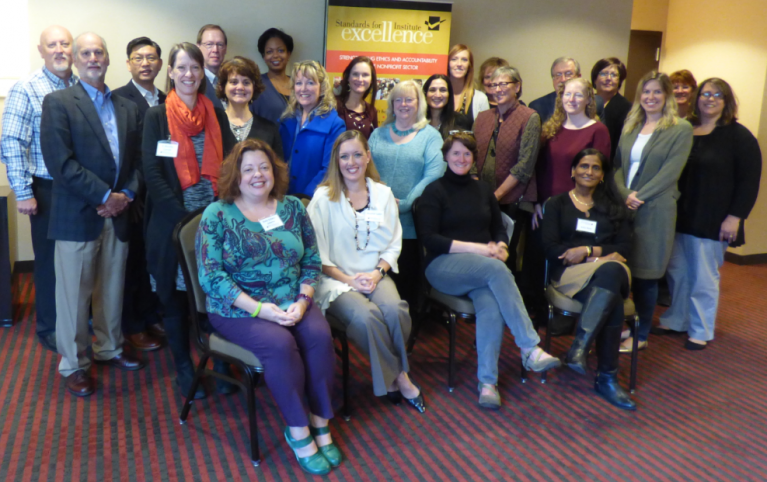
    2017 Class of Standards for Excellence Licensed Nonprofit Consultants

    The Standards for Excellence Institute, an initiative designed to help nonprofit organizations operate more ethically and accountably, announces its 2017 Class of Licensed Consultants. Class members hailing from ten states recently completed the intensive, three-day training seminar and can assist nonprofits nationwide.

    Standards for Excellence Licensed Consultants use their extensive knowledge of the multi-faceted initiative to help nonprofits strengthen their governance practices and exceed the rising demand for nonprofit accountability. They provide nonprofit organizations with organizational assessments, consulting, training, and assistance in the application process for national Standards for Excellence accreditation.

    Cyrus N. White, who traveled from St. Louis, Missouri to participate in the program, offered, “My consulting practice keeps a tight focus on assisting nonprofit boards to govern with greater confidence, skill, and intended results. I rely on the use of evidence-based practices for credibility and impact. Leaving the Standards for Excellence training, I felt confident that these proven practices and resources would enhance my capacity to benefit clients.”

    Kathy Bosin, a new Licensed Consultant from Easton, Maryland said of the training, “The content was both deep and broad, and the three days flew by. I know that I’ll be a much better consultant because of the training. I’m really glad that I invested in this opportunity.”

    “I’m excited to share the program with nonprofits to build their capacity as well as the public trust,” said Jessica Sotelo, who traveled from Blackfoot, Idaho to become a Licensed Consultant. “I believe nonprofits have the opportunity to position their organization for greater fundraising and program success through the Standards for Excellence program.”

    Heather Iliff, President and CEO of the Standards for Excellence Institute, shared that, “We are thrilled to welcome this prestigious group of individuals into our Licensed Consultant fold. Nonprofits around the country can count on these great professionals to help them implement these proven best practices in nonprofit management and governance.”

    The Licensed Consultant Program has grown each year since its inception in 2006. A searchable directory of consultants can be found on the Institute’s website.

    Here are the most recent Licensed Consultants:

    Kathy Bosin, Easton, MD Allison Brody, Williamsburg, VA E. Brooke Carroll, Gaithersburg, MD Asha Clark, Rockville, MD Debbie DiVirgilio, Elkton, MD Shelly Gardeniers, Edgewater, MD Allison Albert Guercio, Baltimore, MD* Barbara Huston, Pasadena, MD Kaaryn Keller, Baltimore, MD Louise Koonce, Wilmington, DE Sung Kwon, Silver Spring, MD Heather Lalor, Annapolis, MD Heather Lamey, Anniston, AL Gerald Meck, Lititz, PA Susan Kate Moss, Memphis, TN* Kathleen Prasser, Hanover, MD Charlotte Rich, Arnold, MD Kim Righi, Galena, MD Kate Scherr-Adams, Baltimore, MD* Jessica Sotelo, Blackfoot, ID Taylor Strange, Washington, DC* Thaddeus Toal, Annapolis, MD Cyrus White, Wildwood, MO Jerry Wright, Oklahoma City, OK*

    *Licensed through a Standards for Excellence Institute Replication Partner.

    The Standards for Excellence Institute will offer the next Licensed Consultant program in the fall of 2018.  For information on the Licensed Consultant program, visit standardsforexcellence.org/become-a-licensed-consultant.

    The Institute, an operating division of Maryland Nonprofits, uses the Standards for Excellence program as its vehicle for effective change. The Standards for Excellence program works to help nonprofit organizations act ethically and accountably in their management and governance, while enhancing the public’s trust in the nonprofit sector.

  • 5 Ways to Make Changes That Stick

    5 Ways to Make Changes That Stick

    As a Standards for Excellence Institute Licensed Consultant, I sometimes see organizations crumble when faced with change. Both internal and external factors force organizations to change their way of operating and fulfilling their missions. When external changes arise, (such as changes in grants, donors, or volunteers) nonprofit organization are left to cope with limited resources. Internally, nonprofit organizations also cope with changes in technology, staff, and funding. These changes are often more traumatic than we expect they will be. Unfortunately, significant changes can bring negative consequences to organizations that are not equipped to deal with transition.
    With Standards for Excellence Institute® resources, nonprofit organizations have measures in place to adapt to significant changes, making them more equipped to function effectively as times change.
    Make sure that your organization is ready to embrace change using these 5 tips:

    1. Make a compelling, supportive argument.

    Staff members are more likely to accept a change when they can see that it is essential to the development and function of the organization. With certain changes, especially those in technology and software, it’s difficult for staff members to grasp the importance of the change. Inspire your staff to embrace the change by showing them that you just can’t function without it!

    The Standards for Excellence® Code identifies specific benchmarks and measures that provide objective standards and best practices on how a nonprofit should operate.  According to the code, “the executive is responsible for the day-to-day management and operations of the organization. The executive should be committed to the mission of the organization and have the skills necessary to manage the paid and volunteer talent, and financial resources of the organization.”

    As an executive director you can combat resistance using data that proves changes are benefiting your organization in program reach and communication effectiveness, and with stories to show the positive impact the change is making in the community you serve. Putting a face to the change will compel staff, volunteers, and community members to embrace it.

    You can show that the change is doing more than benefiting your organization’s internal function. It is helping you to fulfill your mission and serve your community more effectively.

    2. Be a role model.

    In uncertain times, we look to leaders to guide us into the unknown. Establish which key staff members are driving the change, as they will become the leaders that model the transition. If there is a change in technology, those who master the new system first will become a resource for those still catching onto it.
    Ensure that executive directors and board members show interest in the change. If the leaders of the organization do not support the change, no one else will either! You can’t compel your staff to respect something without modeling that respect yourself.

    3. Provide massive support.

    Your staff will likely adjust to the change in a variety of ways. Provide an extensive support system so that your staff doesn’t feel abandoned in the transition. Often, more support is needed than we expect, so plan on providing more support than seems required. Provide helpful resources and emotional support to guide everyone along in the process. Holding the hands of your staff through a difficult process will help everyone to emerge more equipped, comfortable, and confident in the changes that were made.

    Not everyone can admit when they are uncertain or confused with new changes. Allow extra time for adjustment, giving everyone a chance to catch up!

    4. Acknowledge fears and doubts.

    In conjunction with your established support systems, assure your staff that it is OK to feel insecure about unfamiliar territory! Shifting roles, staff rearrangement, and the redistribution of resources may leave employees feeling disconnected to their work, or useless in their new roles. Employees are especially sensitive to shifting roles and changes in staff structure. Unfortunately, colleagues may not readily respond to others’ new roles and power structures.

    To combat these emotional consequences, pay attention to the existing social structure of your organization, and comfort team members when the norm is disrupted.

    5. Plan extensively for the change.

    Break larger goals into smaller, concrete steps. With this approach, when small goals are accomplished, we can celebrate mini-victories along the way! This boosts the mood of everyone involved and sheds a positive light on the transition process.

    Additionally, predict problems before they arise. Issues with technology (problems with new software or a lack of training with new systems) and resistance from your team are very common. By acknowledging that these problems may come up, you can competently attack issues as they arise.

    Finally, create your own definition of “done.” Track your organization’s progress towards the goal by remembering your original vision, resources used, and any milestones accomplished along the way. Then, when your team reaches the end goal, you can look back and feel accomplished about everything that was completed along the journey.
    Then, establish a marker that will signify the official ending of the change. Without a specific ending point to mark the completion of the change, we lose interest and feel as if the goal is not complete. Combat this anxiety and unrest over unmet goals by establishing a finite, terminal end goal. Now, all that is left to do is celebrate the successful transition!

    Rob Levit is a Standards for Excellence® Licensed Consultant.

  • Congratulations To Our Latest Organizations! (8/24/17)

    Congratulations To Our Latest Organizations! (8/24/17)


    The Standards for Excellence Institute would like to congratulate several organizations who recently earned or renewed their accreditation under the Standards for Excellence: An Ethics and Accountability Code for the Nonprofit Sector:


    The Standards for Excellence Institute would like to congratulate the following organizations who recently earned or renewed their Basics Recognition under the Standards for Excellence: An Ethics and Accountability Code for the Nonprofit Sector:

  • Do’s and Don’ts of a Strategic Planning Retreat

    Do’s and Don’ts of a Strategic Planning Retreat

    As an executive director, board member, and Licensed Consultant through the Standards for Excellence Institute®, I have attended and administered multiple strategic planning retreats. These getaways have the best of intentions – advancing the mission and vision of the organization, building a closer relationship between board and staff, updating the strategic plan to reflect current and emerging reality, and finding new solutions to persistent issues.
    The Standards for Excellence® Code identifies specific benchmarks and measures that provide objective standards and best practices on how a nonprofit should operate.  According to the code, “nonprofits should engage in ongoing long and short-term strategic planning activities as necessary to determine the mission of the organization, to define specific goals and objectives related to the mission, and to evaluate the success of the organization’s programs toward achieving the mission.”
    Unfortunately, many strategic planning retreats end up, at best, as a temporary exercise with little follow-up momentum and at worst, a train wreck where previously unknown organizational and board issues bubble to the surface.
    The success or failure of a strategic planning retreat can lie in the hands of the group facilitator, who must deeply understand the organization that they are guiding. Simply having the tools and resources to lead a retreat are not enough; a successful group leader is aware of the organization’s history and the personal dynamics of the group.
    Many years ago, I participated in a board retreat where the facilitator was well-meaning but basically incompetent. They unintentionally pitted two board members against the executive director, resulting in a permanent rift that led to resignations and years of rebuilding for the organization. Not good. Time, resources and energy are so often limited for retreats, so it is crucial to choose the right facilitator – one with experience, process, people skills, and intuition – to keep the agenda on track.
    All too often, strategic planning retreats go awry. However, when done right, they can be a morale boost, momentum builder and galvanizing force for a nonprofit to create a strategic plan that is accessible, visionary and most importantly, useful to the organization. Fortunately, executive directors, staff, and board can plan for an effective strategic planning retreat by taking some easy yet critical steps:

    Before the retreat…

    1. Vet the facilitator.

    Choose a Licensed Consultant from the Standards for Excellence Institute® and ask for references and previous retreat experience. It is not enough for a facilitator to have a good process or be an “expert”. They must be engaging and be able to read the energy in the room.

    Attendees can be nodding their head “yes” while meaning “no” or feel intimidated about speaking up. I see many facilitators who are clueless about the psychological and social components of a retreat. Fatigue issues and personal chemistry can affect progress, and this may go unnoticed by a facilitator barreling through a SWOT analysis or group survey.

    A good retreat leader knows three things: a) the organization he/she serves b) the essential core of the strategic planning process, and c) a little about human relations and psychology to navigate the dynamics in the room.

    2. Check expectations.

    Strategic planning retreats aim to solve complex problems and create guidelines and programs for the future. However, not everything can be accomplished in just a one- or two-day retreat. While an organization can get a good start through the retreat process, producing a strategic plan takes many hours of “offline” work. The strategic planning process goes on as team members continue planning, haggling, communicating with board members, and soul-searching.

    During the retreat…

    1. “Be the guide on the side, not the sage on the stage.”

    Facilitators should take moments to step aside, offering helpful guidelines to move the conversation forward. Setting parameters for discussion, using interesting and interactive tools that get people moving and generating ideas, and establishing mutually agreed upon rules for constructive dialogue can be helpful activities for retreats.

    2. Don’t let the loudest voice in the room dominate the discussion.

    It is critical for ALL board members and staff to speak up and be heard in the retreat. Get the conversation started by eliciting verbal or written contributions in both small and large discussion groups. All too often, the loudest voice drowns out those with valuable perspectives, leading to hurt feelings, frustration and a strategic plan that is good-looking but lacking in its full potential.

    3. Capture no more than 5 essential strategic points.

    A strategic planning session should “under-promise and over-deliver” rather than be a shopping spree of new initiatives. Focus on fewer high-quality goals, rather than an abundance of strategic directions that go unfulfilled.

    A good retreat facilitator will gently probe and push attendees to refine and define their thinking – not to lock it into place, but to clarify it. In this way, attendees can leave the retreat with stronger drive to pursue a small number of strategic points.

    4. Be aware of “saturation points.”

    Strategic planning is exhausting! Frequent breaks and interactive activities that involve movement and stations will ensure that attendees feel energized, acknowledged, and attentive.

    5. Avoid getting “into the weeds” on any one issue without a resolution or time limit.

    A strategic planning retreat should never devolve into a gripe session or focus too much on what hasn’t worked in the past. While it is critical to analyze past performance, it is human nature to become bogged down in details that happened yesterday rather than envision a future that will propel the organization forward.

    After the retreat…

    1. Organize and disseminate notes as soon as possible.

    The board chair and executive director should follow-up almost immediately with attendees to be sure that all voices were heard, that there aren’t any bruised egos, and that all that needed to be said was said. Without this step, the entire process can be derailed.

    2. Review observations with the group facilitator.

    Check in the with the facilitator for overall comments, observations on personal and group dynamics, and next steps. By analyzing the highs and lows of your group session, you can ensure the success of future retreats.

    3. Begin formulating your strategic plan.

    Assign and schedule board members with excellent writing and organizational skills to begin the difficult process of taking the strategic direction notes and formulating them into a plan.

    There are many more subtleties of a strategic planning retreat and the actual process than space allows, but I wanted to capture some of the essential “should and should-nots” of an actual retreat. Armed with this information, your organization can maximize the precious time, energy and resources of board and staff and begin the path to creating a truly useful and visionary strategic plan.
    Choosing a competent facilitator can make all the difference in your strategic planning retreat. Choose a group leader that helps you to fulfill your mission and vision, build better relationships between your staff, and strategize to create a strong future for your organization. Standards for Excellence Institute Licensed Consultants can ensure that your strategic planning session is a success. Find a Licensed Consultant near you today!

    Rob Rob Levit is a Standards for Excellence® Licensed Consultant.

  • Choose Your Own Adventure: 5 Steps to a Sustainable Strategic Plan

    Choose Your Own Adventure: 5 Steps to a Sustainable Strategic Plan

    Life is like a “choose your own adventure” book.

    With each choice we make, our adventure changes. With one big difference. In a “choose your own adventure” book, we don’t know where the decisions will lead us (unless we look at the end). But in real life, we’re pretty good at anticipating consequences – if we think of it. It’s one of the things that makes us human.
    Consider – if you look backward, you can probably describe the path that led you to live where you live, work where you work, love whom you love. Hindsight makes the path easy to see. Moment after moment you made choices – consciously or unconsciously – and each choice created the possibility of making the next choice.
    Each moment is the result of all the moments that came before. As Hildy Gottlieb wrote in The Pollyanna Principles: Each and every one of us is creating the future, every day, whether we do so consciously or not.

    We can choose our own adventure when we plan for the future.

    Not only can we anticipate the consequences of a particular choice, we can reverse engineer the future we want, imagine the steps that led us there, and consciously use those steps to build a path to that desired future. We can imagine we are standing in that future, and use imaginary hindsight to recount how it happened.

    What about Strategic Planning?

    In an organization, reverse engineering is tailor made for strategic planning. Here are the five steps:
    1. Gather all the people who have a stake in your future – board, staff, volunteers, clients, supporters, funders, government – and envision the future.

    • If we are 100% successful in whatever it is we decide to do, what will be different?
    • For whom? What does that future look like? Who will be affected?

    THIS is the inspiration. By envisioning the future, you inspire each member of the board, staff and community to make it a reality. What will be different because YOU exist?

    Asking many people who will be affected reminds us that whatever we do is being done by – and affecting – people: clients, frontline staff, administration, community, donors, board, neighbors. This is key to the success of the plan. Think about how difficult change is for some people. It’s often because the people who were planning didn’t include and get buy-in from the different people who would be affected.
    2. Consider what needs to be in place for that future to be a reality.

    • What do each of these ‘whoms’ need to know, believe, have, for you to achieve this success?
    • What needs to be in place for this plan to be successful?

    Some of these are beliefs, e.g., staff and board need to believe this vision is possible. It might be knowledge, for example, staff need to know how to do the job – which itself leads to realizing that the staff will need training. It might be feelings, for example, the board needs to feel engaged in the process and willing to step out of their comfort zone — which leads to a need for board guidance. It may be legislation, like appropriate laws or appropriations, which may mean the board needs to advocate. It may be tangible things, like a building in which to work, or updated technology.
    3. Assess the resources you already have access to, and identify the resources that you don’t yet have.
    Unlike traditional strategic planning, where you start by considering whether what you have are strengths or weaknesses, when you start with a vision of the future, you have something to measure your resources against. You can evaluate whether your assets are really strengths. Just because you have a great music department, if you’re trying to become a STEM resource center, it’s not necessarily an asset. Framing the question about needed resources this way, you can think of missing resources as just one more step to take on the way to the end result.
    Based on our previous examples, needed resources might be time, people, faciliaties. Time for staff to be trained; time and locations for staff meetings; activists or lobbyists to advocate the legislature; a building, funds for a building, or relationships with commercial property owners.
    4. What actions do we need to take to make sure the resources are available; to ensure the things we need are in place?
    Now that we know what we need, and what we have, we can figure out what we need to do. When we start with the vision, identify what needs to be in place, and assess what we already have, then it becomes obvious what actions you need to take.
    For example, if legislation needs to change, then we know we need to research our legislators’ positions so we can effectively speak with them; we need to train our board members to be advocates; our staff needs to create materials to support our advocates’ work and a calendar that correlates with the legislative calendar.
    Finally:
    5. Individuals accept responsibility for making sure each item gets done.
    Plans without accountability – knowing who is doing what, by when – are the kinds of plans that get put on a shelf. Nice ideas, elaborate wish lists, but not truly actionable. As Tom Peters is reported to have said, What gets measured gets managed.

    Complexity and Success

    These five simple steps become more complex – and far more successful – as we identify more affected stakeholders. Including all the people who will be affected makes it far more likely that the needs of each will be taken into account, and no steps will be missed. You’ve looked at both external and internal conditions for success, with an emphasis on the people, rather than the things.

    Congratulations! You can choose your own adventure!

    What will YOUR future be?

    For more tips and thoughts on nonprofit board governance, planning and facilitation, sign up at The Detwiler Group, or email Susan Detwiler directly.
    Blog post originally posted on detwiler.com.

    Photo Credit: Credit to Sharon Fullerton Photography.

  • Managing Difficult Board Members

    Managing Difficult Board Members

    You know who they are.

    They engage in sidebar conversations with other board members or even the members about what they think is wrong with the board or the executive director or the organization in general. They joined the board simply to promote themselves or their business and then come up with schemes to get the organization to buy their services or products. They ask for special favors such as upgraded airfare or free tickets to a fundraising event or free products from vendors. They commandeer meetings and interrupt other board members or talk incessantly. They don’t show up for meetings. They don’t have their assigned tasks ready when asked or drop the ball altogether. They never raise a single dime. They insist money be spent on projects that are not in keeping with the mission or they come up with grandiose projects for which they will bear no responsibility. The over-scrutinize everything the CEO does and never find anything worth praising. They have unreal expectations of the CEO, often calling at home or while he/she is on vacation. They are rude to volunteers or members. They have no comprehension of nonprofit governance and often make suggestions that are contrary to maintaining nonprofit status. They are willing to break the law, falsify tax documents or behave unethically. They date or have a romantic relationship with a staff member. They donate a large amount of money so they can blackmail the other board members or CEO or staff with their generosity. They go behind the CEO’s back and direct staff to perform certain tasks. They get their friends hired to the nonprofit. I could go on. These are just a few of the things I (or my colleagues) have personally experienced. The point of this article is what is a CEO or board member to do with board members who misbehave? Years ago I was speaking to a peer explaining a particular problem I was having with a board member. He gave me a piece of advice that was golden. “Put a board member between you and the problem.” In other words, it is the responsibility of the board to manage its membership and even the most talented CEO must turn to the board for assistance in dealing with bad board members. This isn’t always easy because frequently board members don’t want to be confrontational or they hope that a problem will eventually work itself out. Most often though, problems do not go away on their own and ignoring them can cause them to grow. Problems are best avoided through written policies, governance structure, and organizational culture.

    A clear set of guidelines such as a “Conflict of Interest” statement that each board member must agree to and sign, can help organizations fend off attempts at hijacking the organization for personal gain. Conflict of Interest statements can also define what board members are free to discuss with non-board members or the public at large. The Standards for Excellence Institute’s Board Excellence Handbook includes a sample Conflict of Interest statement that can be tailored to fit your organization.

    Board members who don’t attend meetings can be dealt with by establishing a policy for meeting attendance. I’ve always favored the policy that requires a board member who misses two meetings in a row be automatically removed and must affirmatively be voted back on the board. This saves the board from having to vote members off the board, which so often boards are reluctant to do. Establishing clear guidelines for fundraising expectations can also save the board headaches. After talking with CEO’s for several years, I would hazard a guess that well over eighty percent of board members do not raise money for the organization they serve. This is contrary to one of the essential responsibilities of being a board member, fundraising. How a board handles an obnoxious person is a reflection of organizational culture. Ideally the president or chair of the board should manage meetings in such a way that no one person can dominate the agenda or bully the other members. However, if board behavior is out of hand, it might be time to call in a consultant to conduct board training.

    And speaking of board training, does your organization have a board handbook and are new members provided with training? This is an area that is often overlooked or dismissed. And while organizational expectations might seem obvious, it should be remembered that people are born “board members” and many people who find their way onto board service are well-meaning volunteers, not governance experts.

    The functionality and health of the board of directors is a direct reflection of the health of the nonprofit. If a board is dysfunctional, the organization will be dysfunctional. If a board is focused, healthy and mission driven, the organization will be the same. If you are dealing with problematic board members, it’s time to take action; delaying will only cause the problems to grow. 

    Bunnie Riedel is a Standards for Excellence Licensed Consultant. Her areas of expertise are board development, strategic planning, communications and media relations and public policy advocacy. riedelcommunications.com

  • Understanding Nonprofit Obstacles: What Headwinds Do Your Clients Face?

    Understanding Nonprofit Obstacles: What Headwinds Do Your Clients Face?

    When you travel from New York to London, the shortest flight is about 6 hours and 45 minutes. When you return, the shortest flight is an hour longer. Flying east, we have tailwinds helping us along. Flying west, we’re pushing against headwinds.
    Every time we make a plan, we’re also making assumptions. Some assumptions are simple and pretty universal – we all experience headwinds and tailwinds in flight.
    But other times we are making assumptions based on our own experiences, sometimes unaware of the headwinds and tailwinds that are helping and hindering us.
    For example, if you ask me how far the nearest Target store is, I’ll answer that it’s about 10 minutes from my home. Unconsciously, I’m assuming you have a car. If my neighbor doesn’t have a car, it will typically take over an hour – walk to the bus stop, take a bus several miles in the opposite direction from Target, so he can change to the bus that will take him there.
    My tailwind is that I have a car and enough money to pay the insurance and fill the tank. His headwind is that he doesn’t have a car. Worse, he also has the headwind that he’s working two jobs, so the time it takes to get to Target is an even greater chunk out of his free time than it would be from mine. He’s flying west, while I’m flying east.

    Estimating based on our own personal experience is natural.

    It takes conscious effort to parse out the advantages and obstacles – tailwinds and headwinds – that make up our personal experience, so we can more clearly see the advantages and obstacles of others.
    When we makes plans, our first inclination is to think about what works for us. What do we like, what resources do we have – time, cash, knowledge – that we can employ. Planning based on our own experience may work if everyone is just like us – same background, same experiences, same resources.

    But our clients, patrons, staff members and visitors are not all the same.

    To successfully serve the community, we have to consciously find ways to understand our clients’, patrons’, staff members’ and visitors’ experiences. Not just what the headwinds (and tailwinds) are, but also their ramifications. I may have known that my neighbor didn’t have a car; that doesn’t mean I understood what the implications were when it came to shopping and the decisions they force you to make. If you have to go through that much trouble to shop at Target, then it may make sense to pay the higher prices at the local bodega. The ramifications of one situation affect the next, which affect the next.
    Before digging into the myriad of experiences of clients, patrons, staff and visitors, take time to consider the headwinds you’ve encountered growing up and getting to where you are in life. Then stop and consider all the tailwinds that have helped you on your way – the mentors, the education, sustenance, the visits to cultural institutions.
    Which of these are universal? Which are uniquely yours? Which make you wonder about the tailwinds and headwinds of others?
    To schedule a time to explore your board and staff headwinds and tailwinds, reach Susan Detwiler at sdetwiler@detwiler.com or www.detwiler.com.

  • Licensed Consultant Journey: Robin Talbert, J.D.

    Licensed Consultant Journey: Robin Talbert, J.D.

    The Standards for Excellence® Institute continues to build a national network of qualified nonprofit consultants licensed to provide training, consulting, and support on the Standards for Excellence: An Ethics and Accountability Code for the Nonprofit Sector. Standards for Excellence Institute Licensed Consultants come from a broad range of backgrounds and experiences. In anticipation of the upcoming Licensed Consultant Training, we’re highlighting the journeys of some of our consultants.

    My Standards for Excellence license has made me a better consultant, a better volunteer board member, even a better spouse. 

    After a career in-house at a variety of nonprofit organizations, I have spent the last five years consulting. Having worked in a nonprofit think tank after college, a legal services agency after law school, and eventually spending over 20 years at AARP, I thought I knew the sector pretty well. I have always liked variety in my work and moved across departments while at AARP, never staying in one role too long. So eventually, as I began to look for more flexibility and less 9 to 9 stress, consulting seemed worth exploring.  

    I was referred by a colleague to Maryland Nonprofits and applied to the three-day Standards for Excellence Licensed Consultant training in 2011. My goals were to: 

    • Identify and fill in gaps in my knowledge on nonprofit management and governance, 
    • Access tools and resources with which to build a consulting practice, and 
    • Gain confidence to market my experience.  

    And that’s exactly what the training did. Five years later, the Standards for Excellence Codebook and resources are my go-to for the myriad issues nonprofits face. Whether I am helping an organization create a strategic plan, conducting a survey, or strengthening board and staff relations, I have the Institute’s trusted, tested, and thorough materials at my fingertips. In addition, staff are accessible and responsive when I have questions about a particular topic or resource.  

    I keep a supply of Codebooks on-hand and give them out freely to potential clients as well as to friends and colleagues in the sector. I rely on the resources for my own volunteer work with organizations and on boards. And finally, since my husband leads a small national advocacy organization, I regularly give him advice and information from Standards. 

    He gets my discounted hourly rate.  

    -Robin Talbert, J.D., Standards for Excellence Institute Licensed Consultant

    The Licensed Consultant Training is an exclusive professional development initiative available annually to a limited number of qualified applicants. To participate in this three-day licensing seminar you must successfully complete an application and screening process, including a review of professional experience conducted by Standards for Excellence Institute staff, and be accepted to the program. Learn more here.